
25 Years After 9/11: The Making of a Minute in Gander
September 9, 2026
It was 7:35 on a chilly Saturday morning last March, and in the lounge of Gander International Airport airport, Rick Mercer was pacing the floor, looking grim, speaking into a flip phone.
“Hang on, hang on, hang on,” he said into the handset: “Thirty-eight planes?!?!?!”
Clad in a sports jacket, bronze and silver tie and slightly baggy tan pants, Mercer was very definitely stepping out of character. In a switch from his real-life role as the country’s most celebrated satirist and jack-of-all-entertainment trades, he had agreed to portray Gander’s long-time mayor, Claude Elliott, in the latest Historica Canada Heritage Minute.
Now, Mercer was doing repeated takes of a pivotal early scene — where Elliott first learns that Gander is about to welcome an influx of unexpected, indefinitely stranded guests — more than half the town’s population of 12,000.
Gander is a town long known as “crossroads of the world” based on its strategically located international airport, built in 1936 for its refuelling convenience to the Great Circle route between New York and London. Based on that positioning, during WWII it grew into the largest airport in the world, referred to by Winston Churchill as “the largest aircraft carrier in the North Atlantic” as the staging and refuelling point for over 20,000 Allied bombers and fighters bound for Europe.
It is a place otherwise in the middle of nowhere — 200 miles inland from St. John’s — but whose identity is so intertwined with exploration that most of its streets are named after famous aviators. So, when that fateful phone call came to Claude Elliott, mayor of an already exceptional town, it came to the right place.
On 9/11, Elliott became a central figure in the extraordinary mobilization of Gander residents and others from outlying communities to accommodate nearly 7,000 people from 38 aircraft and 90 countries on one of the worst mornings in history.
On that day a quarter century ago, the unprecedented use of passenger aircraft for suicide missions attacking American landmarks — the World Trade Center in Lower Manhattan and the Pentagon in Northern Virginia; the U.S. Capitol was spared by a brave counter-suicide mission — caused the emergency closure of U.S. airspace and left thousands of passengers with no place to land, except, it soon became apparent, the perfect airport.
On Sept. 1st of this year, a quarter century after the actual events, those onetime hosts and others gathered at Gander International Airport, this time to see the outcome of the Minute-making efforts dramatizing their experience in the little theatre adjacent to the airport lounge.
They were – deservedly – the first audience to see this Minute, and far from the last: when it was released online publicly the following morning, it immediately went viral, attracting extensive media coverage, 1.24 million views the first five hours, and more than three million before week’s end.
Because there are so many compelling stories that could not fit in the Minute, we also produced a Making of a Heritage Minute that we have released simultaneously.
Historica Canada’s ‘Making of a Heritage Minute’ behind-the-scenes video/HC
While our new Minutes have, in the last decade, routinely attracted more than a million views in the first month of release, none have come close to matching the immediate popularity of the Gander Minute. Of the thousands of enthusiastic responses posted online, more than a third were Americans.
Almost all delivered the same two messages: they’ll never forget the efforts of Ganderians and other Canadians on that day, and they are deeply sorry and apologetic for the present frayed state of Canada-U.S. relations.
Many of the locals who came for the screening were among those who had taken stranded strangers into their homes in 2001.
For them, it was a chance to remind people of their role and that of their community in opening their lives, homes, arms, and hearts to people they’d never met.
For Rick Mercer, a longtime pro bono board member of Historica, it was an opportunity to express his fierce pride in his home province, and his country, in a meaningful, lasting way.
For Historica Canada — the organization I lead as president and CEO – the decision to produce a Minute on this subject was relatively easy. The choice met our informal criteria for the Minutes of being “an event that in some way shaped the country in which we live today” — and which is an episode of enduring pride. The drama was self-evident.
That juxtaposition of the irrepressible humanity of Newfoundlanders in the face of events defined by their inhumanity; the contrast between the brutality of horrifying mass murder and, 1,000 miles away, human beings caught in the turbulence of history landing in a sanctuary of sympathy and Screech, is already a Canadian legend, immortalized most famously in the musical Come from Away.
It was clear from the outset this would be a unique Minute in many ways. First, of the more than 100 Minutes now in our collection, virtually all are about incidents far enough in our past that few or none of the principals involved are still present for the re-telling of their efforts.
We often (though not always) make Minutes about remarkable but lesser-known topics and people, based on our belief that if we would all take more time to learn about our country’s past achievements, we could get rid of the tiresome, inaccurate trope that Canadian history is ‘boring.’
‘Welcome to the Rock’, from the Broadway musical ‘Come from Away’
In this case, the subject matter was well-known – thanks in good measure to Come from Away, which has been telling the Gander story on stages across the United States and Canada ever since its 2015 premiere.
In fact, several of our consultants had also worked on the musical. One of our actresses in the Minute, Petrina Bromley, had a feature role in the original Broadway cast and in addition to appearing in the Minute, helped us as a consultant.
Some years ago, we put in place a requirement that some key creative roles in each Minute should be filled by people from the community we are portraying — whether that revolves around geography, gender, ethnicity or other representations of diversity.
We worked with Newfoundland-based production company Elemental Pictures, whose managing partners, Rob and Peter Blackie, are Gander natives. The challenge in creative production in Newfoundland these days isn’t whether there is sufficient high-end talent — there is no shortage of that. The real challenge was in finding a window in the province’s booming television and film production business when our top choices would be available.
We built our filming schedule to arrange for the availability of Rick and award-winning writer/director Deanne Foley. That commitment to local talent extends throughout: the municipality’s current mayor, the affable Percy Farwell, plays an air traffic controller in the opening clip of the Minute.
As always – but even more so in this case – perhaps the biggest challenge in production wasn’t what to put in, but rather all the wonderful stories we had to leave out because we only have 60 seconds in which to tell a story involving thousands of people.
We didn’t need to elaborate on the 9/11 attacks themselves because the main events are well known. Any one of hundreds of people could have been used as the focal point in the Minute because so many ‘ordinary’ people did so many extraordinary things.
Elliott became the focus because of his key role in coordinating the massive rescue effort. And he, like everyone involved, could easily have become overwhelmed by the enormity of the challenges of feeding and housing thousands of terrified strangers with no preparation time — but was not.
Elliott is just one among many people who stepped up that day featured in this minute.
Des and Jeanne Dillon recall their actions as veteran Red Cross volunteers. Brian Williams, general manager of the remarkable aviation museum in Gander, describes how he and others ferried the newcomers to their temporary homes and found them diversions to pass the time.
Geoffrey Tucker, then the airport vice-president, describes how the rattled newcomers relaxed once they were given a trademark Newfoundland welcome and a quick Salvation Army briefing.
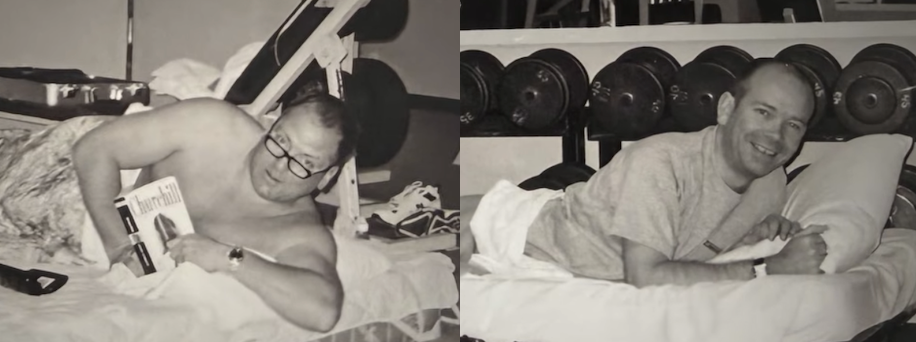
‘The Basement Boys’, a.k.a. ‘The Liverpool Lads’, bunking in the Comfort Inn gym
Karen Mills, general manager of the local Comfort Inn, recalls her dismay when two young British men showed up looking for a place to stay and her hotel was already full. Then she remembered that the gym in the basement had washroom facilities and spare cots on site. The affable Liverpudlians were immediately dubbed The Basement Boys and bunked in the gym until they were able to go home. Every year since on 9/11, they have sent flowers and a card of thanks.
In the end, the driving force behind the locals’ actions was best summed up by resident Scott Cook, who said, referring to Newfoundland’s relative isolation and sometimes harsh conditions — which apply particularly to Gander: “Our culture is designed from necessity to look after each other.”
That was evident in the reception we received as visitors during the shoot, and again at the launch.
The normal custom in a theatre is for the action on stage to be the main attraction. In this case, we flipped the script. Those of us who got up briefly to speak before the Minute aired were well aware that the actual stars of the day were in the seats in front of us.
We were the ones privileged to meet them.
Anthony Wilson-Smith is President and CEO of Historica Canada.