
31 Years After the AMIA Bombing, Canada Must Confront the Iranian Threat
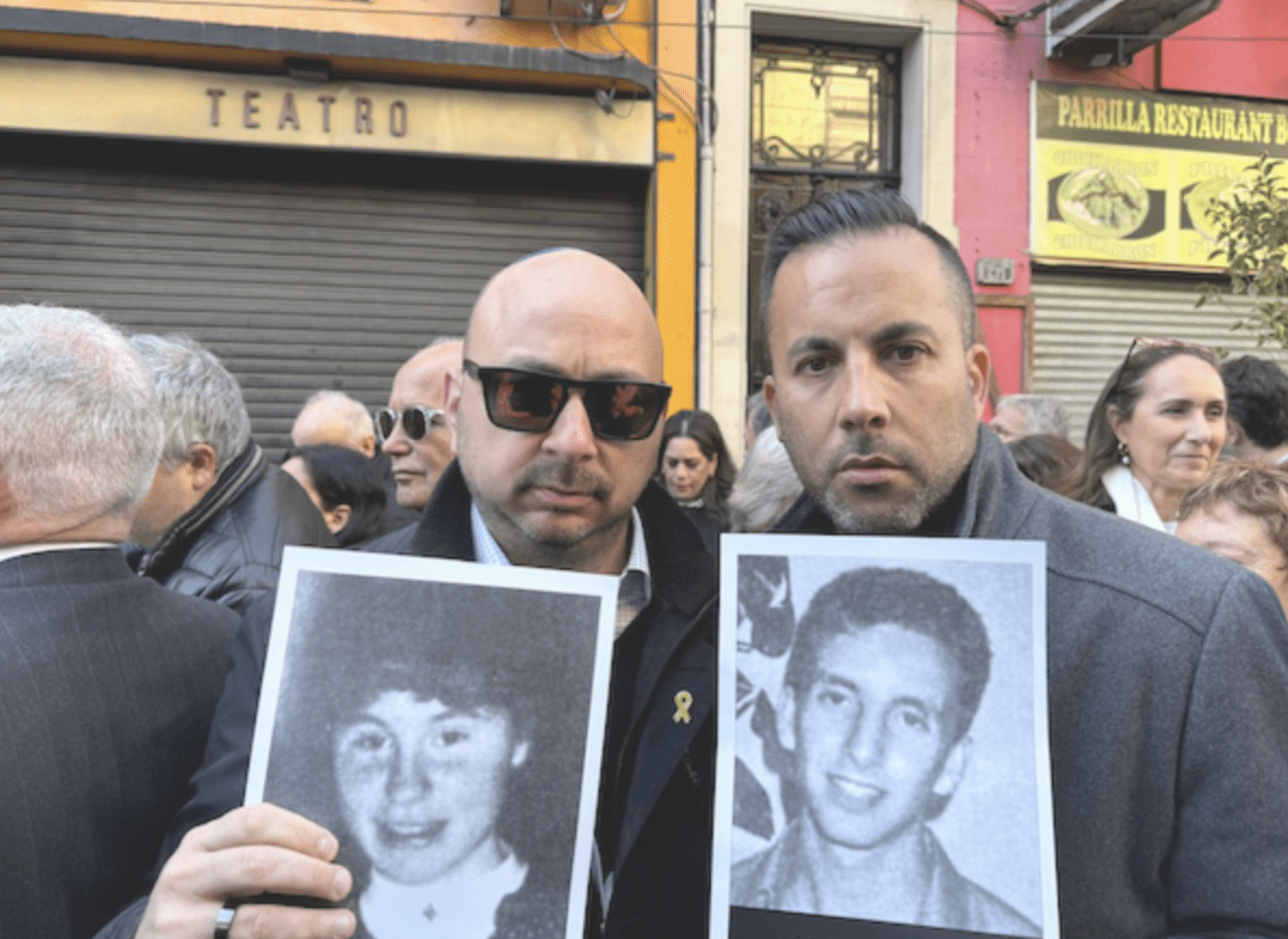
The author, right, in Buenos Aires marking the 30th anniversary of the AMIA bombing in 2024/Courtesy Nico Slobinsky
By Nico Slobinsky
July 17, 2025
It’s easy to think that the threat from Iran is distant—something contained to the Middle East, far from our lives on the other side of the world. But the truth is: it’s not far at all. I know, because I’ve lived it.
On the morning of July 18, 1994, I was a 15-year-old high school student, sitting in a history class in Buenos Aires, Argentina. At 9:53 a.m., a 600-lb bomb tore through the heart of the city’s vibrant Jewish community: the Asociación Mutual Israelita Argentina, the AMIA building—the city’s main Jewish Community Centre and a central hub of Argentine-Jewish life since its founding a century earlier, in 1894. On this morning, in a much smaller world, a nightmare was delivered from 14,000 km away.
The suicide attack killed 85 people and injured more than 300. In the language of explosions as expressions of terror, that casualty count was not caused to make a statement; it was done to cause maximum loss of life. It remains the deadliest terrorist attack in Argentina’s history. Its impact—on me and on my community—remains to this day.
The Jewish community in Argentina has deep roots. In 1994, it numbered 200,000 Argentinians—the largest Jewish population in Latin America the sixth-largest outside Israel. My family had proudly called the country home for four generations. Like so many others, our lives revolved around AMIA.
That morning, the heart of our community was engulfed in chaos. A cloud of smoke and dust rose above the city and seemed to settle on us all. Phones rang incessantly. The principal entered the classroom, exchanged a few words with our teacher, and suddenly everything changed. Students were pulled from classes. The school emptied in a hushed panic.
I remember the fear. I remember frantically trying to reach family and friends, many of whom worked at AMIA. One miraculously survived after being pulled from the rubble. Others had not yet arrived when the bomb exploded. But three didn’t make it—Viviana, Cristian, and Guillermo. I will never forget them.
The rage and sorrow in the days that followed were overwhelming. But so, too, was the resolve. My father, like so many others, went straight to the site to help clear debris, to rebuild, to reclaim. A temporary AMIA office opened just blocks away, becoming a gathering point for grief, solidarity, and the relentless pursuit of justice.
That office is where I began my journey as a Jewish community volunteer—where I learned that even amid devastation, we organize, we remember, and we continue.
The rage and sorrow in the days that followed were overwhelming. But so, too, was the resolve. My father, like so many others, went straight to the site to help clear debris, to rebuild, to reclaim.
Over the years, we came to understand the full scale of what happened. Hezbollah and Iran were implicated in the attack. And yet, despite international investigations and evidence, justice has yet to be served—because of corruption, cover-ups, and even assassinations.
The perpetrators of the AMIA bombing have never been held accountable.
This year, as we mark 31 years since the bombing, we do so in the shadow of heightened tensions in the Middle East and increased threats here at home. Iranian agents are suspected of operating in Canada. The FBI has warned of possible sleeper cells in the US. The threat is not theoretical. It is real, it is here, and it is now.
The 1994 AMIA bombing was part of a pattern of Iranian-backed terror that continues to this day.
The Government of Canada can prevent tragedies like this from happening by taking decisive action. That starts with blocking and removing Iranian agents from operating in our country. It means banning the glorification of terrorism, which has no place in our democracy. And it requires boosting security support for Jewish institutions that are facing growing threats.
During the election campaign, Prime Minister Mark Carney was clear: “The increased security costs amidst rising antisemitism should not be borne by the Jewish community alone.” Now is the time to urgently act on commitments to increase funding and partner directly with our community security agencies.
This anniversary is a painful reminder that Iran and its proxies must be held accountable—not only for this horrific crime, but for the others that bear their fingerprints.
Until that happens, the bombing will remain an open wound. One we carry with us.
Because we have memory, we demand justice. Porque tenemos memoria, exigimos justicia.
Nico Slobinsky is Vice President, Pacific Region, at the Centre for Israel and Jewish Affairs.