
Policy Q&A: Former G7 Sherpa Peter Boehm’s Kananaskis De-Brief
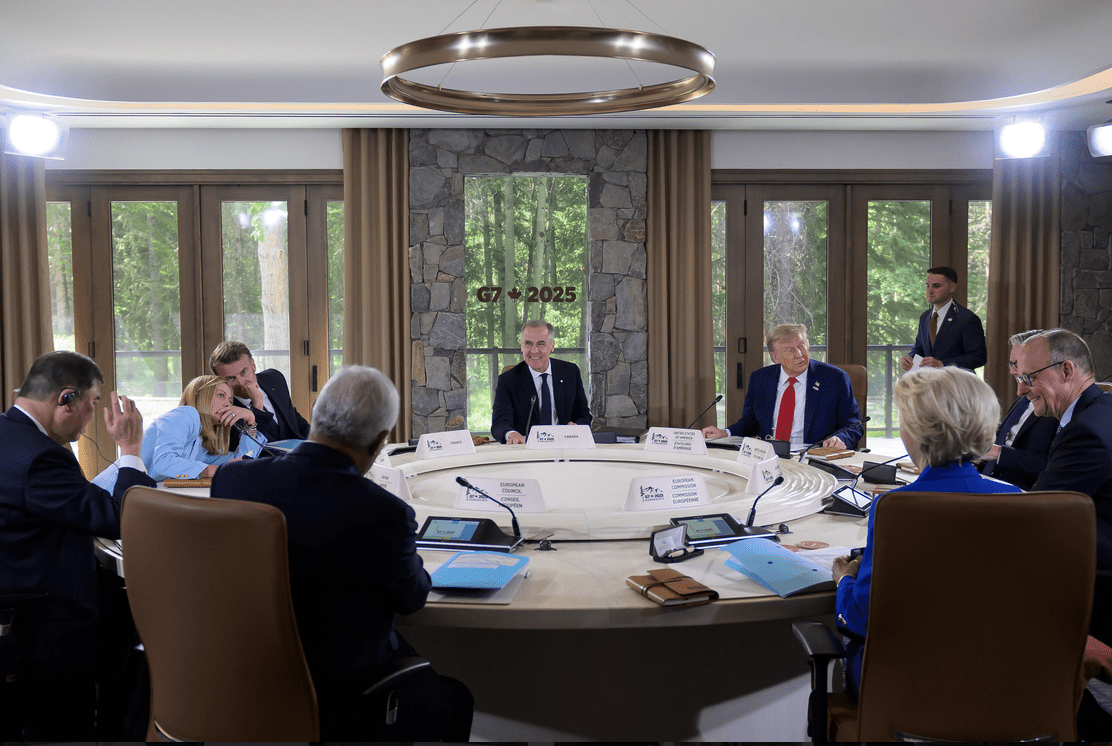 June 16th G7 Global Economic Outlook Working Session/Government of Canada
The G7 Kananaskis came and went this week with a relatively calm if early exit by Donald Trump, generally positive reviews for Prime Minister Mark Carney’s first major multilateral test and the 50-year-old multilateral group still intact. Sen. Peter Boehm, who served as Canada’s Sherpa for six G7s, including at Charlevoix in 2018, conducted his latest G7 Q&A with Policy Editor Lisa Van Dusen on the Kananaskis takeaways.
Lisa Van Dusen: Senator Boehm, what’s your general takeaway from Kananaskis? As you expected? Better? Worse?
Sen. Peter Boehm: On balance, I think in G7 terms, the Kananaskis Summit was a modest success and for Canada, at this moment in time, a significant one. As in the past, some pundits, as is their habitual wont, had already opined before the event’s conclusion that we have seen the end of the G7. I don’t think so.
I had expressed optimism in our last Q&A that there would be some substantive results, had noted the difficulties in dealing with a compressed period for the Sherpa-led negotiations, event management planning and execution — all because of our own politics once Canada assumed the G7 presidency at the beginning of the year. Then of course there was the “known unknown” of President Donald Trump’s approach to the summit — including how long he would stay — and the potential for global events to affect the agenda.
Deputy minister and Sherpa Cindy Termorshuizen and her talented team deserve much credit for being able to pivot quickly on negotiations and to accommodate last minute RSVPs from some leaders invited to the “outreach” session. Having an agreed G7 Chair’s Summary and six specific consensual issue statements underscores my point. Having joint statements on critical minerals, artificial intelligence development, cooperation in quantum technology, a Kananaskis Wildfire Charter, combatting foreign interference with a focus on transnational repression and countering migrant smuggling are all significant and well-timed initiatives.
As predicted, there were many bilateral meetings even with the early departure of President Trump. The unpracticed players: Keir Starmer of the United Kingdom, Friedrich Merz of Germany, Shigeru Ishiba of Japan and European Union Council president António Costa acquitted themselves well and clearly took to the traditional informal atmosphere that characterizes these events. Veterans Emmanuel Macron of France, Giorgia Meloni of Italy and Ursula Von der Leyen of the European Commission were active throughout, with President Macron this time being the recipient of Trump’s nasty parting shot.
There will likely be a few more G7 ministerial meetings during the rest of the Canadian presidency, in following tradition a foreign ministers’ meeting on the margins of the United Nations General Assembly in the fall and perhaps virtual meetings of leaders to discuss developing global events. Work on all subjects will continue, below the tree line if we wish to use the mountain metaphor. Then onwards to Evian in 2026 and the United States in 2027. That latter summit may very well stand for the existential test.
Lisa Van Dusen: It seems that a lot of the lessons that you imparted from Charlevoix were metabolized and applied to this G7 in terms of how to deal with the disruption hazard of President Trump. Did you see anything you would have done differently?
Sen. Peter Boehm: There were the ex post facto lessons from the Charlevoix Summit in 2018, drawn to the greatest extent from our negotiating experience with the American Sherpa team. Among them was the need to be prepared for a tough negotiation, an evident lack of high-level sign-off on the part of the US regarding certain themes (for instance, the rules-based international order, which almost led to the collapse of the communique at the summit) and overt American opposition to a consensual position on climate change.
In the Sherpa meetings, we began by discussing, then negotiating our seven consensual issue statements and had them in final form ad referendum to the leaders. We saved negotiation of the communiqué until the end, with a view to turning it into a Chair’s Statement in the event there was a significant lack of consensus.
The big, less-than-beautiful comprehensive discussion on US-imposed tariffs did not take place at Kananaskis but, had it taken place, could well have been the disaster moment.
We ploughed ahead on this at long Sherpa meetings at Baie-Saint-Paul two weeks before the summit and then for two “all-nighters” at the summit itself before bringing our last point of disagreement — phrasing of “the rules-based international order”— to the attention of the leaders (see famous photo) for them to resolve.
We were exhausted and I fell asleep in the front row during Prime Minister Trudeau’s press conference (he forgave me) where his innocuous comments sparked the irate tweet that emanated from Air Force One. At a team post-mortem discussion, we concluded that in future it would be better to issue a chair’s statement rather than pursuing the tortuous path of a communiqué that might fall short of consensus.
I travelled to Paris in September 2018 to pass the G7 torch symbolically to my French colleague. The French decided to eschew the negotiation of a joint communiqué for the Biarritz Summit the following year and issued a Chair’s Declaration and nine consensual statements. So, the Kananaskis approach this year was by no means unique.
On another, more bureaucratic level, placing all G7 summit responsibilities (negotiation, event planning, security, ministerial meetings, and stakeholders’ outreach) under one accountable designated deputy minister worked very well.Recommended by the Auditor General following the 2010 G8 Summit in Muskoka and the G20 Summit Toronto (the latter remembered for street riots), it allowed me a free hand to act in all G7-related matters with the authority of the prime minister. Former prime minister Trudeau endorsed this approach again at the beginning of our current G7 presidency.
Lisa Van Dusen: You served as a G7 Sherpa to two prime ministers — Justin Trudeau and Stephen Harper. This G7 was Mark Carney’s first major test on the foreign policy and diplomacy front. How do you think he did?
Sen. Peter Boehm: All prime ministers I have worked for, whether as Sherpa or as the designated senior official, have had their own approaches, briefing and intervention preferences. They also have their own style. Their staff usually stands back, knowing that it will be just the prime minister and the Sherpa in the meetings (often for hours). Mark Carney came into this summit as chair with deep and comprehensive economic experience, more than anyone in the room.
After all, he had been at a number of these tables in a supporting role — for two different countries, no less. I first met him 20 years ago on the fringes of a cabinet meeting and at that time, he was the G7 Finance deputy, the senior official at the Department of Finance charged with handling the economic aspects of the summit on behalf of the finance minister. We also collaborated during the sovereign debt crisis in 2008 when he was Governor of the Bank of Canada and I was ambassador to Germany. It therefore came as no surprise to me that he was an effective chair, proving that after such a brief time in office as a head of government, he is already an international player of note.
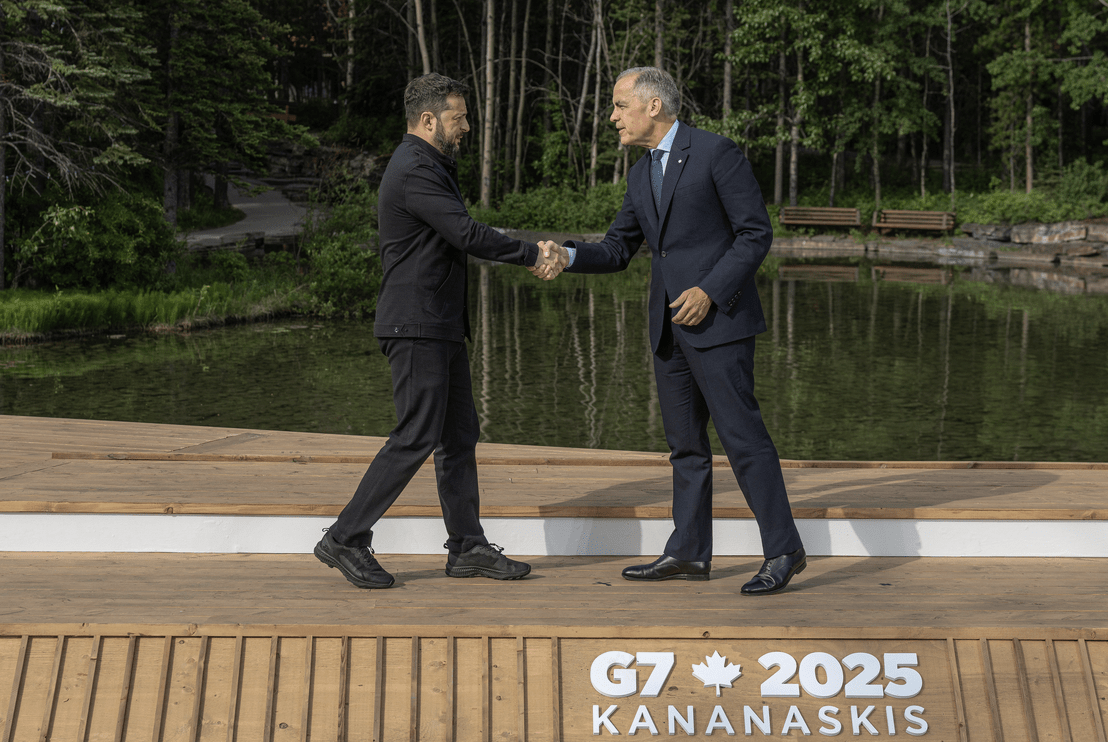 Prime Minister Mark Carney greeting Ukrainian President Volodymyr Zelensky/Government of Canada
He had set out his priorities in thematic fashion a few weeks before the summit, and, in reflecting his view of the present being a “hinge moment” for both the G7 and Canada, invited a broader range of leaders (Mexico, Brazil, Korea, Indonesia, India, Australia, Ukraine and South Africa). The G7 leaders’ discussion with President Volodymyr Zelensky of Ukraine also included Mark Rutte, the NATO Secretary General (this, 10 days ahead of the NATO summit in The Hague).
The presence on the last-day outreach session of Cyril Ramaphosa, the president of South Africa and host of the forthcoming G20 summit, was significant in developing what I consider to be the necessary crosswalks between these two informal summit entities. As the president of our third-largest merchandise trade and CUSMA partner, Claudia Sheinbaum did attend, even though she did not manage to receive her desired meeting with Donald Trump.
The other “outreach” countries formed part of Mark Carney’s priority list of strengthening and building other global partnerships. This included the bilateral meeting with Indian prime minister Narendra Modi, where he and Carney took a few steps forward in a fraught relationship. Overall, there seemed to be quite a bit of diplomatic bilateral speed-dating, an important summit tradition. The chair of the meeting sets its mood and tone. Justin Trudeau did that effectively the last time around (despite the fireworks at the end) and Mark Carney has continued that Canadian tradition.
Lisa Van Dusen: President Trump’s first public statement at the summit delineated all over again his affinity for Vladimir Putin in a forum whose very democratic membership criteria saw Putin ejected more than a decade ago. What impact do you think that had?
Sen. Peter Boehm: Donald Trump’s public arrival comments on the benefits of inviting Russia to the summit were interesting. He had said the same thing privately at the leaders’ foreign policy-themed dinner at Charlevoix seven years ago, much to the discomfort of former British prime minister Teresa May, who was managing the aftermath of the novichok nerve-agent poisonings in Salisbury by Russian agents. For me, the Russia G8 and G7 file has been a bit of a leitmotif through my summit work. I was the Sherpa assistant in 1995, a director-level position in the ministry that I had named the “yak” in keeping with Himalayan traditions as the beast of burden who carries the Sherpa.
Then Sherpa Gordon Smith and I journeyed to Moscow in January of that year and secured the agreement of President Boris Yeltsin to attend a portion of the G7 Summit in Halifax that June. This was the first step in the creation of the G8. Fast-forward to 2013, my first summit as Prime Minister Stephen Harper’s Sherpa at Lough Erne in Northern Ireland in what would be the last G8 summit. President Putin dominated the evening foreign policy discussion, focusing exclusively on Syria.
It was also at this meeting that Putin referred to Harper as a Trotskyite (I was the witness). In a short pull-aside between Stephen Harper and US President Barack Obama at which I was present, both leaders agreed that it would prove nigh impossible to have a reasonable conversation at eight.
Russia was next in the G8 presidency rotation, and I went to a Sherpa meeting in Moscow in early 2014 to plan for the Sochi Summit. Since Russia decided to annex Crimea and the Donbas in Ukraine right after the Sochi Olympic Games, it became truly clear that the existence of the G8 as a group was in jeopardy.
Prime Minister Harper and I planned our strategy. Since I was concurrently his Nuclear Security Summit Sherpa and there was a summit on that subject taking place in The Hague in March 2014, I worked with the other sherpas and the Dutch organizers to secure a time slot and room for the G7 leaders to meet at the event. It was there that the leaders decided to continue as a G7, replacing the doomed Sochi summit with a G7 summit in Brussels in June. The Russians were not happy, to say the least.
It was a fascinating experience to be present and having a small part in the creation of the G8 and a larger one in its demise. For my troubles, the government of the Russian Federation has twice sanctioned me and I am forbidden to travel there.
President Trump has creatively given Justin Trudeau credit for blowing up the G8, well over a year before he assumed power. As for me, it was a fascinating experience to be present and having a small part in the creation of the G8 and a larger one in its demise. For my troubles, the government of the Russian Federation has twice sanctioned me and I am forbidden to travel there.
The bottom line: no G7 leader apart from President Trump would wish to see Putin back at the table. The set-piece speeches and long palavers of the G20 should continue to serve that purpose.
Lisa Van Dusen: That the aversion of a disastrous finale at Kananaskis might be attributed to the early departure of the American president seems to qualify as a teachable moment for the group moving forward. Does the viability of the group perhaps hinge on its retraction to the G6, or the replacement of the US with a more like-minded member to maintain it as a coherent, cohesive G7?
Sen. Peter Boehm: Kananaskis ended well, if less dramatically than Charlevoix seven years ago when Donald Trump also left earlier than intended. Work on the Charlevoix communiqué and statements continued well past that exit (some to this day) and the Kananaskis outputs will as well. Prime Minister Carney was effective in calmly drawing the President into the public and private conversation and appears to have been building upon their earlier discussions, whether at their meeting in the Oval Office or in conversations since. They made progress on tariffs and trade with a 30-day deadline for a security and economic partnership. They appear to have achieved a certain modus operandi and that is a teachable moment, both in bilateral and multilateral terms.
I recall former German Chancellor Angela Merkel, telling me at the 2017 Taormina Summit in Sicily that she saw Justin Trudeau as “der Trump Flüsterer” (“the Trump whisperer”). Well, if so, that obviously did not last.
I believe it would be premature to jump to the conclusion that we are on the verge of a G6. The viability of the G7 is that it includes like-minded democracies with the US as an anchor. Its finance and economic components and processes are baked-in as prime minister Carney knows all too well. The documents from the G7 foreign and finance ministerial meetings in Charlevoix and Banff were consensual, with initiatives that will require work. I expect future ministerial meetings during our presidency to also project serious results.
For whoever is the US President, the G7 summit is one of many “mandatory” events that fits into a measurable scale of relative importance. At Charlevoix, Donald Trump was very focused on his next meeting, with North Korea’s Kim Jong Un in Singapore. This year, on top of all known global turbulence, there was the sudden outbreak of hostilities between Israel and Iran. Trump suddenly had a bigger crisis to manage, and when I recall his distaste for multilateral discussions over a round table of policy talk, his decision to leave was inevitable. In its 50 years of existence, the G7 process and summit has been flexible to adapt to events, trends, crises, and different personalities around the table.
The collective persuasive powers of the leaders at Kananaskis would never have changed Donald Trump’s mind about being a “tariff guy.” The Chair’s Summary refers to “a focus on economic developments, market volatility and shocks to international trade;” leaders referred to “an open and predictable trading regime to drive investment and growth” and so on.
The big, less-than-beautiful comprehensive discussion on US-imposed tariffs did not take place at Kananaskis, but had it taken place, could well have been the disaster moment. But indirect references in a Chair’s Summary also form a deft teachable moment, in that the seeds have been sown so that discussion will need to continue.
As one media headline noted: “Trump got the spotlight, Carney the win.” No one can be a soothsayer on summitry. But Canada did well at Kananaskis and should savour the moment, ephemeral as it might be.
Senator Peter M. Boehm, a regular contributor to Policy magazine, is a former ambassador and deputy minister and, at prorogation, was chair of the Standing Senate Committee on Foreign Affairs and International Trade.
Policy Magazine Editor and Publisher Lisa Van Dusen has served as a senior writer at Maclean’s, Washington columnist for the Ottawa Citizen and Sun Media, international writer for Peter Jennings at ABC News and an editor at AP National in New York and UPI in Washington.