
NATO and the Trump Paradox
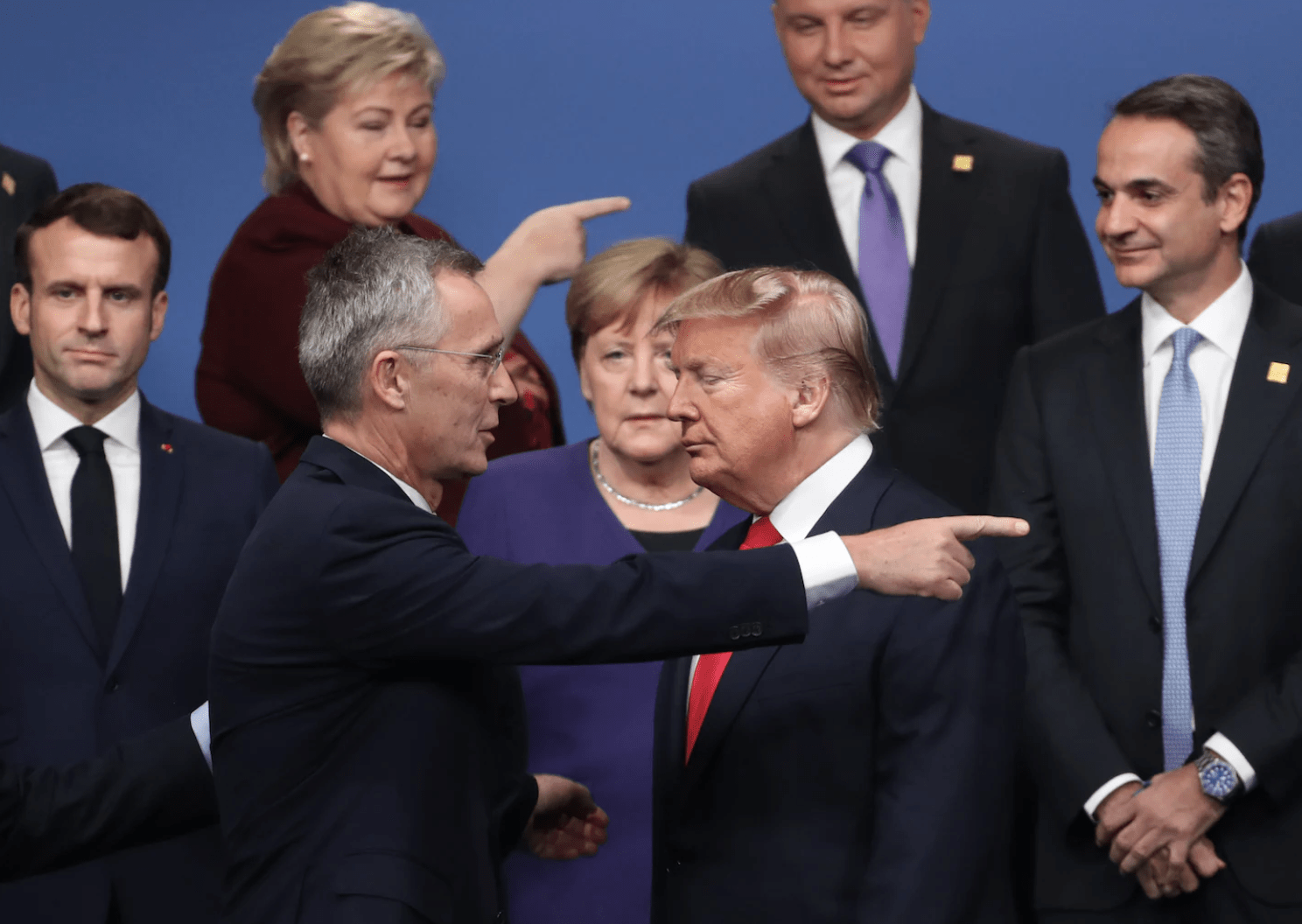 President Donald Trump at the 2019 NATO Summit in Watford, UK/AP
By Lisa Van Dusen
June 23, 2025
With America engaged in active military conflict in the Middle East on the eve of this year’s NATO Summit, the meeting Tuesday and Wednesday in The Hague has acquired a fresh layer of context.
Back in 2019, two weeks before the NATO 70th anniversary summit in Watford, UK, French President Emmanuel Macron delivered a shot across the existential bow of the transatlantic military alliance. No, not the bit where he told The Economist NATO was “brain dead”. It was during his unapologetic elaboration on that comment.
“Who is our common enemy?” Macron asked during a news conference. “This question deserves to be clarified.”
Those were the days.
Six years later, Donald Trump — who left the Watford summit early after calling Justin Trudeau “two-faced” for gossiping about him with Macron, Boris Johnson, and then-Dutch prime minister/now NATO Secretary General Mark Rutte into a hot mic — is back. And in his second term, Trump’s escalated assaults on the geopolitical status quo include unprecedented confusion over the question of who America’s enemies are.
At a moment when NATO is demanding — at Trump’s insistence — a significant transfer of wealth from the treasuries of Western democracies to the defence industry, this is not a small consideration. In 2024, the Stockholm International Peace Research Institute (SIPRI) reported global military spending at $2.443 trillion, the highest level ever recorded. An increase to 5% of GDP across the 32 NATO member countries will dwarf that number.
This shift in fiscal priorities comes at a time when AI is expected to drastically reduce human employment across multiple industries in a way that is unlikely be offset by a WWII-style surge in weapons manufacturing. Or, as Policy columnist Daniel Béland wrote in his February piece titled Guns vs. Butter in Canada’s New Security Context, “Fiscal imagination might be needed to pay for our new, higher defence bills.”
Twenty-five years into a century that has seen a stunning evolution in the nature of warfare, it may help clear up any confusion to specify from which threat NATO’s vastly expanded arsenal is meant to defend its imperilled democracies. It’s much easier to rally public opinion in support of a leap from butter to guns if people know precisely which cause we’re supporting by rationing our butter.
Assuming America, as the (for now) nominal superpower of the rules-based international order currently targeted by its autocratic competitors-turned-frenemies is a useful threat barometer, the 2025 Annual Threat Assessment delivered to Congress in March by the US intelligence community identified China as “the most comprehensive and robust military threat to U.S. national security.”
And yet, until he bombed Iran’s nuclear sites on the weekend, the current commander in chief’s signature military deployment has been against “the enemy within” in downtown Los Angeles — just one among many profile pages from the autocracy playbook that Trump has felt free to replicate.
So, who are Trumpian America’s enemies? The answer to that question defines its perceived and potential conflicts of interest as a NATO member.
If America’s president threatens to annex Canada in the manner of Vladimir Putin annexing Crimea, with a prelude of resistance-draining “economic force” amid a very real and costly global tariff war, does that place America in violation of a North Atlantic Treaty that commits its signatories’ to “safeguard the freedom of their peoples,” “founded on the principles of democracy, individual liberty and the rule of law”?
The conundrum of Donald Trump for NATO is that he is redefining-down America’s role in the world from the Oval Office, which clearly creates multiple challenges for the country’s longstanding democratic allies.
And, if that and countless other Trumpian scenarios, narratives, set pieces, dramas and acts of sabotage of America’s previously reliable role now define it — as Policy columnist Jeremy Kinsman writes in his column for our NATO series, War and Peace, 2025: Canada, NATO, and a Rogue America — as a rogue state, why is NATO going to such lengths to accommodate Trump‘s insistence on an increase of defence spending to 5% of GDP?
“There is no way they would be going to 5% without Trump,” a Trump administration official boasted to Politico on condition of anonymity ahead of this week’s Hague summit. “So he sees this as a major win, and it is.”
The conundrum of Donald Trump for NATO is that he is redefining-down America’s role in the world from the Oval Office, which clearly creates multiple challenges for the country’s longstanding democratic allies, including and especially NATO members.
If, as Prime Minister Mark Carney has said, Canada’s old relationship with the United States is “over” based on Trump’s refashioning of that relationship as one of belligerence, hostility and threatened aggression, why is the same president currently repurposing America as an economic and security threat to NATO allies setting the NATO agenda?
After two decades during which the most significant shifts in geopolitical power consolidation were executed without firing a shot via overwhelmingly non-kinetic means — from economic coercion to cyberpoaching and cyberattacks to debt capture to strategic corruption to performative propaganda — great-power hot war has made a comeback almost as astonishing as Trump’s. It has been back since Vladimir Putin invaded Ukraine in 2022.
Trump himself reminded the world of that last Saturday with the bombing of Iran’s nuclear infrastructure. At this writing, the reprisal for those attacks was just carried out against Al Udeid Air Base in Qatar, the largest US military installation in the Middle East. Fittingly enough in today’s conflict ecosystem, that Iranian reprisal is being characterized as performative.
If Putin’s deployment of hardware against Ukraine has taught us anything, it’s that tanks, bombs and missiles are no match for either “the fury of an aroused humanity”, to quote FDR, or, in more prosaic terms, cheaper technology, including the Ukrainian drones that destroyed $7 billion worth of Russia’s military hardware in a single day in Operation Spiderweb.
Indeed, in the old days, long before the hot-war comeback, starting in 2006 and stretching into the Obama administration, Iran’s nuclear capability was significantly depleted by an extended, much quieter malware offensive in Operation Olympic Games, dubbed by The Atlantic‘s Marc Ambinder in 2012 “The most sophisticated state-sponsored cyberattack in the history of civilization.”
New York Times national security correspondent David Sanger broke that story in his 2012 book Confront and Conceal: Obama’s Secret Wars and Surprising Use of American Power, and further explored the shift from conventional to cyber warfare in his 2018 book The Perfect Weapon: War, Sabotage and Fear in the Cyber Age. “Cheap to acquire, easy to deny, and usable for a variety of malicious purposes,” per the book blurb, “cyber is now the weapon of choice for democracies, dictators, and terrorists.”
Which is not to say that it makes absolutely no sense for NATO to revert to a massive investment in hardware along with its cyber capabilities at a time when China is increasing its own defence spending by 7.2%, a volatile Vladimir Putin presents a constant threat to Europe, and events in the Middle East have newly illustrated the precariousness of global security in a moment of geopolitical flux.
But since a major driver of that flux is the current occupant of the Oval Office, it may require a more nuanced approach to strategic communications this week to insulate the optics of the Trump paradox.
Policy Editor and Publisher Lisa Van Dusen has served as Washington bureau chief for Sun Media, international writer for Peter Jennings at ABC News, senior writer for Maclean’s and as an editor at AP National in New York and UPI in Washington.