
‘Apple in China’: A Tech Behemoth’s Not-so-Grand Bargain
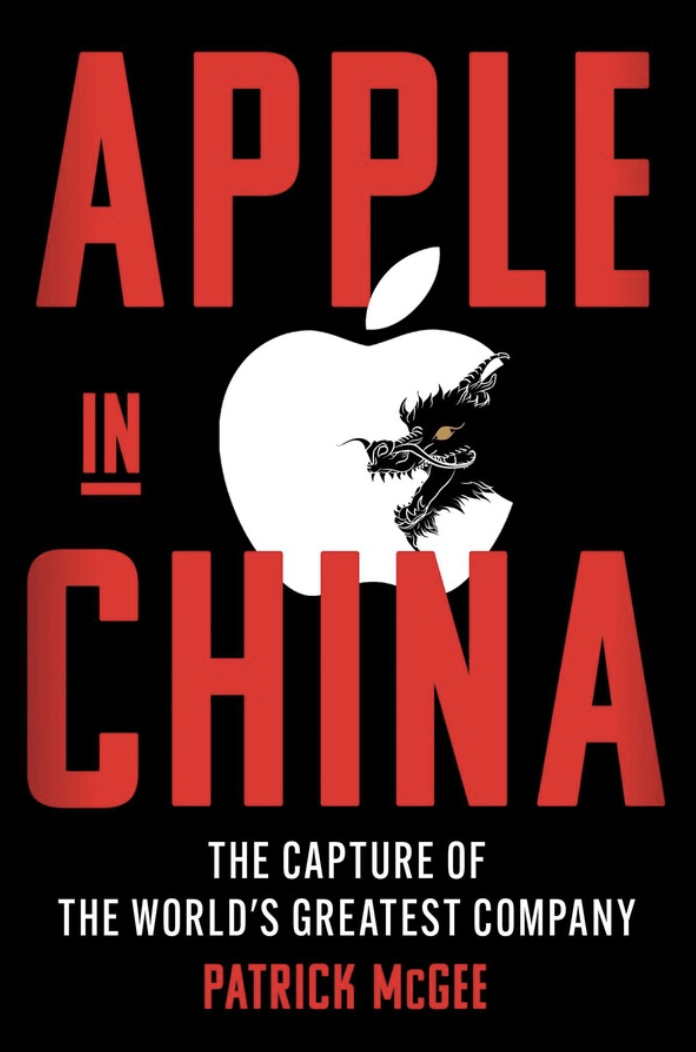
Apple in China: The Capture of the World’s Greatest Company
By Patrick McGee
Simon & Schuster/May 2025
Reviewed by Colin Robertson
June 23, 2025
Of all the confluences of business and geopolitical power of the past quarter century, Apple’s investment in China may have been the most impactful. The Cupertino tech behemoth, soon expected to be the first company in history to crack the $4 trillion capitalization threshold, has invested in Chinese manufacturing to the tune of $55 billion a year since 2015.
It was a bargain mutually beneficial to a company seeking cheap labour and a developing nation with aspirations to be a global great power fuelled by economic might.
But Apple’s investment has come with geopolitical economic complications, especially now that Donald Trump has launched a trade war complicating his erratic relationship with Xi Jinping, writes Canadian-born journalist Patrick McGee in his new book Apple in China.
“External risks” warns McGee, “like China annexing Taiwan, or China and the United States becoming more estranged, or Beijing feeling the country has learned all it can from Apple — are far more existential than any product launch.”
McGee knows his subject. He is the Financial Times San Francisco correspondent covering Apple and US technology. Apple in China is based on his decade-long mastery of the beat and more than 200 interviews.
The book traces the decades-long relationship between Apple and China with Apple investments comparable, says McGee, to the US Marshall Plan investment in post-war Europe. “Year in, year out,” writes McGee, “Apple took the most cutting-edge designs, processes, and technical understandings from around the world and scaled them in China.”
Working with manufacturing partners, notably Taiwan’s Foxconn, they turned “fields into factories” within months, creating — according to Apple CEO Tim Cook — more than five million jobs in China. Today, 90% of its lucrative iPhone assembly is in China.
McGee explores the intersection of technology and geopolitics and the dilemmas around contract manufacturing and tech supply chains.
Apple and the People’s Republic of China are locked in what until now has been a mutually beneficial relationship: trading Apple technology for Chinese labour. Apple has invested billions in equipment and sent thousands of its engineers to share their knowledge with their Chinese suppliers.
Training their Chinese teams was so effective, says McGee, that at one point Apple needed to fly Chinese engineers into America’s heartland to complete a new project.
A tribute to Chinese perseverance, it also reflected years of Chinese government investment of over 2% a year of GDP in research and development. They also set up new research institutions, successfully commercializing much of that science.
Some of it also comes, as US and other Western authorities have long reported, from stealing technology from elsewhere.
But with the Trump tariffs and the Chinese response, Apple now finds itself at risk of losing it all.
Apple has begun efforts to de-risk from China, asking its supplier partners to replicate their China-based capacities in India. According to The Economist, Apple aims to assemble almost all the iPhones for the US market in India by 2026. McGee says average monthly manufacturing wages in 2024 were just $195 in India versus $1,139 in China and $5,912 in the United States.
But decoupling to India brings its own challenges.
Doing business in India is still a frustrating trek through its impenetrable regulations. Labour is less reliable. So is getting infrastructure built and, even then, there are often questions around quality. And it also needs to up its game when it comes to innovation.
Looking forward, McGee predicts more trouble for Apple.
First, with the support of the Chinese government, its Chinese competitor, Huawei, is “back with a vengeance”. Huawei products now approach Apple standards. Its chips may not be as good as those Apple uses — produced at Taiwan’s TMCS — but they are capable and improving. “If Apple continues to spur Chinese development of cutting-edge processes,” warns McGee, “Americans may soon look up and see that China has become self-sufficient in advanced electronics, robotics, and chip fabrication.” Chinese brands, says McGee, accounted for just 23% of global smartphone shipments in 2013, but their share surpassed 50% in 2020.
Colin Robertson’s interview with Patrick McGee for CGAI’s Global Exchange podcast
Second, against the backdrop of the China-US trade war, Chinese netizens have encouraged a patriotic boycott of Western brands that also fits comfortably with the Chinese government’s policy of ‘Made in China’ by Chinese enterprise.
Chauvinism is depressing sales of all things Western, be it luxury cars, handbags, or fast food. The risk to Apple of Chinese nationalism, says McGee is “for the foreseeable future, permanent.” Apple’s dependence on the local infrastructure of labour and manufacturing — resources and basics including roads, and water — has lately become less reliable. “Electricity”, McGee writes, “all of a sudden it’s only available four hours a day.”
Third, the accelerating risk of having a Taiwan-made chip in every iPhone, iPad, MacBook, desktop Mac, Air Pod, and Apple Watch. Xi Jinping repeatedly calls for the island’s “reunification” with the motherland, promising to “resolve” the Taiwan question “in this generation.”
Geopolitical economics once again trumps globalization. Xi Jinping is also very different from his predecessors. He makes no bones about wanting to fundamentally change the current world order.
At the end of the Cold War, a sense of “the end of history” encouraged wishful thinking about China, especially in the United States. Shaping US policy and that of its allies toward China in their ongoing diplomatic, economic, and cultural engagement was the belief, indeed conviction, that with economic development China and the rest of the world would embrace democracy, free trade and the market economy. It would just be a matter of time, so the thinking went, before China would become more like us.
Second thoughts began to surface when China’s state-owned, heavily subsidized enterprises began dumping steel and other products. But, for the most part, the West turned a blind eye, looking instead to the lower-cost goods on offer. So, too, the West brushed aside allegations of massive industrial espionage through cyber-intrusion and reports of Chinese Communist Party pressures applied to the Chinese diasporas in Five Eyes nations.
Chinese companies are already globally dominant in terms of 5G provision because they are cheap and reliable. So, too, are their electric vehicles, solar panels, nuclear modules and other green technology. Once installed, it guarantees a dependency for the coming decades, virtually ensuring future domestic tech development.
China is also catching up in artificial intelligence. Increasingly applied to its ‘surveillance state’ technology, it is finding buyers in the Global South that prefer the Chinese version of a ‘rules-based order’.
One day, writes McGee, when this has all ended in tears, we will ask ourselves:
“How did they do it? How did China advance so quickly, particularly in such complex areas as advanced electronics? Some portion of the disquieting answer is that Apple taught them.”
Apple in China is a cautionary and still unfinished tale of ambition, greed and naiveté as American capitalism cozied up to Chinese authoritarianism.
Canadian business can learn from Apple’s experience in China but it should not deter us.
Prime Minister Mark Carney and Premier Li Qiang’s recent conversation begins an overdue recalibration of our relationship. The first such exchange at the head of government level in seven years, according to Chinese ambassador Wang Di, it turns the page on the Meng Wanzhou-two Michaels episode. While not forgotten, we need to get beyond it because a frozen relationship is not working for geostrategic, business or people-to-people relations.
Engage, trade and promote people-to-people ties with China we must. To ignore or try to isolate the rising superpower is akin to cutting off our nose despite our face. But, as we learn from Apple in China, we need to do so with ‘eyes wide open’, taking particular care with the export of technology while enforcing red lines on cybertheft and foreign interference.
Contributing Writer Colin Robertson, a former career diplomat, is a fellow and host of the Global Exchange podcast with the Canadian Global Affairs Institute in Ottawa.