
The Future of Iran’s Nuclear Program: Could Withdrawal from the NPT be Next?
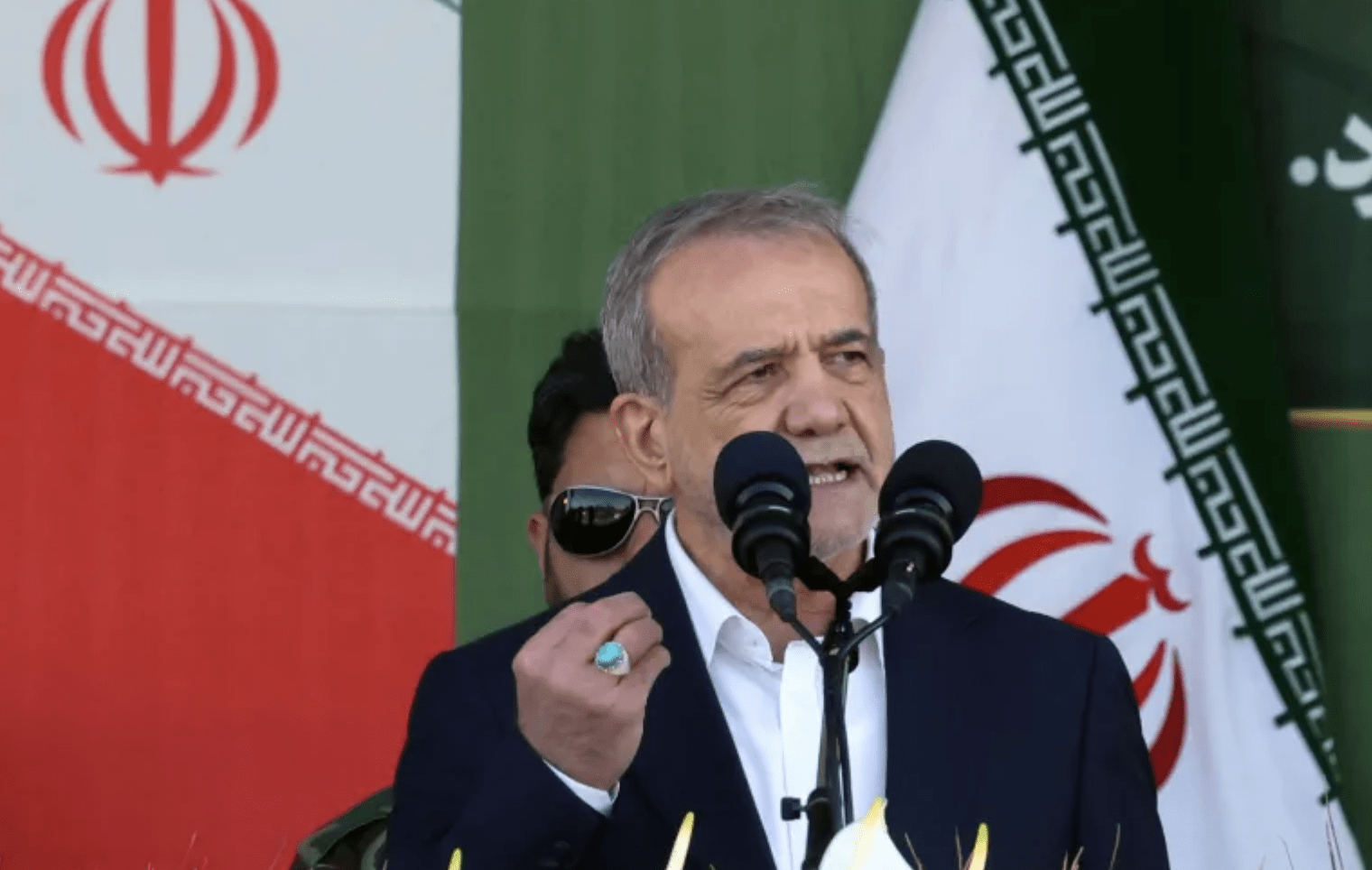 Iranian President Masoud Pezeshkian in Tehran, on April 18, 2025/EPA
By Paul Meyer
July 5, 2025
Three weeks after Israel began attacking Iran, setting off retaliatory strikes and eventually leading to America’s bombing of Iranian nuclear sites on June 22nd, Iranian President Masoud Pezeshkian has now ceased cooperation with the International Atomic Energy Agency (IAEA).
The IAEA is not a United Nations agency but one that does report to the UN General Assembly and Security Council. In the nearly quarter-century long dispute between the international community, represented by the IAEA, and the Islamic Republic of Iran over the nature of its nuclear program, there has been one constant: Iran’s status as a non-nuclear weapon state party to the Treaty on the Non-Proliferation of Nuclear Weapons, more commonly known as the Nuclear Non-Proliferation Treaty, or NPT.
Under the NPT, which has been in force since 1970, all 191 state parties (except the five recognized nuclear weapon states of the US, Russia, China, France and the UK) commit not to develop or acquire nuclear weapons in return for being able to exercise “the inalienable right” to use nuclear technology for peaceful purposes.
These states conclude safeguards agreements with the IAEA providing for the monitoring of their nuclear facilities to ensure there is no diversion of nuclear material to proscribed purposes, namely developing nuclear weapons. While adhering to these safeguards, Iran has exercised its rights under the NPT to develop an indigenous capacity to enrich uranium and has contracted with Russia to construct a number of nuclear reactors for generating electrical power.
There have been longstanding concerns regarding the true nature of Iran’s program and the IAEA has identified several discrepancies or information gaps that have prevented it from granting Iran a fully clean bill of health. Cooperation with Iran has however been ongoing throughout these years, with IAEA inspectors having direct access to Iran’s declared nuclear facilities.
Concerned states have in the past tried to supplement the IAEA’s efforts by negotiating a broader deal with Iran that would provide Tehran with relief from economic sanctions imposed on it in return for accepting stringent constraints on its nuclear program. In 2015, Iran and its negotiating partners, the five permanent members of the United Nations Security Council and Germany (the P5+1) concluded an agreement titled the Joint Comprehensive Plan of Action (JCPOA) that entailed major restrictions on Iran’s nuclear program coupled with an intrusive verification process.
To cite one example, under the JCPOA, Iran was limited to 3.67% enrichment of uranium (suitable for civilian power reactors but well below the roughly 90% enrichment desired for nuclear weapons). This complex agreement also specified a penalty for non-compliance involving so-called “snapback sanctions”, which effectively allowed the partners to quickly re-impose the sanctions lifted in the event Iran was non-compliant with its commitments.
The JCPOA seemed to represent an effective diplomatic solution to a longstanding non-proliferation problem. By all accounts, the agreement was being dutifully implemented when President Donald Trump decided to withdraw the United States from the agreement in May 2018. He boasted at the time that he would be able to strike a better deal with Iran by applying “maximum pressure” on that country. Such a deal did not materialize and it appeared that Trump’s exit from the JCPOA was motivated more by spite for President Obama, whose administration had negotiated the agreement, than from any substantive objection to its terms.
Fast forward to 2024 and the initiation of armed attacks between Israel and Iran in April and October. Israel had managed in these attacks to eliminate Iran’s air defences, placing Iran in a situation of extreme vulnerability. Prime Minister Benjamin Netanyahu had long hyped the “existential threat” posed by Iran’s nuclear program and sought an opportunity to eliminate it. In contrast, the US intelligence community had long maintained that Iran had terminated its active nuclear weapon program in 2003 and the theocratic leadership which had rejected nuclear weapons via a fatwa had not reactivated this program.
The fact that Iran had enriched some 400 kg of uranium to a 60% level was viewed by some as evidence of its intent to go for a bomb, while others considered it as the only leverage Iran could employ in its efforts to incentivize its JCPOA partners to return to a diplomatic deal over its nuclear program. The IAEA inspectors remained in place and hence could continue to document the scope and result of this enrichment activity.
This difference of opinion with the United States over the actual state of affairs in Iran did not deter the Israeli government in its efforts to destroy Iran’s program or to convince the US to condone and ideally participate in its military action. Citing internal Israeli intelligence pointing to an acceleration of Iran’s program and progress in designing a nuclear payload for its ballistic missiles, Netanyahu decided to strike on June 13, one day after an IAEA report on Iran’s NPT Safeguards Agreement concluded that Iran had failed to provide credible explanations for the presence of uranium particles in undeclared facilities and was in violation of its NPT verification obligations.
Iran could conclude that the only sure way to deter Israel and the US is to clandestinely pursue the development of a nuclear bomb and a delivery system for it. The example of North Korea looms large in this context as the only state to date to have withdrawn from the NPT, in 2003.
The Israeli assault occurred after Iran and the United States had completed five rounds of negotiations for a new nuclear deal and were due to meet again on June 15.
The Trump administration initially hesitated in its response to the attack with Secretary of State Marco Rubio stressing that it represented a unilateral action by Israel. President Trump, after announcing a misdirectional two-week deadline on his own decision as to whether to take military action, ordered air strikes on June 22. The US aerial assault was crucial in efforts to destroy the deeply buried nuclear site at Fordow, as only the US possessed the massive, so-called “bunker buster” penetration bombs to reach these buried sites (and the bombers capable of carrying these huge weapons).
The Israeli-American attack against Iran constitutes an aggression against a sovereign state and a violation of the UN Charter. Although Israel depicted its assault as a case of self-defence under Article 51 of the Charter, international law requires a state to have been actually attacked or subject to an “imminent threat” of attack. The suggestion that some future emerging threat justifies a pre-emptive attack does not meet the standards of the Charter and its injunction to settle all disputes peacefully. It is but the latest in a series of abrogations of international law as the rules-based international order is degraded by illegal acts of state violence.
Within this disturbing context, which has witnessed the cancellation by one American president of a treaty negotiated by another American President, the norm of nuclear non-proliferation is sure to suffer. Iranian leaders may well reconsider their position on the acquisition of nuclear weapons given that their non-nuclear weapon status under the NPT has not been sufficient to protect them from being assaulted by two nuclear-armed states.
Iran could conclude that the only sure way to deter Israel and the US is to clandestinely pursue the development of a nuclear bomb and a delivery system for it. The example of North Korea looms large in this context as the only state to date to have withdrawn from the NPT, in 2003. Despite the application of a serious sanctions regime against North Korea, there has been a striking reduction of external pressures against Pyongyang since they demonstrated their possession of a nuclear weapon and a gradual acceptance of their de facto nuclear weapon state status.
President Trump has dropped his “fire and fury” rhetoric and abandoned his first term efforts to strike a denuclearization deal with Pyongyang. In January, Trump referred to North Korea as a “nuclear state”, alarming Seoul by implying US acceptance of a new nuclear status quo.
While its foreign minister reiterated Iran’s commitment to the NPT on Thursday, one further step Iran might take as it considers the damage inflicted upon it and reasserts its national pride in the wake of the Israeli-American assault would be to, at some point, withdraw from the treaty. It could justify such a withdrawal citing the injury to its “supreme national interests” (in the language of the treaty).
While a withdrawal by Iran would not in itself be a trigger for launching a nuclear weapons program, it would open up this avenue under international law and would enable it to end any oversight by the IAEA into its activity. While, since the US strikes, President Trump has characteristically indulged his penchant for exaggeration (Iran’s nuclear infrastructure was “totally obliterated”) most observers believe that Iran’s program has been set back by only a matter of months or a couple of years. No one contests that Iran possesses the engineering, scientific and technical capacity to develop a nuclear device if it decides to do so.
Israel may present Iran acquiring a nuclear weapon as constituting an existential threat but Israel, a non-signatory to the NPT, possesses a significant if undeclared nuclear arsenal of its own. An arsenal which Iran can counter-argue poses an existential threat to it as well as to other states in the region.
An Iranian exit from the nuclear non-proliferation regime would not only exacerbate the crisis over Iran’s nuclear intentions, but would also represent a body blow to the already shaky NPT. The last two review conferences of the NPT in 2015 and 2022 have failed to produce an outcome document. Internal tensions prompted by the evident failure of the five recognized nuclear weapon states to implement their nuclear disarmament obligations under the treaty are intense.
The next review conference, slated for 2026, could be a make or break one for the NPT. A decision by Iran to withdraw from the NPT could well prompt a wider exit de jure or de facto from the global non-proliferation regime and a revival of the threat of nuclear proliferation long held in check by the NPT.
Paul Meyer is an Adjunct Professor of International Studies at Simon Fraser University and a Director of the Canadian Pugwash Group. A former career diplomat, Meyer served as Canada’s Ambassador and Permanent Representative to the UN and the Conference on Disarmament in Geneva (2003-2007).