
The Canada-EU Security and Defence Partnership: Opportunity, Risks, and Uncertainties
 Shutterstock
The following is the summary of a report released on July 9, 2025, by The Expert Group on Canada-US Relations.
By Perrin Beatty, Mark Norman, Vincent Rigby and Tim Sargent
July 10, 2025
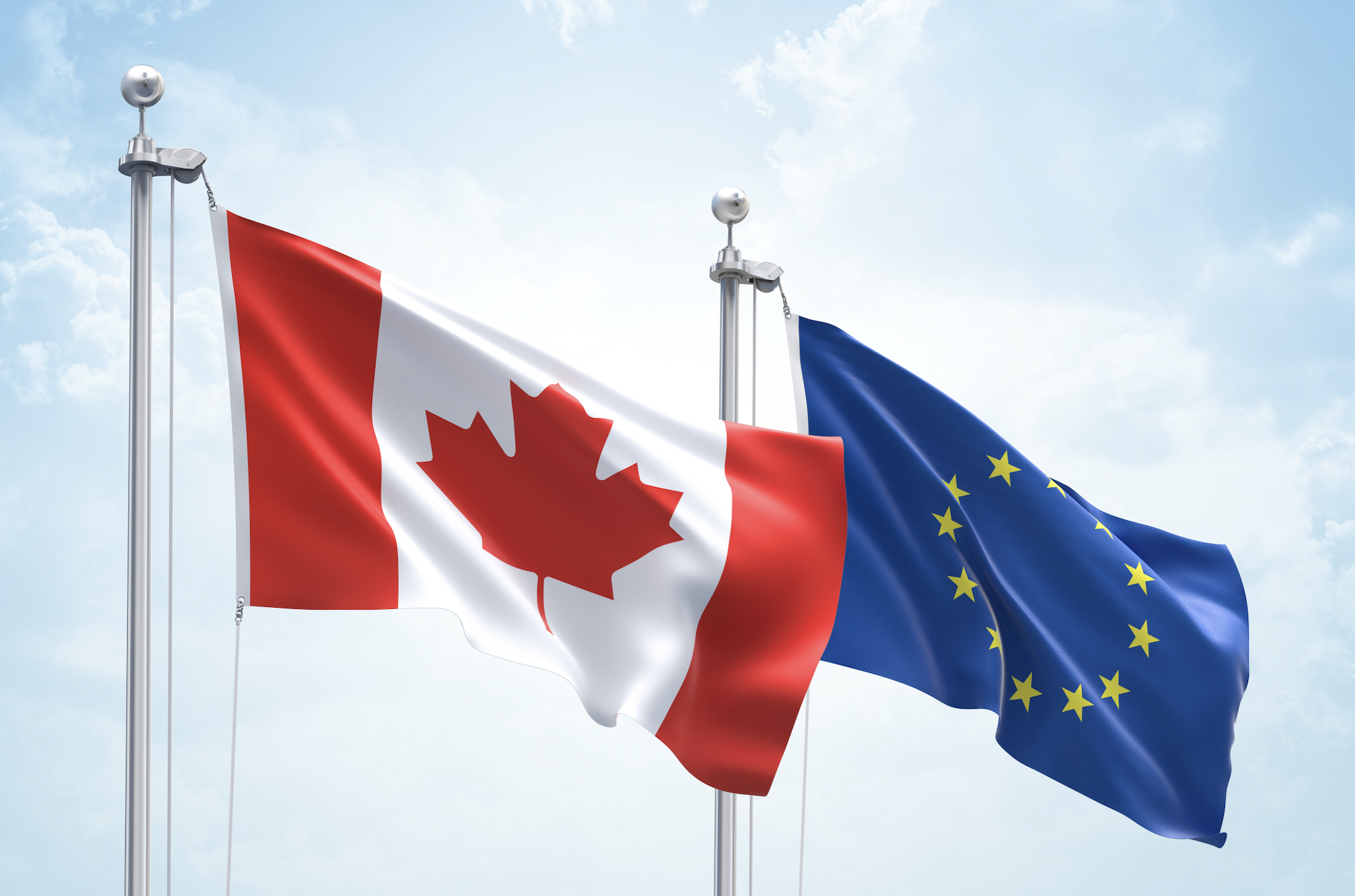
The Canada-EU Security and Defence Partnership (SDP), signed on June 23 in Brussels, marks a major turning point in Canada’s approach to both national security and economic growth.
For decades, Canada has relied heavily on the United States for its defence needs, with about 75 percent of its military procurement coming from south of the border. This has left Canada vulnerable to shifting US policies and trade tensions, as seen in recent years.
The new agreement with the European Union is designed to change that dynamic by opening up access to a much broader range of defence suppliers, technologies, and investment opportunities across 27 EU countries.
The partnership is not just about buying more military equipment; it is also about building a more resilient, innovative, and self-reliant Canadian economy that can weather global uncertainties.
By meeting its NATO targets, Canada will be spending more on defence — moving from about 1.37% of its national income to 2% in the near term. The government has also committed to a 5% percent annual expenditure by 2035. This increase isn’t just a number on a page; it represents a massive infusion of investment into Canadian industries, from aerospace and artificial intelligence to mining and clean technology.
Policy Contributor Colin Robertson’s CGAI Global Exchange podcast episode with with the authors.
For ordinary Canadians, this potentially translates into tens of thousands of new jobs, especially in regions such as Quebec, Ontario, and British Columbia, where manufacturing and mining are already strong.
When combined with the increases in defence spending, the benefits of the new partnership are significant. By working more closely with the EU, Canada stands to gain not only from direct defence contracts but also from being integrated into Europe’s vast supply chains.
The EU’s own defence spending will likely exceed $1 trillion by 2035 under the 5% of GDP benchmark, and Canadian companies will now have a seat at the table for these lucrative projects. This means more exports, more innovation, and more opportunities for Canadian workers and businesses.
The partnership also includes provisions for joint research in emerging technologies such as hydrogen energy and advanced manufacturing, which can help position Canada as a global leader in clean tech and digital industries, and research and development in Arctic security technologies.
Mining firms will see new demand for critical minerals like lithium and nickel, which are essential for Europe’s booming electric vehicle industry. If it is successfully implemented, the projected benefits of the agreement will be economically significant.
While the SDP offers significant strategic and economic promise, its success is far from assured. A variety of fiscal constraints and political, structural and implementation hurdles could slow or limit progress toward the ambitious goals set out in the agreement.
Fiscal Constraints
Canada: Meeting the commitment to raise defence spending from 1.37% to 2% of GDP — and to 5% by 2035 — will require tens of billions in new annual outlays. This comes amid rising debt, a limited discretionary budget, and competing social priorities. Achieving and sustaining these targets risks fiscal instability, especially if economic growth underperforms or political support wanes.
EU: Many EU countries face similar or greater fiscal challenges. The Stability and Growth Pact and new EU fiscal rules impose strict limits on deficits and debt. While temporary flexibility is allowed for defence spending, highly indebted nations may find it insufficient, and the scale of required increases is likely unachievable for most without deep cuts elsewhere or politically fraught tax hikes.
Political and Structural Obstacles
Canada: Decades of underinvestment have left the Canadian Armed Forces with equipment shortages and procurement delays. Political resistance, bureaucratic inertia, and public ambivalence about defence spending further complicate efforts to meet NATO and EU expectations. The US may attempt to constrain or thwart the pivot to EU markets.
EU: Divergent national interests and fiscal capacities threaten unity. Spain, for example, has publicly rejected the 5% target as “disproportionate,” committing to only 2.1% of GDP. Such rifts could undermine collective EU efforts and limit the scope of joint projects.
Implementation Hurdles
Both sides face administrative and logistical hurdles in aligning procurement standards, integrating supply chains, and ensuring timely delivery of new capabilities.
Despite these hurdles, the overall policy implications are clear. The partnership is a bold step toward making Canada less dependent on any single ally and more integrated into a broader network of like-minded democracies.
It recognizes that economic security and national security are now inseparable, especially in a world where supply chains, technology, and resources are increasingly strategic.
By investing in its own industrial base and forging stronger ties with Europe, Canada is taking measures to safeguard its sovereignty and potentially create new engines of economic growth that will benefit Canadians.
The work of the Expert Group on Canada-US Relations, which is supported by the Norman Paterson School of International Affairs, Carleton University, and the Canadian Global Affairs Institute, is featured in our Policy Series: The Expert Group on Canada-US Relations on Navigating Trump II.
