
‘Pitfall’: Down, Out, and on the Lam in Small-Town Saskatchewan
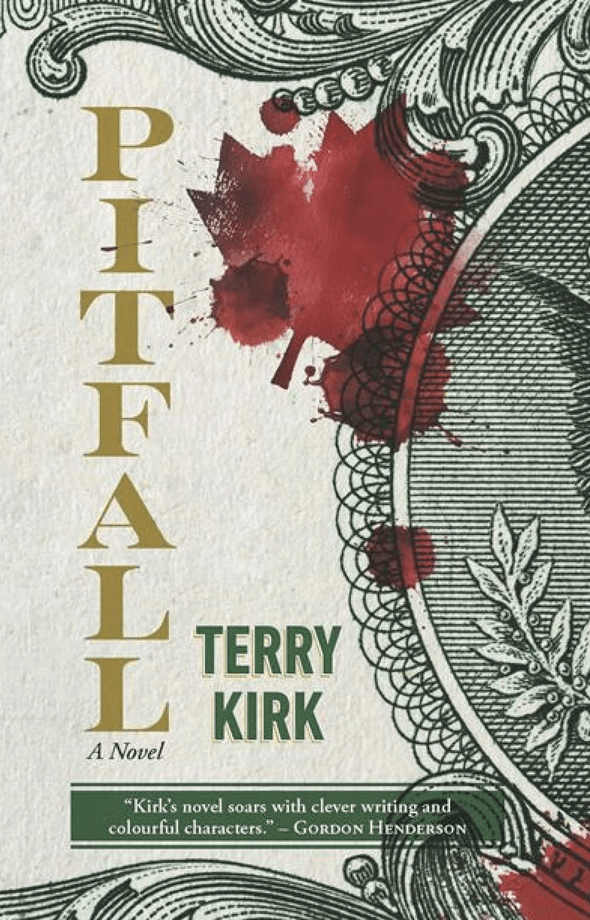
By Terry Kirk
At Bay Press/February 2025
Reviewed by Anthony Wilson-Smith
July 13, 2025
Frank Cork suddenly has a big problem. Or, more to the point, no end of big problems.
It’s October 29, 1929: an unprecedented plummet in stock prices on the New York Stock Exchange has triggered a crisis of confidence in the entire U.S. banking system. Frank, who made a fortune on the Chicago Commodities Exchange speculating on the price of wheat, is an immediate casualty of the Great Crash.
Overnight, his own fortune and his clients’ investments are wiped out. To make matters worse, he’d made a powerful enemy the day before when he publicly denounced the city’s bullying, corrupt mayor. He’s also earned the enmity of Chicago gangsters, narrowly escaping an apparent ambush. With his life in tatters, all he can do is flee, which he does…to rural Saskatchewan, the home of much of the wheat that has been at the heart of his heady rise and sudden fall.
So begins Pitfall, the fast-paced début novel by Terry Kirk, better known till now in well-placed Ottawa and Toronto circles as a successful lawyer, business entrepreneur, and sometime political activist (along with husband Glenn O’Farrell). Kirk also studied journalism in university before taking law.
The skills Kirk acquired in law, business, and politics are all brought to bear in a plot that features a keen sense of what makes a good tale, impeccable historical research, a deep understanding of market forces – and a first-hand knowledge of rural Canada at ground level. The last quality is, literally, in her DNA: Terry’s mother was born and raised in Gainsborough, SK (last recorded pop. 254), 23 km north of the border with the United States.
Any novel worth the read needs a compelling lead character, and Frank is all that. He is a complex figure who is grateful for his life, dearly loves his wife and children, wants generally to do the right thing but has become cocksure and overly comfortable with a lifestyle unimaginable to him in earlier years. He is impetuous, self-serving on a regular basis, and gives little thought to the long game measured against his immediate satisfaction.
When his life blows up, his first reaction, after considering and rejecting suicide, is to run from family, friends and the mess confronting him without telling anyone his whereabouts or even if he is still alive. Clad in the expensive suit in which he began the day but with only a small amount of cash on hand, he boards a train to a place he has never visited but knows all about second hand – the Saskatchewan wheatfields. Meanwhile, seemingly everyone in Chicago – friends, family, foes – tries to figure out what has happened to him with contrasting emotions of affection and anger.
The skills Kirk acquired in law, business, and politics are all brought to bear in a plot that features a keen sense of what makes a good tale, impeccable historical research, a deep understanding of market forces – and a first-hand knowledge of rural Canada at ground level.
From there, Kirk toggles skillfully between descriptions of the new life Frank unexpectedly begins and the one he left behind. To explain his unusual circumstances, Frank concocts a story about being an author keen on researching the hardscrabble Prairie town in which he washes up. Prohibition is in place, and he is befriended by a farming family whose patriarch turns out to be mixed up in the lucrative business of bootlegging liquor into the United States. Meanwhile, the handwringing over what has happened to him at home unfolds against the backdrop of the beginnings of the Great Depression.
Kirk neatly lays out the path by which, through scheming and circumstance, Frank finds safe path back to join – and rescue – his suddenly-destitute family. The road to that outcome has its share of necessary potholes to keep the pace moving briskly. There are startling plot twists, some double dealing, and neat use of real-life history, such as the bootlegging still hidden in the tunnels under Moose Jaw.
There is also Frank’s ability to channel some of his own fast-talking, deadbeat father’s skills in a positive manner. In fact, an underlying subtext of Frank’s adventures is the way in which he discovers abilities he didn’t know he had – and a value system stronger than might have originally seemed the case.
To say any more than that would betray not only the ending, but also the pleasure in getting there. Kirk, born in Winnipeg, MB, raised in Peterborough, ON, and well-travelled across much of the rest of Canada, has the sharp eye of someone accustomed to continually adjusting to new settings.
In fact, she is currently getting more experience in that through a national book tour – a rarity these days. That’s well-timed: in this summer of Canadiana, Pitfall seems a natural choice for a read at the cottage, on a beach – or, for that matter, in a small Prairie town.
And if there is the understandable sense of withdrawal that comes with the end of a really fun read, there is also relief: the follow-up novel, Plunder, is already complete. The adventure continues – not only on the printed page for readers, but also for an author clearly reveling in her new craft.
Anthony Wilson-Smith is President of Historica Canada and former Editor of Maclean’s magazine.