
Poilievre the Ideologue is a Conservative Problem

July 19, 2025
The Conservatives lost the federal election this year by 482,004 votes. Pierre Poilievre is right to note that his party was competitive, winning a higher share of the vote than it had in 40 years.
It could look like Poilievre was knocking on the door of a breakthrough victory. But looks can also be deceiving.
Here are a few key data points from our latest Spark Insights national survey.
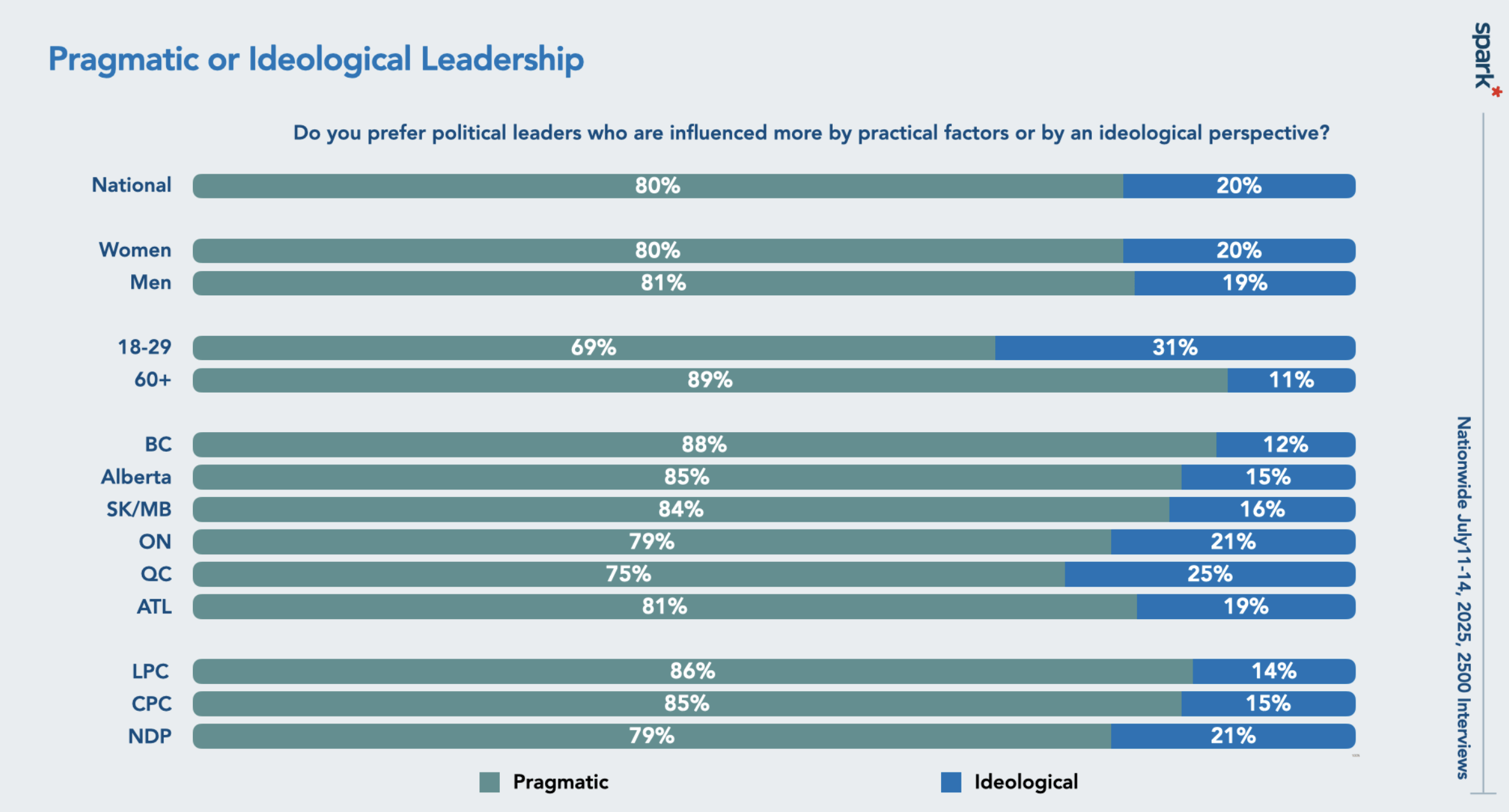
We asked if voters “prefer political leaders who are influenced more by practical factors or by an ideological perspective”. By a 4:1 margin, our respondents said they liked pragmatism better.
As one might expect, the preference for pragmatism increases with age, but not as much as the old aphorism about the young having more heart suggests. Among those under 30, 69% prefer pragmatic leaders. Among those 60+, it’s 89%.
Pragmatism is by far what most Albertans want (85%) and the same is true for those who voted Conservative this year (85%).
Why does this matter and how does it affect our politics today?
While a case can be made that Justin Trudeau was a fairly pragmatic prime minister, many voters over time came to see his government as more ideologically inflected and farther to the left than they wanted.
The prominence of culture-war politics in the US, and in many other democracies, has tended to polarize voters and stigmatize parties. The Liberal Party, which had for many years been the most pragmatic of Canadian political parties, seemed to many like it had lost touch with the centre.
But today, the competitive landscape has shifted.
Most voters (64%) see Mark Carney as a pragmatist. That’s true among people who voted Liberal (87%) but also among a healthy percentage of those who didn’t (43%). A majority of Albertans (55%) see Carney as pragmatist.
It’s a major part of why we currently see a 67% approval rating for the Carney government. Carney is seen as doing more than “playing to a base”. His approval level is a remarkable 59% in Alberta and 45% among those who didn’t vote Liberal.
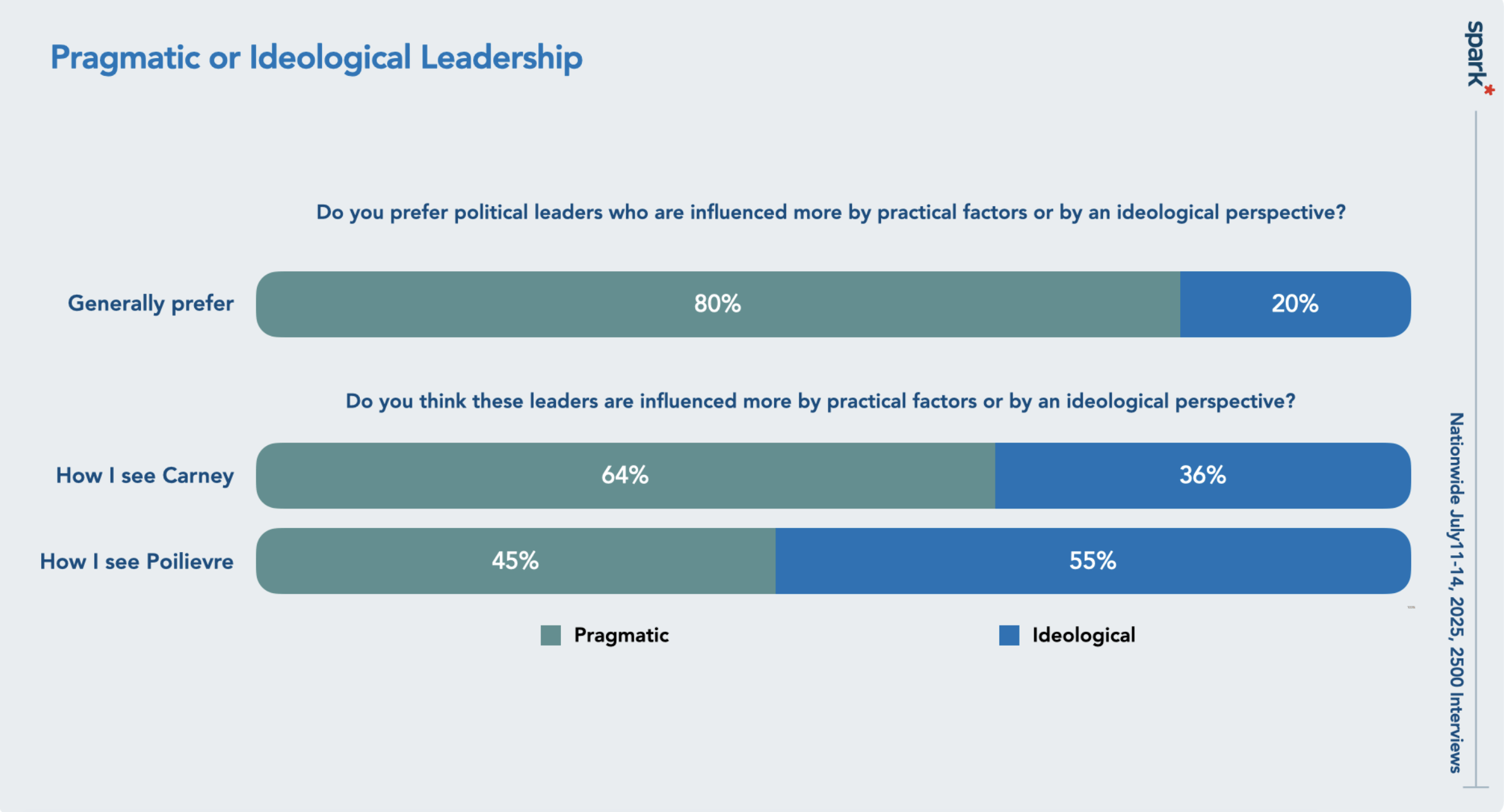
Meanwhile, most voters (55%) see Pierre Poilievre as more of an ideologue. That’s an even more common view among older voters (59%) who, as noted earlier, are the most inclined to want a pragmatist.
Among the 80% of voters who are pragmatically inclined, the Liberals have a 17-point lead over the Conservatives today, and Carney has a +40 personal positive/negative rating. Poilievre is -6. Among these voters, 68% think of Carney as a pragmatist, only 44% see Poilievre that way.
Between now and January, Pierre Poilievre has a couple of contests that are obvious. First is winning a seat in Battle River Crowfoot. In the last five federal elections, his party won more than 80% in the riding in four of those elections. It’s hard to imagine him losing this election. At the same time, it is fair to note that over five elections and almost 15 years in Carleton riding, Poilievre gained more prominence as a politician, but failed to win any greater share of the vote.
His second test will be about his leadership of the Conservative Party. Most seasoned observers think Poilievre will sail through this test with a strong endorsement. In our survey, 77% of those who voted Conservative want to stick with Poilievre, a number that is somewhat less than table-pounding confidence. In Alberta, 49% would prefer a new leader.
If Canadians more broadly were voting, 60% would vote to replace him. Names like Ford, Moore and Kenney all look to have some appeal.
So, as summer evolves, the question is whether Pierre Poilievre will.
Is his best strategy to fire up the ideological base of his party to win a massive endorsement in January, knowing that doing so might jeopardize his competitiveness in the next election?
Or, to try to convince more Canadians that he is not an ideologue, and in so doing convince his party that he has a better chance to win the next election than he seems to have today?
Policy Contributor Bruce Anderson has been a pollster, strategy and communications advisor for more than 40 years. He is a frequent commentator on Canadian politics and public policy including on The Bridge podcasts. He is a founding Partner and Chief Strategy Officer of Spark Advocacy. He was an active, public supporter of Mark Carney during the Liberal leadership campaign and federal election.