
UNGA 80: Notes from a UN Mission When the Drama was Good
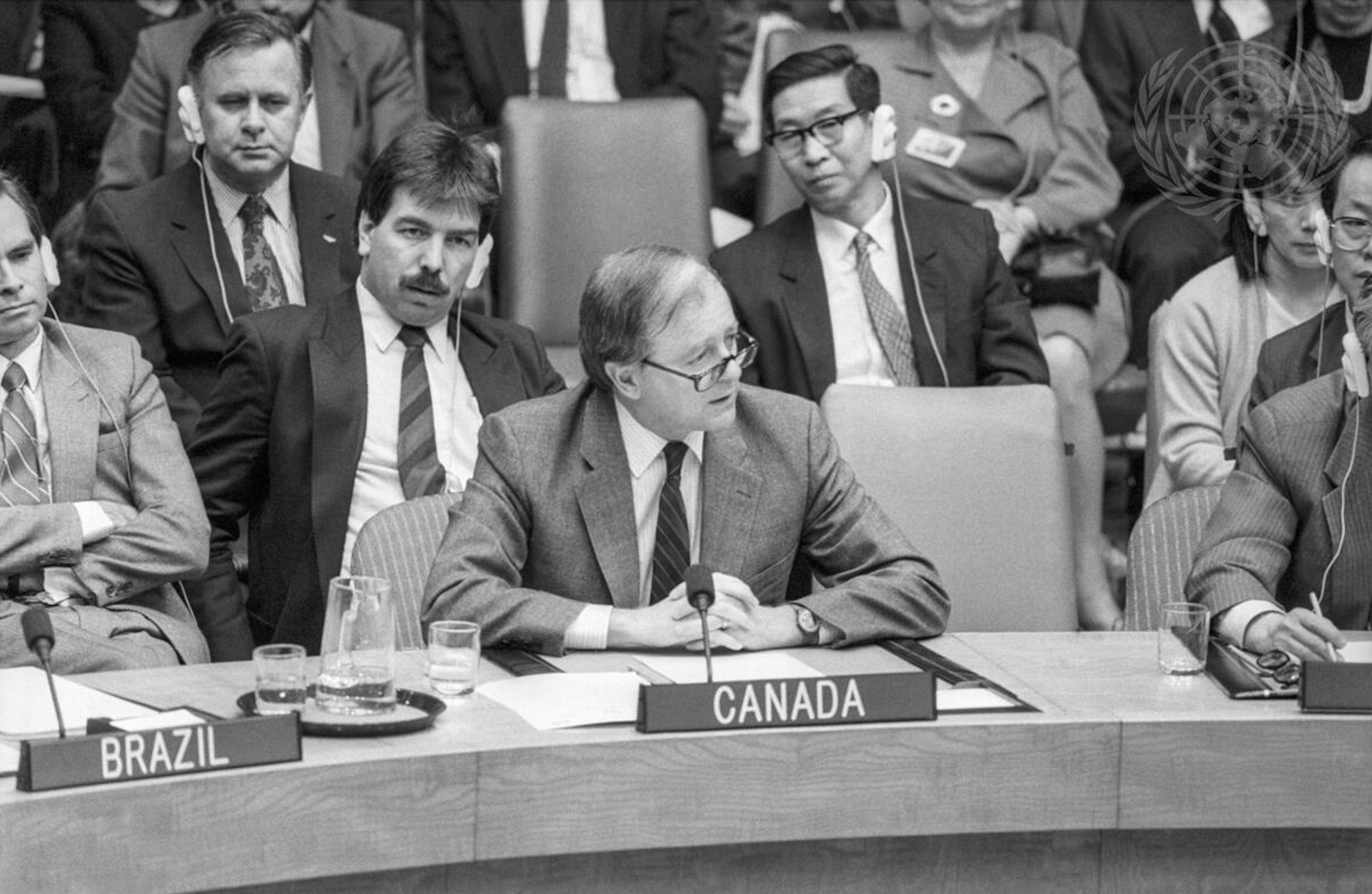 Yves Fortier serving as president of the United Nations Security Council in 1989/UN Photo
By Yves Fortier
September 8th 2025
This year marks the 80th anniversary of the signature of the United Nations Charter by Prime Minister Mackenzie King and the representatives of 49 other countries at the UN Conference on International Organization (UNCIO) in San Francisco.
On this anniversary, it is appropriate to recall Article 1, Section 1 of that Charter, which sets out the purposes and principles of the United Nations. It reads as follows:
“To maintain international peace and security, and to that end: to take effective collective measures for the prevention and removal of threats to the peace, and for the suppression of acts of aggression or other breaches of the peace, and to bring about by peaceful means, and in conformity with the principles of justice and international law, adjustment or settlement of international disputes or situations which might lead to a breach of the peace.”
Note that the words “peace” or “peaceful” appear five times in this section.
In July 1988, when my secretary told me that the Prime Minister of Canada, my friend and former law colleague Brian Mulroney, wanted to speak to me about the United Nations, I knew little about the UN Charter except that it governed the multilateral organization whose members had the awesome responsibility of maintaining peace and security in the world.
After nearly 30 years at the Bar and as a partner in the law firm of Ogilvy Renault in Montreal, I was very happy to continue to practice law as an advocate litigating cases before courts in Canada and elsewhere, including the International Court of Justice in The Hague.
Nevertheless, I accepted my friend’s invitation and drove to Ottawa the following day for a private dinner at “24” as we called the PM’s residence, 24 Sussex.
The Prime Minister was an avowed ‘aficionado’ of the United Nations and, as such, an excellent advocate for the institution. In no time, he convinced me that Canada needed me as its UN ambassador in New York and, more importantly, as its representative on the United Nations Security Council in 1989 and 1990. Canada was then vying for a seat as one of the 10 non-permanent members elected for a two-year term by the UN General Assembly.
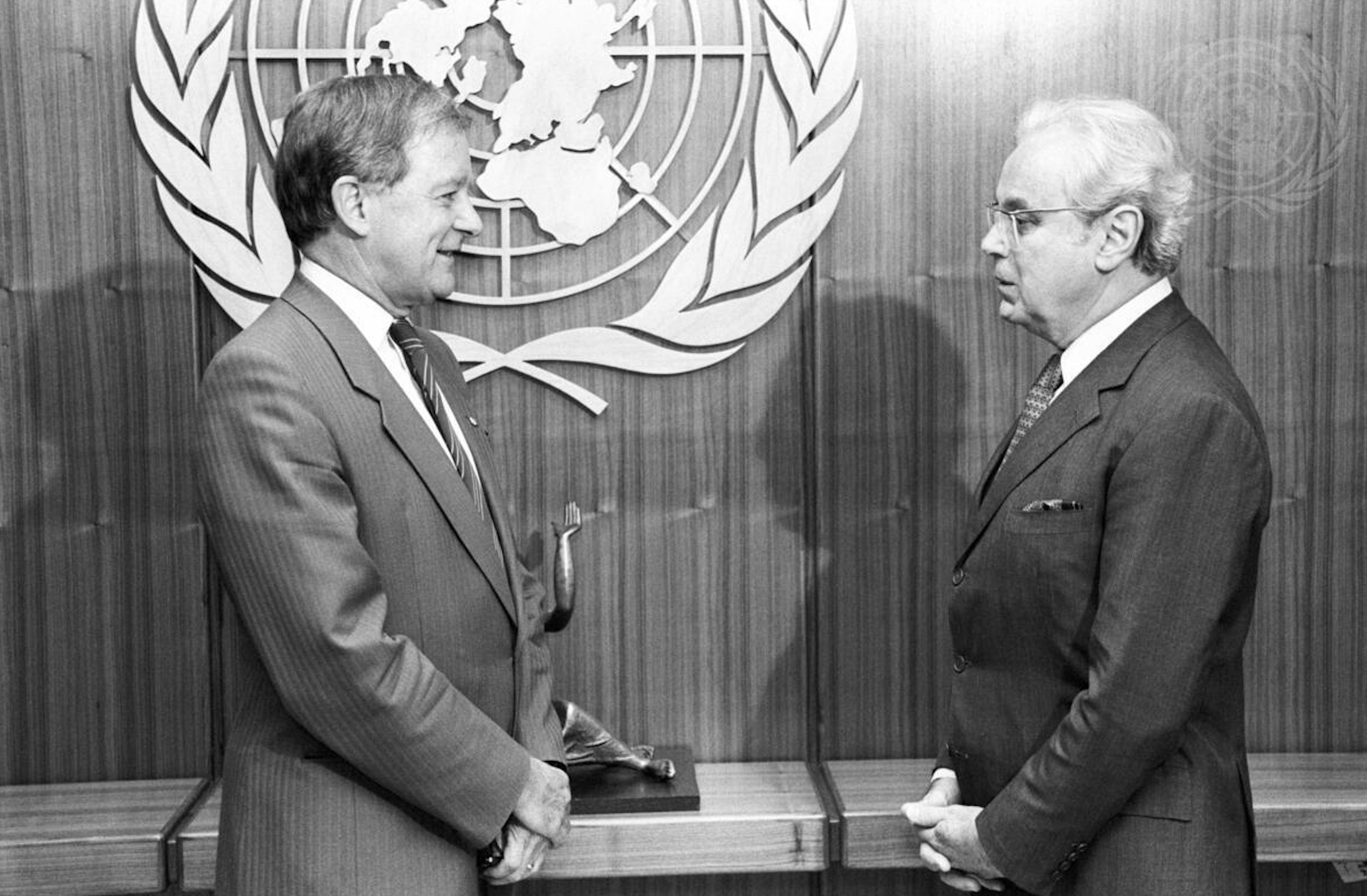 Presentation of credentials to UN Secretary General Javier Perez de Cuellar, September 14, 1988/UN Photo
One month later, I had moved to New York and was trying to convince my new colleagues in the General Assembly that Canada, as a leading blue beret and an ever-present member participating actively in all UN committees, deserved to be elected to one of two rotating UNSC seats.
At the end of November, when all the votes were counted and with due credit to the Prime Minister and my modest arguments on the floor of the General Assembly, Canada was elected as a non-permanent member of the Security Council with the largest majority that any member state had ever gathered.
It bears repeating and stressing that this majority was due in large measure to the UN commitment of Prime Minister Mulroney. Some of his successors have tried to have Canada elected to the Security Council, to no avail. They each lacked the passionate dedication that Brian Mulroney held for the United Nations.
In fact, as few people know, after 1988, when the time came to elect a new UN Secretary General, the five permanent members of the UNSC — the United States, Russia, the United Kingdom, France and China — were each trying to convince Mr. Mulroney to come to New York to fill the role. Regrettably, as his emissary, I had to inform my colleagues that he still had work to do in Ottawa.
During my two years on the Security Council, there were many threats to international peace and security that required our constant work, deliberations, and decisions. I think of the Gulf War and the situation in the Middle East. We were constantly deliberating in the break-out room where decisions were negotiated.
It was an exciting time for humanity; in many ways the opposite of the negative drama and upheaval we’re experiencing today in international relations. I recall, in particular, our discussions on perestroika, the restructuring of the Soviet Union under the direction of Mikhail Gorbachev, for whom Prime Minister Mulroney had enormous respect as a reformer.
Overnight, it seemed, the Berlin Wall fell, the Cold War ended, freedom prevailed, and the Soviet Union was Russia again. Now, Canada’s extremely able ambassador, Bob Rae, spends just as much time dealing with Vladimir Putin’s attempts to put that genie back in the bottle.
Indeed, Russia’s use of its veto in the UNSC since February 2022 has prevented the United Nations from declaring its flagrant breach of the UN Charter.
Similar use of the P5 veto power — the price that had to be paid for the creation of the UN in 1945 — by permanent members of the Council has led, during the last 80 years, to other breaches of the Charter. At no point has that price seemed as high as it has in this century, as the clash between democratic and autocratic powers has played out across multilateral institutions, including the UN.
Nobody, including its most steadfast defenders, has ever claimed the UN is perfect. However, I echo the words of Lester Pearson — architect of UN peacekeeping operations — and of many other foreign policy luminaries, that if the United Nations did not exist today, it would have to be invented.
For that, and for the many other reasons that have kept it alive this long, I wish the United Nations and all those who work toward — and are protected by — its success, a very happy 80th birthday.
Hon. Yves Fortier PC, CC, OQ, KC, served as Canada’s Ambassador to the United Nations from 1988 to 1992.