
Pragmatism Over Wishful Thinking: Crafting a New China Strategy

September 28, 2025
Perhaps the strongest indication that Prime Minister Mark Carney’s UNGA meeting with Chinese Premier Li Qiang last week signalled a new era in bilateral relations was the Xinhua coverage.
“China and Canada have been promoting the improvement and development of their bilateral relations in a practical and constructive manner, which has been widely welcomed by all sectors in both countries,” reads the Xinhua piece.
Quite a departure from the rhetoric out of Beijing during the lowest days of the dynamic over the past decade.
Foreign Affairs Minister Anita Anand is expected to travel to China in mid-October, with additional ministerial visits likely to follow this fall. Taken together, these moves amount to a visible thaw in a relationship that has been in a deep freeze for several years.
Mr. Carney has described his approach to China as a “variable geometry engagement”: deep engagement where interests align but limited or no engagement where our national or economic security is at stake. While this is sensible in theory, it is far harder in practice.
Beijing rarely compartmentalizes. Rather, it links issues, redraws red lines, and often conditions cooperation on acceptance of its preferred narratives on Taiwan, the South China Sea, and human rights.
Beijing rarely compartmentalizes. Rather, it links issues, redraws red lines, and often conditions cooperation on acceptance of its preferred narratives on Taiwan, the South China Sea, and human rights.
The Biden administration’s selective engagement with China produced only limited results. For Canada, which has far less leverage, the only way selective engagement can work is with clear guardrails at home and strong coalitions abroad.
When Ottawa released its Indo-Pacific Strategy in 2022, it effectively situated China inside a larger regional plan, which was closely aligned with U.S. policies at the time. But the world has moved on, and Washington’s own approach to Beijing is shifting.
Meanwhile, the structural challenges of dealing with China remain: state-directed industrial policy, data-localization demands, arbitrary regulatory action, economic coercion, and supply-chain vulnerabilities—alongside national security concerns about foreign interference, transnational repression, and Beijing’s support for Russia.
The United States may be viewed as the more disruptive power at the moment, but that does not make China any more trustworthy.
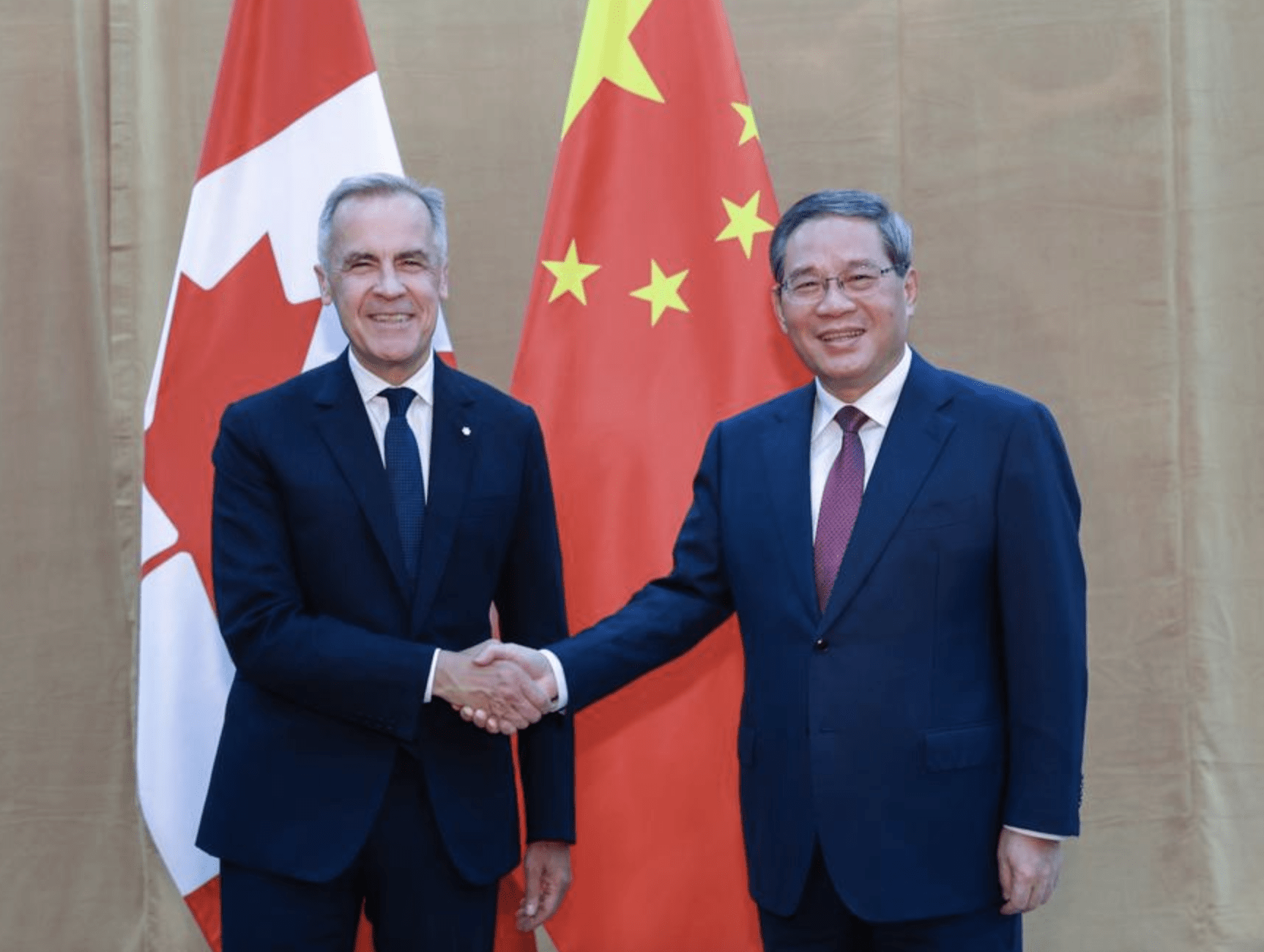 Prime Minister Mark Carney and Premier Li Qiang at the UNGA, September 23, 2025/Xinhua
In many respects, China was the first mover in unsettling the global economic order—by pursuing an unbalanced, export-led growth model; subsidizing overcapacity in sectors such as steel, solar, batteries, and EVs; protecting its domestic market; manipulating its currency to boost exports; and leveraging state pressure and forced technology and intellectual-property transfers to move up the value chain. U.S. responses, especially under President Trump, have added volatility, but they do not negate the underlying challenges created by Beijing’s mercantilist policies.
Full decoupling from the world’s second-largest economy is neither feasible nor desirable. However, a full embrace would be naïve, as the deepening of economic ties with Beijing carries real risks. What is needed is a disciplined middle path: a made-in-Canada China strategy grounded in several core imperatives.
First, set clear guardrails. Engagement with China should be explicitly off the table in critical infrastructure, advanced semiconductors and other dual-use technologies, sensitive data, telecommunications, defence supply chains, and research with direct security applications. Investment screening, procurement rules, and research partnership guidelines must be aligned and backed by credible enforcement.
Second, define narrow lanes for cooperation. Climate transition, public health, and agri-food exports are areas on which engagement with China can advance Canadian and global interests. But engagement must proceed only with a clear-eyed understanding of Chinese Communist Party policy and vigilance against conditionality—and without self-compromise on Canada’s values.
Third, in an atmosphere where Beijing will be exploiting America’s self-isolation, continue de-risking from both China and the United States. Over-reliance on any single buyer or market exposes exporters to sudden shocks. Pursuing market openings in China must go hand-in-hand with accelerating diversification into other Indo-Pacific and European markets. The lessons from our experience with canola are a stark reminder: when over 60 per cent of exports flow to one buyer, painful disruption is only a matter of time.
Full decoupling from the world’s second-largest economy is neither feasible nor desirable. However, a full embrace would be naïve, as the deepening of economic ties with Beijing carries real risks.
Fourth, balance exporters’ needs with national and economic security. Advocating for market access in China must be backed by a clear industrial strategy at home—one that prioritizes certain sectors, especially in advanced technologies, accelerates permits, modernizes infrastructure, scales skills, and deploys targeted capital. The goal is straightforward: build competitiveness today to ensure Canada remains a strong industrialized economy tomorrow.
Fifth, reinforce coalitions. Canada’s leverage grows when acting with partners who share its interests, like Japan, South Korea, Australia, the Philippines, New Zealand, Taiwan, the U.S., EU and U.K., and willing ASEAN states. Small, purpose-built groupings can align export controls, co-finance projects, share early warnings on coercion, and set interoperable clean-tech standards.
Finally, invest in our China competence. Since Canada launched its Indo-Pacific Strategy, federal and provincial governments have built more capacity to understand and navigate China. These efforts must continue, building deeper expertise among members of government, business, and civil society alike.
None of this, however, precludes direct diplomacy. Canadian ministers—and the Prime Minister—will need to keep talking with Beijing. At times, these talks will be productive, at others they will be confrontational. Either way, engagement will be necessary but must be based on realism and focus on producing results.
A clear, made-in-Canada China strategy would do three things: protect what matters, engage where our interests truly align, and be on guard against coercive conditionality and issue-linkages imposed by Beijing.
Vina Nadjibulla is the Vice-President of Research & Strategy at the Asia Pacific Foundation of Canada.