
Is Trump Really Angling for a Nobel Prize in Economics?
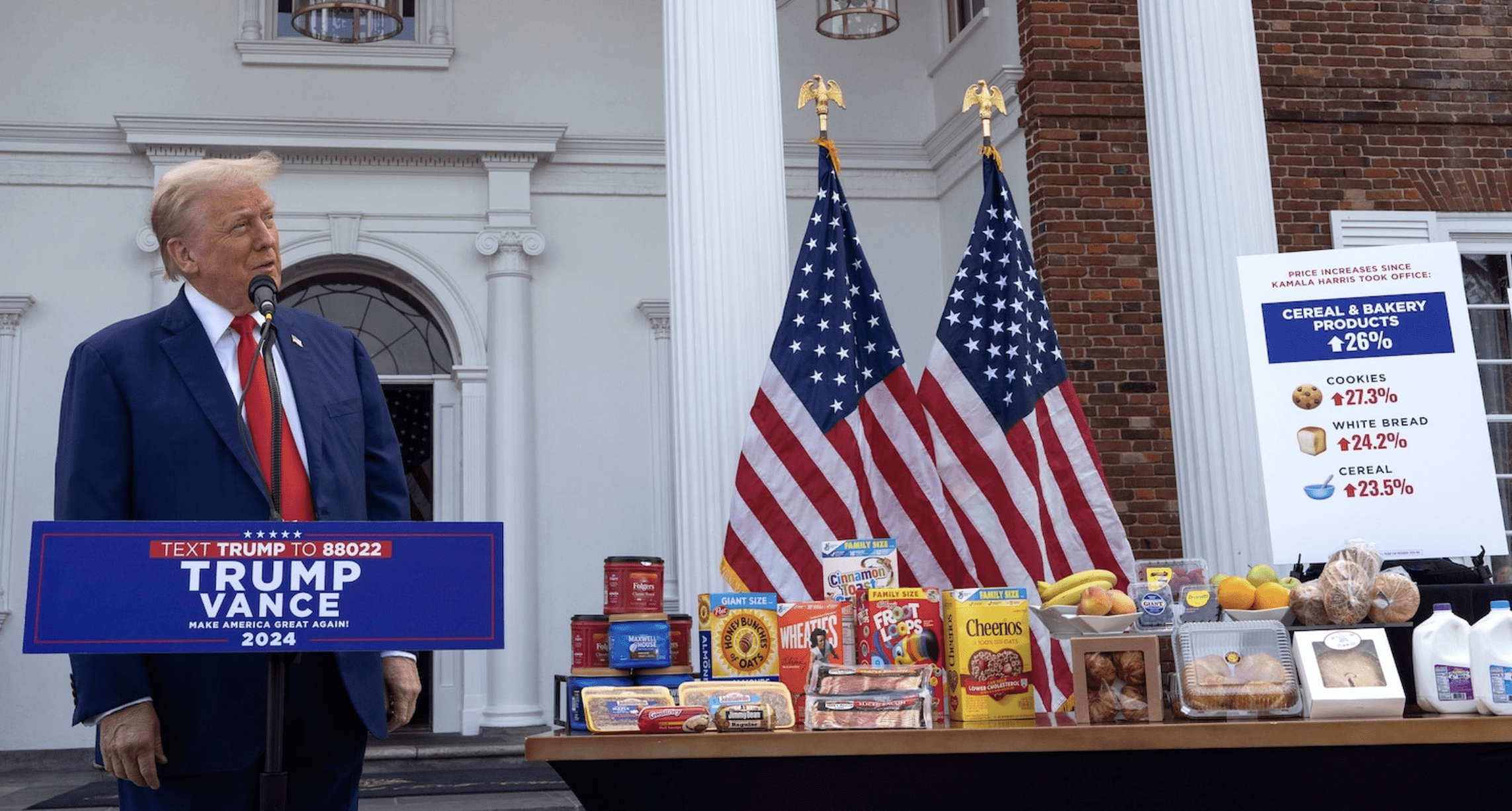 Donald Trump’s historic 2024 ‘groceries’ campaign event at his Bedminster, N.J., golf club/ABC News
By Kevin Lynch and Paul Deegan
September 28, 2025
Kitty-corner from the Oval Office lies a windowless conference room. In 1969, in a somewhat rare and magnanimous display of bipartisanship, Richard Nixon named the room after both Theodore and Franklin Roosevelt. You may now be visualizing it based on the prominent role its Hollywood doppelgänger played in so many episodes of Aaron Sorkin’s The West Wing.
While the Roosevelt Room is dominated by “Rough Rider”, the large equestrian portrait of Theodore Roosevelt by Tade Styka that hangs above the fireplace, it is a rather diminutive object sitting atop the mantle – Teddy’s 1906 Nobel Peace Prize – that is the crown jewel of the room. Three other U.S. presidents have been awarded the coveted Nobel for peace: Woodrow Wilson, Jimmy Carter, and Barack Obama.
But only Donald Trump has often and openly pined for it. “Everyone says that I should get the Nobel Peace Prize,” he told the UN General Assembly last week. While the Peace Prize will likely elude him, could he also be gunning for a Nobel in Economics?
Sound farfetched, even by Trumpian standards? White House trade adviser Peter Navarro has floated the idea on Fox Business Network, “I’m thinking that since he’s basically taught the world trade economics, he might be up for the Nobel on economics because this is a fundamental restructuring of the international trade environment in a way where the biggest market in the world has said, you’re not going to cheat us anymore.”
Ever the contrarian, Trump’s twin economic policies of massive tariffs and massive tax cuts and deficits have been roundly criticized by most of the U.S. economics profession, who have predicted higher inflation, weaker growth, financial-market and stock-market fragility, and a lower U.S. dollar.
Reflecting this consensus, the non-partisan Congressional Budget Office, the Federal Reserve and the International Monetary Fund have all reduced their forecasts for U.S. real growth, upped their predictions for U.S. inflation, and marked down the prospects for global growth.
Economic orthodoxy tells us that tariffs are a tax on both consumption and business inputs as importers pass on the tariff costs to their customers, driving up inflation. High fiscal deficits as far as the eye can see, adding trillions to already high U.S. government debt, will spook financial markets and push up long-term bond rates to compensate investors for government credit risk.
Economists have missed three things about Trumponomics: greed, power, and luck.
Foreign investors will shun buying Treasuries, or even start liquidating their current enormous holdings, as the reserve currency status of the U.S. dollar comes under question. Business investment will dry up due to the uncertainty around tariffs and long-term bond rates. And, on top of all this, global growth will tumble as U.S. tariffs impede trade flows and escalate geopolitical tensions.
So how has it worked out? So far, Trumponomics appears to have wrong-footed the economics profession. Despite average tariff rates today of 18.6 % versus 2.3% last year and a government deficit over 7% of GDP, inflation is not spiking, real growth is not cratering, the U.S. dollar is not falling off a cliff, and stock markets are soaring. Have Trump economic advisors Peter Navarro, Stephen Miran and Kevin Hassett re-invented economic orthodoxy?
Hardly. Both bad and good economic policy take time to work their way through the economy, and the CBO and Fed are doubling down on their forecasts that tariff-induced price increases will materialize and real growth will sag to 1.5% this year, bounce back a bit next year as the massive tax cuts take effect, and then grow at a desultory pace of 1.8% beyond next year, with all risks to the downside.
Team Trump at the Office of Management and Budget, however, foresee only strong real growth of 3% per year and low inflation at 2%. A tale of two economic narratives, with time waiting to declare a winner.
Economists have missed three things about Trumponomics: greed, power, and luck.
The greed of CEOs, especially tech bros, in doing Trump’s bidding in return for regulatory favours and tax cuts. The power Trump has been able to wield in his pursuit of state capitalism: jawboning companies to absorb tariffs rather than pass them on, putting banks and financial institutions on edge about his scope for retribution, and intimidating Congress and the Supreme Court into not holding him to existing laws. And luck: a massive increase in spending on AI infrastructure has excited stock markets and offset weak business investment so far, while a decline in global oil prices due to higher production and less demand has taken pressure off American inflation and the inevitable lags.
Trump’s trade and fiscal policies will take time to disrupt a resilient, tech-driven, U.S. economy.
Recently, the Yale Chief Executive Leadership Institute’s CEO Forum gathered in Washington. The consensus from more than 100 top business leaders representing some of the world’s largest companies and most iconic brands: “Trump’s policies aren’t working”. They noted, “After nine months in office, there is a clear desire to return to a respect for the balance of powers in government, to reinforce international allies, to fortify independent, objective expertise of economists and scientists, to encourage freedom of voice, to stop bullying countries, cities, and companies into resentful, uneconomical compromises. In short, CEOs are calling to make America, America again.”
Orthodoxy and reality are catching up to the former reality-show star and the American economy. Regardless of Trump’s intimidation, financial markets like corporate profits, and they are pressuring firms to both raise prices and cut costs in response to the tariffs. U.S. employment is weakening as companies slash costs. Growth is unbalanced and starting to slow. Trump’s attacks on the Fed are unsettling CEOs and fixed-income investors alike. Overarching it all, geopolitical reaction to the Trump tariffs is generating pushback from all corners of the world.
Even for a president who spends every day aggressively redefining plausibility, a Nobel Prize for economics may be even more of a longshot than a Nobel Prize for peace.
Kevin Lynch served as Clerk of the Privy Council and vice chair of BMO Financial Group
Paul Deegan, CEO of Deegan Public Strategies, was an executive at BMO and CN. He served as Deputy Executive Director of the National Economic Council in the Clinton White House.