
Maia Sandu’s Latest Victory and Moldova’s European Future

By Maria Popova
September 29, 2025
Moldova’s parliamentary election on Sunday was supposed to be an uphill battle for the ruling reformist, pro-European party, the European Action and Solidarity Party (PAS), and a nailbiter for its fomer leader, President Maia Sandu.
The PAS faced several pro-Russian formations, the biggest among them the ironically-named Patriotic Bloc, which features a hammer-and-sickle emblem, evoking a time when Moldova was not an independent nation but a Soviet republic.
Instead of a close race, PAS garnered 50% of the vote, trouncing the Patriotic Bloc’s 24%, and guaranteeing itself a majority in parliament with 54 seats out of 101. This is a second resounding mandate for Sandu, who is herself serving a second term after winning re-election last year.
In Moldova, which has a semi-presidential system similar to France’s, the directly-elected president shares power with a prime minister appointed by parliament. Igor Grosu, the curent PAS leader and an ally of Sandu, is expected to take that post.
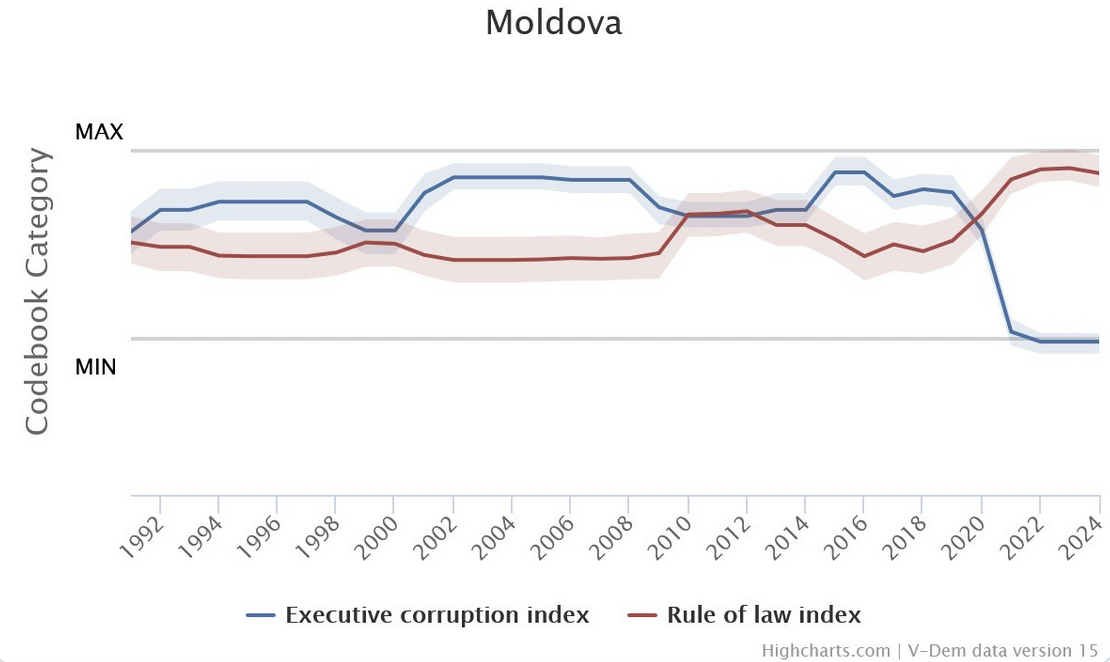
Sandu’s rule of law and anti-corruption reforms are wide-reaching, sustained, and multifaceted, and have brought Moldova much closer to EU membership.
It would not be an exaggeration to say that Sandu has been the most successful Eastern European reformist politician of the 21st century. She has dramatically improved the rule of law, significantly curbed corruption, and made Moldova’s EU membership prospects realistic.
The Varieties of Democracies’ Institute (VDem), which puts out the most reputable indices of democratic governance, indicates that since taking office in 2020, Sandu and her PAS party have implemented effective judicial and anti-corruption reforms that vastly improved the country’s scores on rule of law and clean government.
Other Eastern European reformists have done anti-corruption well for a while (e.g. early Saakashvili in Georgia, Macovei then Kovesi in Romania, Ivanov then Petkov and Vassilev in Bulgaria, Caputova in Slovakia) but none of them have had the political staying power or consistent record that Sandu now has.
One case illustrates the significance of Sandu’s achievement — after painstakingly building several criminal cases, this month Moldovan authorities managed to get fugitive Moldovan oligarch Vladimir Plahotniuc extradited back to Moldova to face charges for allegedly syphoning off a staggering $1 billion USD from three Moldovan banks in 2014.
The political heist is known as “the theft of the century” in Moldova and Sandu’s government is now close to bringing the perpetrator to justice and getting closure for all Moldovans.
This case aside, Sandu’s rule of law and anti-corruption reforms are wide-reaching, sustained, and multifaceted, and have brought Moldova much closer to EU membership. The country was recognized as a candidate state in June 2022 and opened accession negotiations in June 2024. EU institutions have assessed that Moldova is achieving steady progress towards membership.
As impressive a record as successful reform and five election victories is, it’s even more remarkable that Sandu has built it while fending off relentless, all-encompassing Russian interference in Moldova’s domestic politics. Russia’s repertoire of pressure has included intimidation and full-scale invasion threats, voter bribery and manipulation, and a non-stop flow of disinformation.
Russia has cast a long shadow over Moldovan politics since the 1990s through its political control and military presence in Transnistria—a breakaway region of Moldova. Despite pledging at a 1999 OSCE Summit to withdraw all its troops from Moldovan territory by 2002, the Russian army is in Transnistria to this day.
Russia uses the region to undermine Moldova’s state sovereignty, apply economic pressure through controlling energy flows, and block Moldova’s path to EU membership by artificially maintaining the appearance that Moldova is in a border “dispute”.
As impressive a record as successful reform and five election victories is, it’s even more remarkable that Sandu has built it while fending off relentless, all-encompassing Russian interference in Moldova’s domestic politics.
Since Russia launched its full-scale invasion of Ukraine in 2022, Russian authorities have made repeated implicit threats to Moldova by claiming that Moldova, like Ukraine, is used by the West to weaken Russia and Moldovans will be the victims of a Russia-NATO war.
During both the 2024 campaigns (the presidential election and the referendum on Moldova’s commitment to EU accession) and the 2025 parliamentary elections campaign, Sandu’s government uncovered massive vote-buying and disinformation campaigns coordinated and financially backed by Russia to the tune of 200 million euros. Various independent investigations, including by the BBC, have corroborated the extensive vote-buying and social media disinformation campaigns.
That the majority of Moldovans have consistently and bravely voted against renewed Russian domination in dogged pursuit of Moldova’s dream of EU membership is a testament to Sandu’s ability to inspire with a grand vision, while also getting right the day-to-day grind of governance under constant pressure and under the cloud of Russia’s ongoing invasion of Ukraine.
Under Sandu’s leadership, small but strong Moldova stands firm — together with its bigger neighbour Ukraine — in thwarting Vladimir Putin’s plans for Soviet imperial restoration.
Maria Popova is Associate Professor of Political Science at McGill University and Co-Director of the Jean Monnet Centre Montreal. With Oxana Shevel, she recently published a book titled Russia and Ukraine: Entangled Histories, Diverging States.