
Brian Stewart’s ‘On the Ground’: The Power of Observation
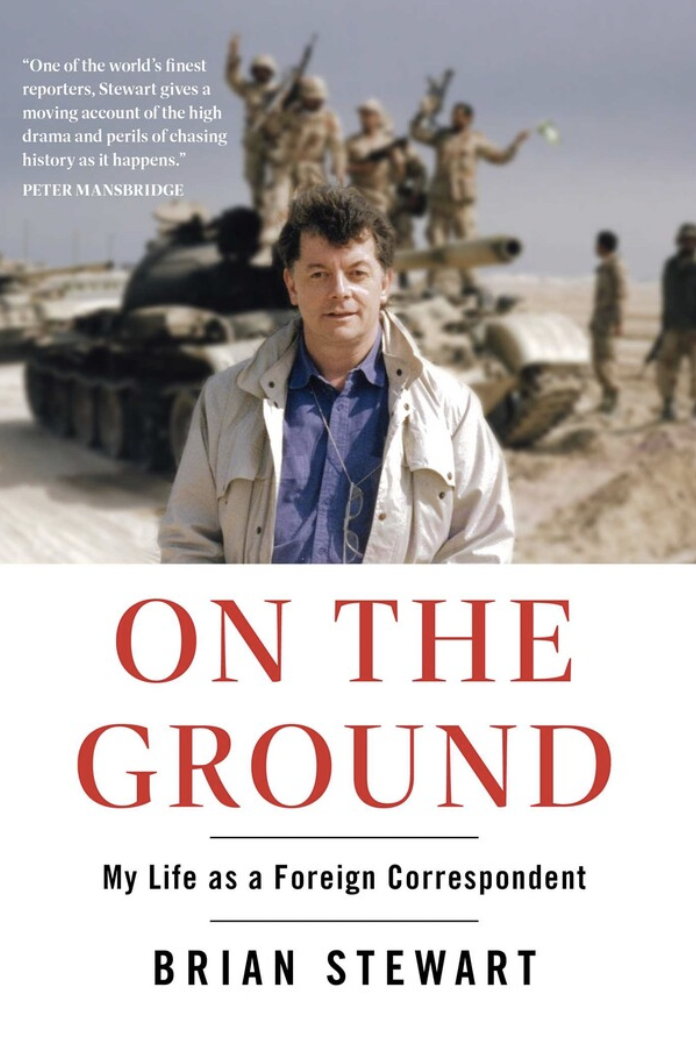
On the Ground: My Life as a Foreign Correspondent
By Brian Stewart
Simon & Schuster, September 2025/352 pages
Reviewed by Don Newman
October 5, 2025
Almost from its inception, the Canadian Broadcasting Corporation was known for the exceptional calibre of its foreign correspondents.
Matthew Halton and Peter Stursberg during the Second World War; Knowlton Nash and James M. Minifie from Washington and New York in the 1950s and 60s; Joe Schlesinger and Bill Cunningham from Paris and points around the world in the 1970s.
In the 1980s, a new name would be added to that list: Brian Stewart. As the London television correspondent for CBC News, Stewart went to Ethiopia in the fall of 1984 to investigate reports of a severe famine engulfing the northern part of the country. The escalating humanitarian catastrophe was caused in part by drought but compounded by the counterinsurgency activities of the country’s autocratic military junta.
What Stewart and his team witnessed was far worse than anything they could have been prepared for: Entire villages migrating in search of food; the corpses of the starved eaten by hyenas; relief camps overwhelmed by the sheer numbers; children dying in their parents’ arms.
“We were shaken by a terrible feeling that what we were seeing was only the beginning of something beyond our full understanding,” Stewart writes in his new memoir, On the Ground: My Life as a Foreign Correspondent. “Everything we saw suggested millions faced death.” In the fall of 1984, the highlands of northern Ethiopia were hell on Earth. And Brian Stewart and his CBC crew were the only TV crew reporting on it.
One child in particular caught Stewart’s eye. Birhan Woldu, a girl of about three, being comforted by her father. “Suddenly, the child slumped into a heap on the pavement,” Stewart writes. He and his crew called out for help. An Irish nun in the nursing station said she would likely die within 15 minutes and be buried later that day. Shaken, the CBC crew left but returned later to record the burial. What they discovered seemed miraculous; the little girl had surprisingly rallied, the nuns had saved her; she was alive.
It was the only happy story from Ethiopia. The rest of the footage in Stewart’s CBC reports were of the catastrophic human disaster unfolding in the country. The stories were broadcast around the world, triggering the same horrified reactions.
Rock musician and producer Bob Geldof saw Stewart’s reports and was moved to launch the relief effort Band Aid, convincing his fellow rock stars to hold two concerts — at London’s Wembley Stadium and at JFK stadium in Philadelphia — which also featured footage from Stewart’s reporting. Birhan Woldu’s face would move millions — so many called in to donate, the telephone system broke down.
Through Live Aid and its fundraising recordings, Do They Know It’s Christmas and We Are the World, Band Aid raised more than $200 million for Ethiopia and its famine victims. Brian Stewart’s name and career were made.
Brian Stewart has produced a compelling account of an exciting, meaningful life at a time when television news was at its peak of influence and power, and he was at the peak of television news.
Typical of a journalist too good to bury a lede, Stewart opens On the Ground with the story of Ethiopia and its importance to his life.
And what a life it has been. Even before his first overseas posting, Stewart was assigned to report from Latin America, where events — particularly in Chile and Brazil — were in turmoil. Covering the Falklands War, in which Britain expelled Argentine troops who had occupied the UK-protectorate islands in the South Atlantic, delayed his posting to the prestigious CBC bureau in London. It was from this bureau that the Ethiopia trip ensued, just one of many major stories he covered from both Britain and Canada.
In fact, the list of major stories Stewart covered reads like a history of the late 20th century: the fall of the Berlin Wall, the first Gulf War, the collapse of the Soviet Union, the fight against apartheid in South Africa, the troubles in the Middle East, and the Troubles in Northern Ireland.
Stewart writes that he had an early interest in world events as a child growing up in Montreal, Halifax and, for four years, in England while his father was posted on a business assignment. It was in Surrey that he told the headmaster of Badingham College of his ambition to work as a foreign correspondent, an admission that was greeted “with bemusement by teachers and bafflement by school friends, who had picked up parental views that all news people tended to be grubby spivs in shabby Mackintosh raincoats.” He was undeterred.
Stewart began in print journalism, working his way up until he was a star reporter with the Montreal Gazette. It was at that point that television came calling and Stewart jumped to a sought-after job in the CBC parliamentary bureau in Ottawa, and from there came promotion to London, where his boyhood prediction of being a foreign correspondent came true.
As Stewart recounts it, the life was one of excitement, sometimes fear and unrelenting pressure (especially after joining NBC as Frankfurt-based correspondent in 1986, one of many Canadian television correspondents regularly recruited by the “Amnets”); from wars in Nicaragua, El Salvador, Afghanistan, and Lebanon, and from the sometimes-cantankerous personalities he had to deal with.
He gives much credit to the camera crews who shared equal dangers with him, and to the producers with whom he worked; particularly two of the CBC’s best-ever, John Owen and Tony Burman.
And Stewart is frank about the price he paid both physically and mentally. The events he witnessed during years reporting left him suffering from conversion disorder, (recently re-labelled functional neurological symptom disorder), something not unlike but different from PTSD. Luckily, it is treatable, and Stewart became the first patient in a landmark international study on the condition’s occurrence among foreign correspondents. He is now comfortably retired with his wife and daughter in Toronto with an appointment at the Munk School of Global Affairs and Public Policy.
Brian Stewart has produced a compelling account of an exciting, meaningful life at a time when television news was at its peak of influence and power, and he was at the peak of television news.
Policy Columnist Don Newman is an Officer of the Order of Canada, and a lifetime member and a past president of the Canadian Parliamentary Press Gallery.