
Central Banking vs. Central Casting: The Latest Carney-Trump Bilat
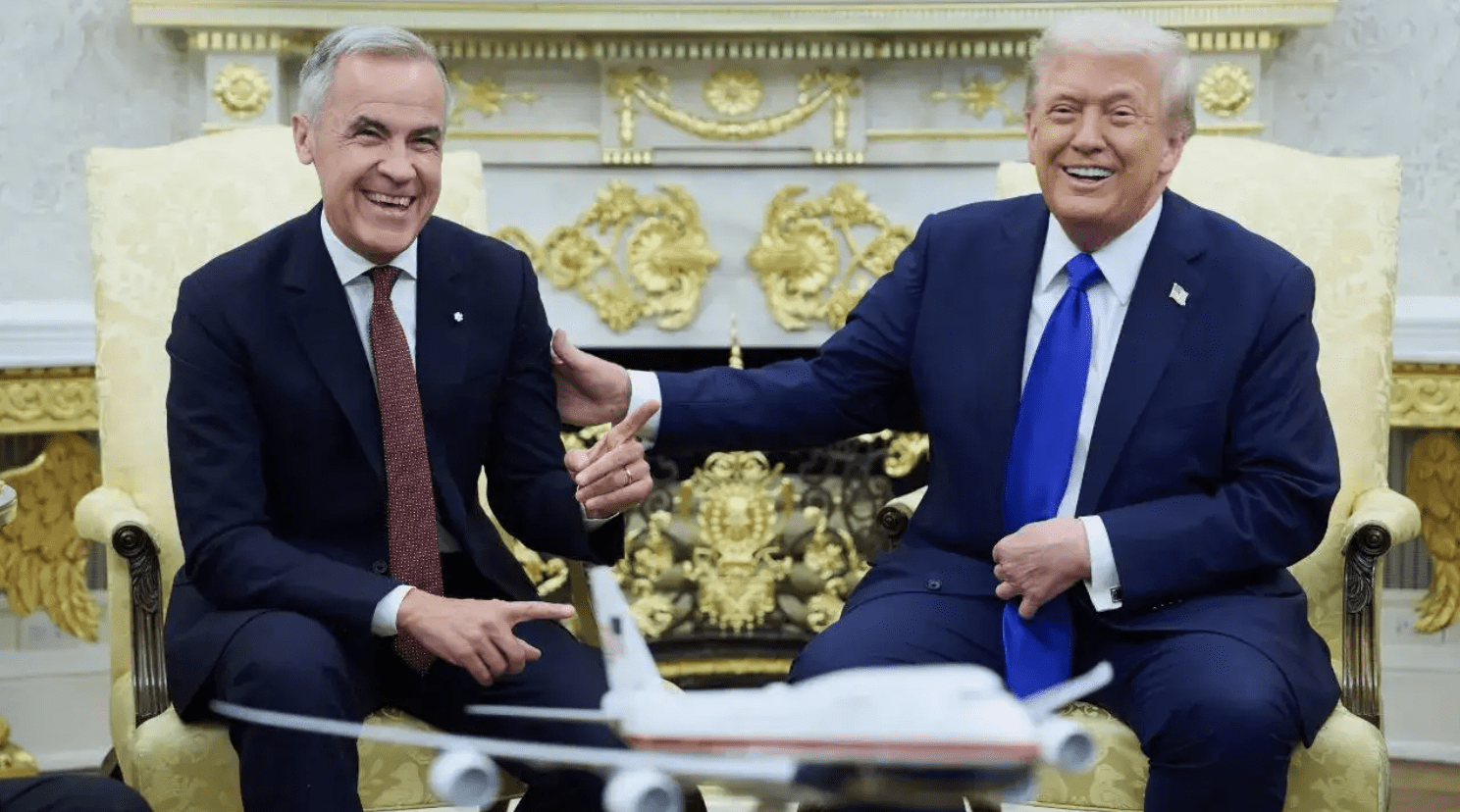 Prime Minister Mark Carney and President Donald Trump in their second Oval Office pool spray, October 7, 2025/AP
By Hon. Perrin Beatty and Fen Osler Hampson, co-chairs, Expert Group on Canada-US Relations
October 8, 2025
Prime Minister Mark Carney may not have emerged deal in hand from his latest White House bilateral with President Donald Trump, but he has clearly figured out how to get Trump’s attention and begin to break the tariff logjam.
As a former Wall Street banker and former head of both the Bank of Canada and the Bank of England, Mark Carney is in a good position to remind Donald Trump that foreign investors are not just backseat passengers in America’s economy, they are in the driver’s seat as some of America’s biggest shareholders.
While Carney didn’t have much opportunity to speak during their second Oval Office pool spray (Carney’s first White House bilat was last May), he nevertheless managed to publicly convey to the President — as he surely did in private — that a Canada–U.S. trade agreement could unleash a trillion or more of Canadian investment in the American economy.
This was a doubly smart move. Other countries that have managed to strike deals with the U.S. have wooed Trump with promises of billions more investment in the U.S. Carney understood he should do the same, not least because Canada is America’s biggest foreign investor. However, it was a zero-cost concession—the best kind to give—because, as Carney knows all-too-well, Canadian financial institutions and pension funds will make their own investment decisions, not the Government of Canada.
Importantly, it was also a none-too-subtle reminder to Trump that his punitive tariffs on Canada—not to mention other countries—are putting billions if not trillions of foreign investment at risk.
If you listen to the way Donald Trump talks about trade, you would think that America is the victim of predatory foreign exporters who exploit U.S. markets while giving little back in return. The inconvenient truth is that the countries Trump targets with his tariffs—Canada, Europe, Japan—are not just trading partners, they are, in fact, America’s biggest shareholders, with direct and portfolio assets worth trillions.
The oft-repeated myth is that China is the biggest foreign investor and bond holder. In truth, the largest foreign asset holders in the U.S. economy are the world’s major democracies. The numbers speak for themselves.
- Canada holds roughly $1.3 trillion in direct investment as of the end of 2024, and, astonishingly, up to $2.36 trillion in U.S. equities and securities, making it America’s biggest foreign shareholder.
- Japan is the largest individual source of foreign direct investment (FDI) with $783–819 billion in direct stakes and an estimated $500 billion or more in U.S. equities, bringing total exposure to well over $1.3 trillion.
- Germany, the UK, and the Netherlands each own huge slices, at $658–677 billion (Germany), $636–743 billion (UK), and $726 billion (Netherlands) in FDI, along with hundreds of billions more in equities.
- The European Union as a bloc invested between $2.06–3.04 trillion in direct assets and holds $7–8 trillion in U.S. equities—by far the biggest by both measures.
- Total foreign equity holdings in the U.S. were a staggering $16.99 trillion as of mid-2024.
Europe (including the UK) accounts for 56% of all FDI in the U.S., the Asia-Pacific region (led by Japan) for 21%, and Canada for 14%—by FDI stock alone. If you add equity ownership, their combined leverage is immense.
What does any of this matter?
Foreign investors have created millions of jobs and generated unprecedented wealth in the U.S. in everything from agriculture to manufacturing to tech and services.
Foreign capital is important to U.S. growth, and to the depth of the U.S. capital markets that fuel innovation and business expansion. It also helps line the coffers (and boost the profits) of Wall Street’s major investment firms. These investments are also critical to the stability of U.S. equity markets, supporting valuations and smoothing out volatility during hard times.
The Trump administration has already acknowledged the fragility of this relationship. Earlier this year, punitive tax provisions targeting foreign investors were stripped from the “Big Beautiful Tax Bill” after global money managers warned they would kill the proverbial golden goose.
Despite these massive stakes, America’s foreign shareholders have generally been shy about playing their real Trump card—the leverage that comes from being America’s principal shareholders. But Carney did that yesterday in the Oval Office.
The reverberative impacts of the highest U.S. tariffs the world has seen since the Smoot-Hawley tariffs of the 1930s are striking not just the U.S. economy as it begins to shed jobs. As Trump’s crippling and lopsided tariffs on steel, aluminum, autos, lumber, and semiconductors, among others, raise pricesand sap consumer confidence in the U.S., they are also making Wall Street increasingly nervous.
The consensus among both expert observers and senior Canadian officials is that — especially given the political remorse incurred by leaders who’ve rushed into deals — it’s better for Carney to make no deal than a bad one. Whatever other leverage Carney brought to Washington this week, he articulated economic intelligence about a major cost to America of this trade war. Let’s hope Trump listens.
Hon. Perrin Beatty, PC, OC, is the former President and CEO of the Canadian Chamber of Commerce and served as a federal minister in seven portfolios, including Treasury Board, national revenue, solicitor general, defence, health, communications and external affairs.
Fen Osler Hampson, FRSC, is the Chancellor’s Professor and Professor of International Affairs at Carleton University, and President of the World Refugee & Migration Council. He is the former Director of Carleton’s School of International Affairs and author and co-editor of some 48 books on international affairs.
Both are Policy contributing writers. You can read our entire Policy-Expert Group on Canada-US Relations Series here.