
‘The Coutts Diaries’: Fresh Insights into an Epic Canadian Moment
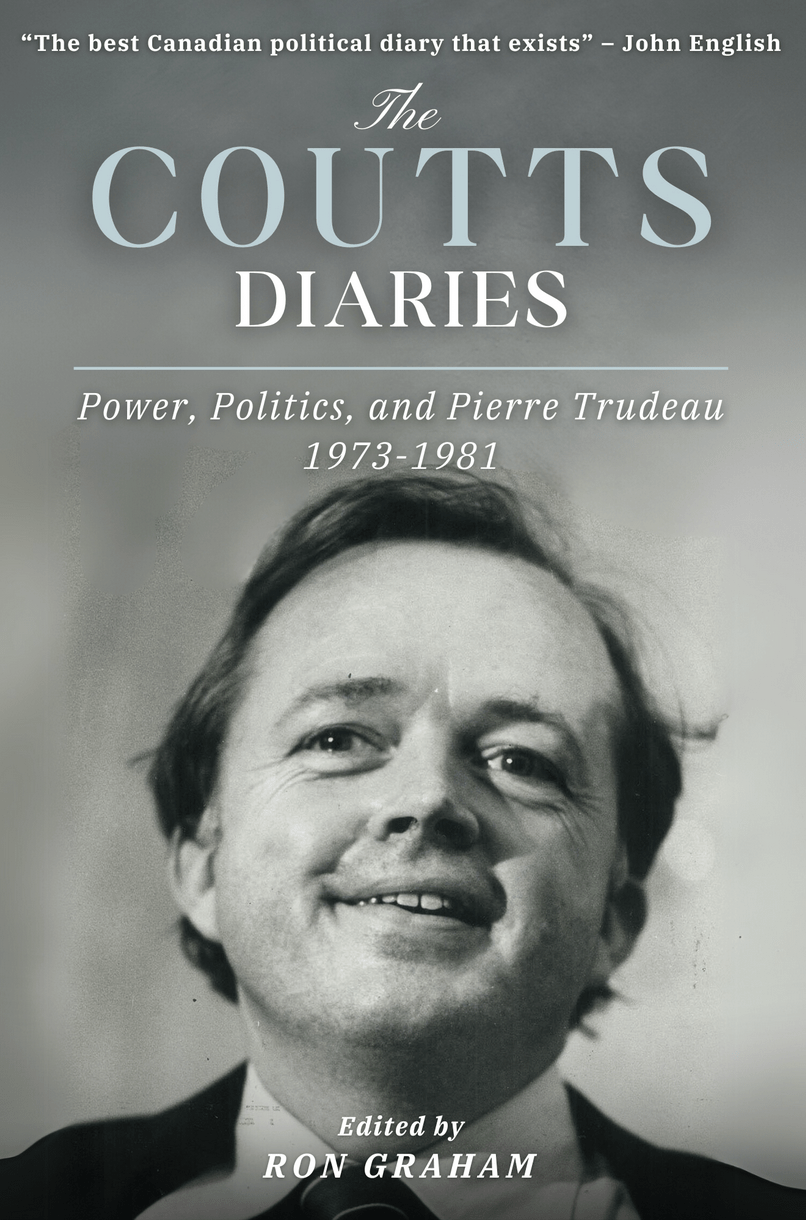
The Coutts Diaries: Power, Politics and Pierre Trudeau 1973–1981
Edited by Ron Graham
Sutherland House, 2025/463 pages
Reviewed by Thomas S. Axworthy
October 8, 2025
Oscar Wilde once quipped, “I never travel without my diary — one should always have something sensational to read on the train.” Virginia Woolf, writing in her diary in April 1919, called the practice a way of “snatching out the little note of truth … the diamonds in the dustheap.”
Together, these voices remind us that diaries mix the mundane with fragments of insight. On September 16, 2025, at Trinity College, University of Toronto, a large crowd gathered for the launch of the Coutts Diaries, masterfully edited by veteran journalist Ron Graham to uncover several “diamonds in the dustheap” of 1970s and 80s political history.
In those days, “Coutts and Davey”/”Davey and Coutts” were the two names most often on the lips of Liberals, national journalists and political junkies. Jim Coutts, the cherubic Liberal strategist born in High River, Alberta, and raised in nearby Nanton (where the Coutts Centre for Western Canadian Heritage lives on in his name) served as appointments secretary to Lester Pearson, advised Pierre Trudeau in the 1974 campaign, and became principal secretary to the Prime Minister in 1975.
As an adviser to two prime ministers, Coutts was present at the creation of the modern PMO, an institution now grown so powerful that many believe unelected personal advisers threaten the parliamentary system itself. Keith Davey, the legendary “Rainmaker” — the burly Ronnie Barker to Coutts’ more compact Ronnie Corbett — returned to prominence after Trudeau nearly lost the 1972 election, used his influence to bring Coutts onto Trudeau’s ’74 campaign plane. Coutts’ wit, experience, and energy soon made him indispensable. Davey left us his memoir in 1986; with Graham’s edition, we finally have Coutts’ take on those same years.
He had a gift for the telling anecdote, and the diaries especially sparkle with campaign mishaps told with wry humour.
The distinction between memoir and diary is important. Distinguished historians like John English and Margaret Macmillan, were present at the Trinity launch, and the point was made that memoirs are almost by definition self-promoting, but they are also reflective, adding context and interpretation. Diaries, by contrast, capture immediacy, raw emotion, and the atmosphere of the times. To paraphrase British historian Asa Briggs: never trust a memoir without a diary beside it; never trust a diary without a memoir to test it.
The launch itself was attended by many who knew Jim Coutts, some of whom—like Dorothy Davey, widow of Keith Davey and herself a formidable strategist—were cited in the diaries. On a panel organized to discuss the book from different perspectives, Alexandre Trudeau, only six years old at the time the diaries were kept, said reading them was “like being in my father’s kitchen.” Graham marveled that after days filled with meetings, travel, and crises, Coutts still had the discipline to record his impressions before bed.
In my own remarks, I noted that many entries reveal why Jim Coutts was such agreeable company. He had a gift for the telling anecdote, and the diaries especially sparkle with campaign mishaps told with wry humour. In Kamloops during the 1980 campaign, for example, local organizers added to an already tight schedule by inviting onstage an elderly man who claimed to be a long-lost relative of Trudeau. After shaking hands, the gentleman promptly collapsed and died.
Plans to fly on to Prince George were cancelled; staff and press scrambled for accommodation. I was able to add a little to Coutts’ telling of the story. Later that evening, Marjorie Nichols of The Vancouver Sun quipped she had already filed under the headline: “Trudeau speaks to 1,000 in Kamloops — 999 survive.”
 Tom Axworthy, Alexandre Trudeau, and Ron Graham at the Trinity College launch of The Coutts Diaries, September 16, 2025/Courtesy
At the center of the diaries stands Pierre Trudeau himself, and Coutts tells us much about this compelling man. In one early entry, when Coutts was just getting to know Trudeau at the start of the 1974 campaign, the diaries record Trudeau grumbling over a late-arriving speech draft, then reading it out flatly to an unimpressed crowd. What looked like irritation was, in fact, pedagogy: Trudeau was teaching Coutts and Davey that he could only be effective if given time to internalize a text and make it his own.
The Constitution was Trudeau’s “magnificent obsession,” as Christina McCall’s acclaimed biography put it, and the diaries confirm the point. Agricultural or economic briefings left him cold (“hard for me to get excited over rapeseed prices,” he sighs), but he came alive when speaking of rights and federalism. The diaries show that after his separation from Margaret, Trudeau seriously considered resignation.
He was persuaded to run again in 1979 only when his team agreed he could emphasize constitutional reform alongside the economy, then the public’s main concern. And when Trudeau resigned the Liberal leadership after losing the election, it was Coutts, more than anyone, who persuaded him to return once the minority Conservative government fell in a confidence vote, leading to the 1980 election.
The Week of December 13-18, 1979, was one of the most memorable in the history of Canadian politics: the Diaries revelations on that week tell us much about Pierre Trudeau and Jim Coutts. Trudeau was a supreme rationalist; he never felt comfortable with a big decision unless it had been examined from every side. Caucus and the party executive had both asked him to lead the party into the election but still, he wavered.
When Trudeau resigned the Liberal leadership after losing the 1979 election, it was Coutts, more than anyone, who persuaded him to return.
Coutts asks himself to what extent was PET acting over the entire weekend and to what extent did he know from the very beginning that he had to run…The clue was when he said, “Keep talking, make me change my mind”. It was a near-run thing. As I watched Trudeau’s press conference the morning of his announcement, it was not until Trudeau pulled out a longer speech draft that I knew Coutts had succeeded in his mission. Had his father not changed his mind about running, as Alexandre Trudeau noted at Trinity, he, and Canadians, would have been denied the singular achievement of the Charter of Rights and Freedoms.
The resurrection of Pierre Trudeau was high drama, but the Coutts Diaries also reveal how grinding politics can be. Max Weber described politics as “The strong and slow boring of hard boards,” and Coutts was boring away constantly — corralling ministers, caucus, bureaucrats, and the party executive (Graham’s editorial notes helpfully sketch the many actors of the time). Coutts loved the very things about politics that Trudeau did not — the tactical gamesmanship, the favour-trading, the back-slapping banter — and his mastery of those political arts left his boss free to focus on the less tactile, more intellectual elements of his agenda. Pierre Trudeau didn’t have to be an extrovert — he had Jim Coutts.
To crib WH Auden’s description of the 1930’s, the 1970s were, for Liberals, a low dishonest decade: stagflation, wage and price controls, the Parti Québécois victory, and Trudeau’s public marital breakdown. Yet through this turmoil, Coutts produced strategy after strategy, wheeling and dealing, persuading and energizing. One striking revelation is his weekly meetings in Toronto with senior figures from Bill Davis’s Conservative government. Those patient coalition-building sessions paid dividends when the Davis government proved crucial to the patriation of the Constitution in 1981.
This slow, brick-by-brick building of coalitions within Cabinet, caucus, bureaucracy, the private sector, and the provinces was a very different process from writing flights of rhetoric on the campaign trail. The Trudeau campaign of 1974, guided by Coutts, raised great expectations. The subsequent government, buffeted by external events, still guided by Coutts, found them difficult to fulfill. Citizens in 1975 quickly grew impatient for results; Canadians in 2025, whipped up by social media, are even more impatient. The Carney government, if it is to be successful, should learn from the Coutts Diaries that the slow boring of multiple hard boards is not enough. It must produce some early wins.
Politics, however, often ends in tears. So it proved for Jim Coutts. Early in the diary, he and Davey muse about his eventual entry into elected politics. In the summer of 1981, a Toronto byelection was engineered to at last give him his chance. He lost by 214 votes. He never once complained to me about the sudden end of his political aspirations. But the single most poignant line in the diary is its last notation, on July 31, 1981, capturing Coutts’ irrepressible optimism as he campaigned on College and Dundas streets: “It couldn’t have been a better day.”
Policy Contributing Writer Thomas S Axworthy is Public Policy Chair at Massey College, University of Toronto. He was recruited by Jim Coutts to join the PMO in 1975 and succeeded him as Principal Secretary to Prime Minister Pierre Trudeau in 1981.