
The Un-Trumpable Wisdom of the Norwegian Nobel Committee
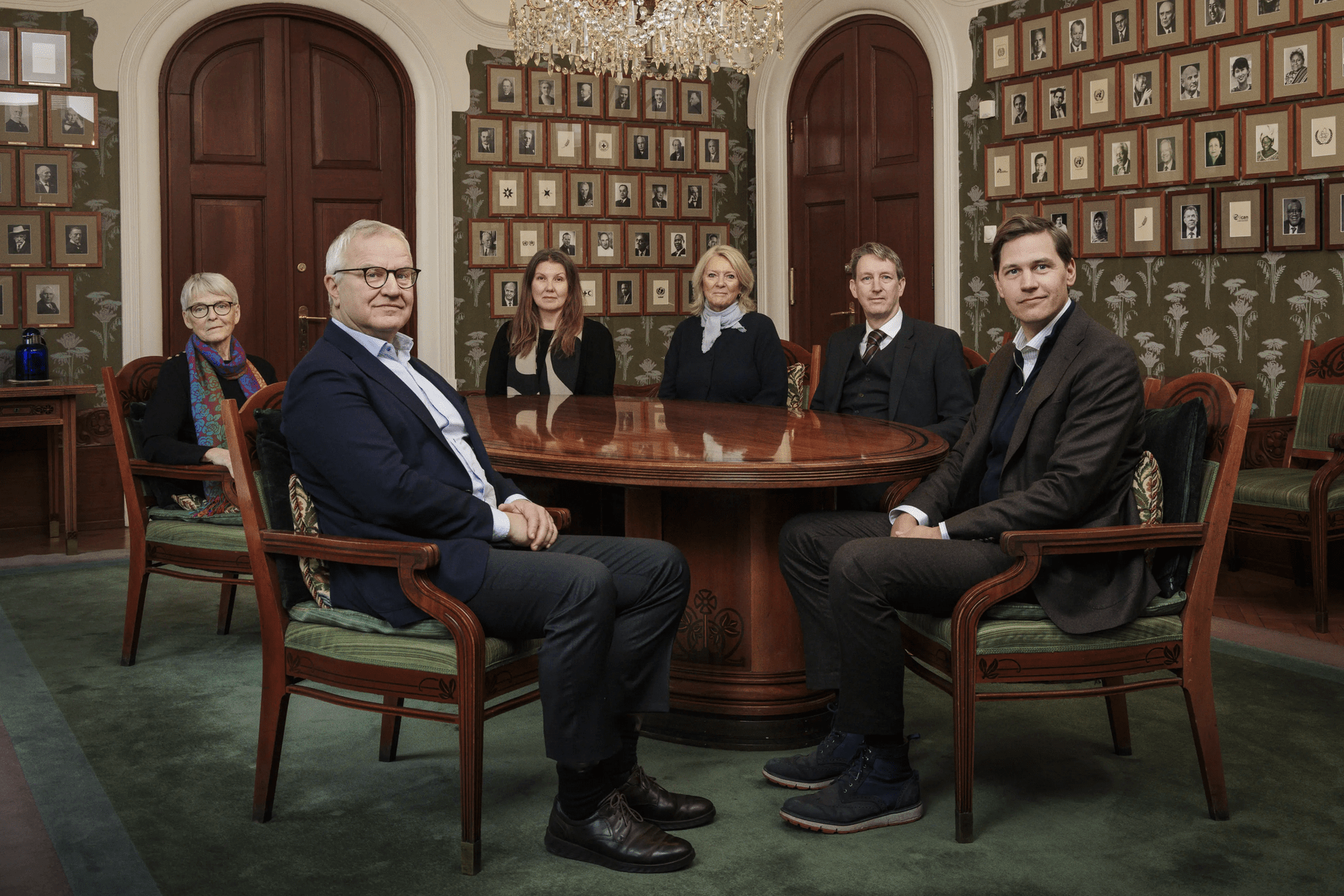 The Norwegian Nobel Committee, 2025. From left: Anne Enger, Kristian Berg Harpviken (secretary), Gry Larsen, Kristin Clemet, Asle Toje (vice chair) og Jørgen Watne Frydnes (chair). © Nobel Prize Outreach/Geir Anders Rybakken Ørslien.
By Jeremy Kinsman
October 11, 2025
It was a huge improbability all along. Donald Trump’s lobbying aside, the principal obstacle to his being awarded the 2025 Nobel Peace Prize was the fact that it was bestowed in recognition for contributions to peace during 2024.
Trump’s repeated incantation of the “wars” he has “ended” since taking office in January wouldn’t count for the five-member Norwegian Nobel Committee (mostly former members of the Storting, or Norwegian Parliament) plus a secretary/chair who sifted through the pile of unsolicited nominations — 338 this year — to pick a recipient.
“This committee sits in a room filled with the portraits of all laureates and that room is filled with both courage and integrity,” Chair Jørgen Watne Frydnes said Friday in response to questions about the committee’s choice. “So we base our decision on the work and the will of Alfred Nobel.”
Indeed, the 2025 laureate, charismatic Venezuelan democrat and civil society leader Maria Corina Machado, cited for her “civilian courage” in leading a long struggle for democracy in a country locked down by authoritarian rule, is truly representative of Nobel preoccupations today.
But since the horrific attack by Hamas of October 7, 2023, in Israel, and the subsequent onslaught by the IDF in Gaza, every objective observer has known that only unequivocal pressure from the President of the United States would bring a halt to the immediate violence. In the end, Trump delivered on the apparent ceasefire in Gaza what President Biden could not (in part because, as a widely accepted element of the Israel-US bilateral relationship, Netanyahu was not going to grant the political victory of a ceasefire to anyone but Trump).
In the convergence of narrative elements that produced a breakthrough in Sharm el-Sheikh this week, Trump evidently convinced Netanyahu to halt the IDF attacks, and convinced Hamas they had to agree to the first phase of a peace plan that called for release of hostages. It deserves loud applause.
The diplomacy was enormously complicated. Tom Friedman of the New York Times reached into billiards for his metaphorical description of it as a “geopolitical bank shot that had to bounce off Israel, Hamas, Qatar, Turkey, the Palestinian Authority, Saudi Arabia, Egypt, and the United Arab Emirates.”
There have been four Nobel Peace Prizes awarded for contributions to Mideast peace: American diplomat Ralph Bunche in 1950, for his mediation of the ceasefire between Israelis and Palestinians that ended the 1948 war over the declaration of the state of Israel; Lester Pearson in 1957 for diplomatic leadership in resolving the Suez crisis by the device of a UN peacekeeping force; Anwar Sadat and Menachem Begin in 1978 for establishing peace between Israel and Egypt brokered in part by US President Jimmy Carter; and Yasir Arafat, Yitzhak Rabin and Shimon Peres in 1994 for signing the Oslo I Accord, brokered by Bill Clinton.
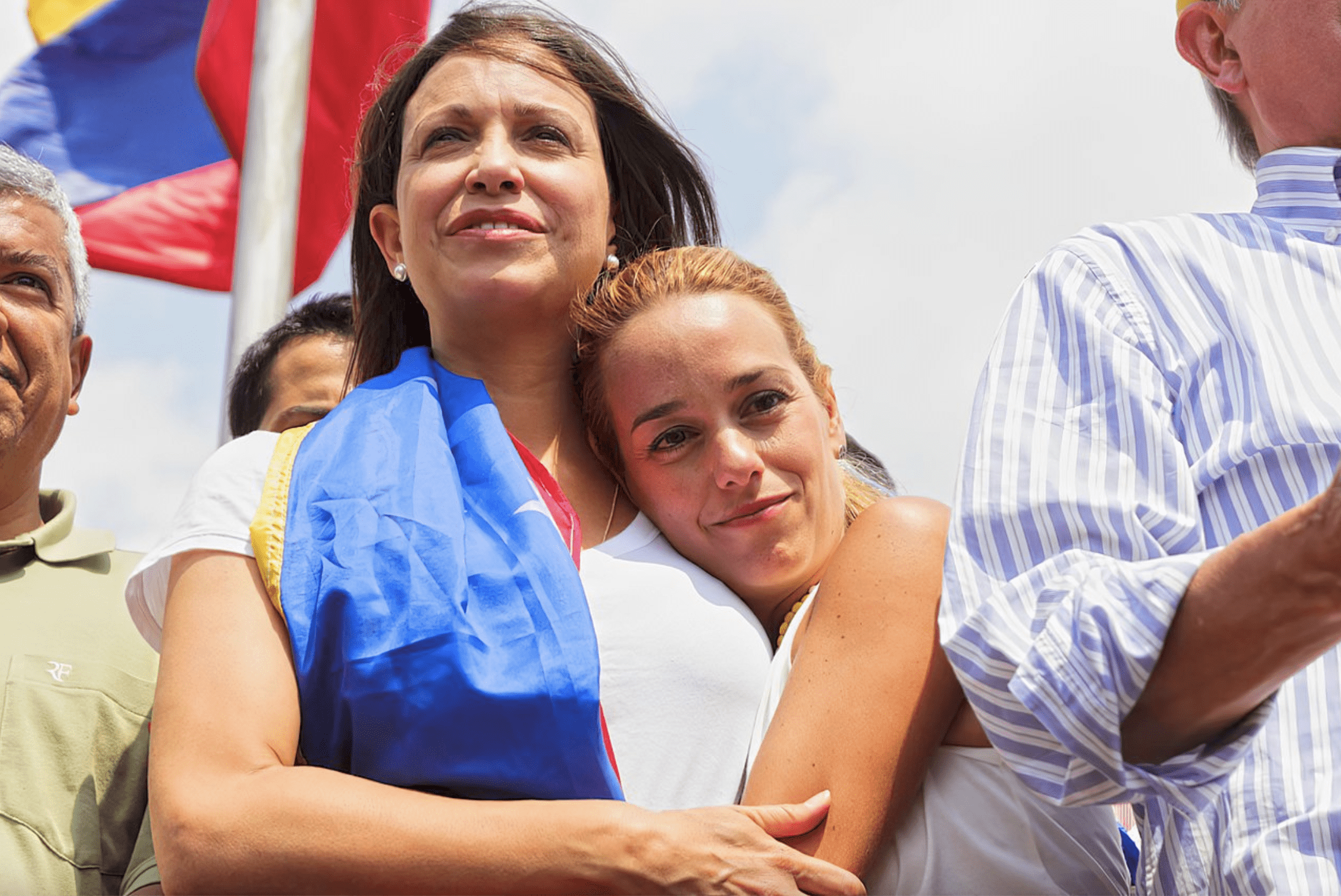 Nobel Peace laureate Maria Corina Machado with Lilian Tintori, wife of opposition leader Leopoldo Lopez, in 2014/Daga 95
Over the last half-century, the Nobel Committee has added a growing rhetorical emphasis on nonviolent resistance to authoritarian repression of civil liberties. Since dictators in this century have chosen to use the same brutal handbook of utmost repression to put down the Arab Spring after 2011 and dissidence in Russia, Belarus, Venezuela, Myanmar, Iran, Hong Kong and elsewhere, the Committee has taken a strong stand against authoritarianism.
Given Trump’s vindictive and divisive rampage against civil liberties in the United States itself, he’s likely already disqualified himself for 2026.
The 2025 recipient was surely not a compromise candidate. A longtime opponent of the dictatorial Chavez-Maduro regime, Machado was barred from running herself in 2024 but was the dynamic force in mobilizing Venezuelans to vote for democracy and democrat Edmundo González. Nicolas Maduro refused to accept the results.
Machado is now in hiding somewhere in Venezuela. Five of her predecessors as laureates were actually in prison. Two women remain there, Daw Aung San Suu Kyi (1991), and Iranian Narges Mohammedi (2023).
A scan of the laureates since 1901 reflects the hopes and disappointments of humanity, across the scourges and threats of the times…wars, disarmament, apartheid, and more recently climate change.
For 125 years, except for the years of world war and a few others where presumably the committee couldn’t reach a decision, the Peace Prize has gone mostly to individuals (112). Many winners since 1901 were deserving national leaders. But individuals recognized in recent decades have been lesser-known people doing vital work, reflecting the advent of civil society as a force in democracy. The last global leader to win the Nobel Peace Prize was President Obama in 2009, which seems to be a big part of Trump’s obsession with winning it himself. In political terms, a Nobel Peace Prize is the ultimate gong, to borrow the military slang for medal.
There has been a recent catch-up recognition of the contribution of women fighting for equity and inclusion, notably in the lists of past Nobel winners. But the predominant emphasis has been on resistance to the compression of civil liberties.
The list of groups and organizations advocating for peace, freedoms, humanitarian support, and international cooperation include: Amnesty International (1977); Office of the UN High Commissioner for refugees (1981); the Pugwash Conferences on Science and World Affairs – Canada (1985); UN peacekeepers (1988); the International Committee to Ban Landmines (1997); Medecins Sans Frontieres (1999); the UN itself and Kofi Annan (2001); the IAEA (2005); the International Panel on Climate Change, and Al Gore (2007); the EU (2012); the Organisation for the Prohibition of Chemical Weapons (2013); the International Campaign to Abolish Nuclear Weapons (2017); the World Food Programme (2020); Memorial (2021); and the Centre for Civil Liberties (2022).
Donald Trump’s policies and budgetary slashes have hurt just about every cause on that list.
Policy Contributing Writer Jeremy Kinsman served as Canada’s ambassador to Russia, high commissioner to the UK, ambassador to Italy and ambassador to the European Union. He also served as minister at the Canadian embassy in Washington. He is a Distinguished Fellow of the Canadian International Council.