
Seven Guiding Principles for a Canada-China Reset

The following is the text of remarks made by Thomas d’Aquino at the Symposium on China-Canada Relations on October 24, 2025 at the Embassy of China in Ottawa.
Ambassador Wang Di, thank you for this kind invitation
Good morning, ladies and gentlemen
What a pleasure to be in such distinguished company. My mission this morning is to lay out some key principles aimed at resetting the Canada-China relationship. But first, let me offer you a brief outline of what I call my China journey.
On October 13, 1970, fifty-five years ago this month, Ottawa and Beijing announced the establishment of diplomatic relations between Canada and the People’s Republic of China. Canada was among the first Western nations to do so. At the time, I was serving as a young speechwriter on the staff of Prime Minister Pierre Trudeau. Thus began my China journey — a faraway country revealed to me as a child through the adventures of 13th century explorer Marco Polo to the court of the great Kublai Khan.
As I look back over the decades since 1970, highlights of my China journey are vividly etched in my mind.
- Early travels to the “Middle Kingdom” exploring China’s history and geography.
- Leading the first Canadian CEO missions to China in the 1980s as head of what today is known as the Business Council of Canada.
- Participating in the first of the Team Canada missions to China led by Prime Minister Chrétien.
- Attending groundbreaking meetings of the Canada-China Business Council in China including meetings in the Great Hall of the People with Premier Zhu Rongji.
- As Chair of the inaugural APEC CEO Summit in Vancouver in 1997, meeting privately with President Jiang Zemin and listening in awe as he recited to me the Gettysburg Address.
- Attending the historic handover ceremonies of Hong Kong to China.
- Visits to China as a director of Manulife, Canada’s largest corporate investor in China.
- Attending the Beijing Olympics in 2008 and the Shanghai World’s Fair in 2010 — epic events.
- Presenting the keynote address to the 2009 meeting of the Mayor of Shanghai’s International Business Leaders Advisory Council during the global financial crisis.
- Over the years, visiting historic sites, museums and centres of artistic excellence throughout China and building my China collection of art and artifacts.
- And not to be forgotten, my stays in the restored house of a Canadian friend at the village of Mutianyu north of Beijing overlooking the Great Wall.
My interest in China in the last decade and a half has not subsided. China has continued to make massive strides in economic development and innovation and has raised the prosperity of the Chinese people to levels that were unimaginable in past decades. Canada, too, has made solid progress and remains one of the most admired countries in the world. But while Canada and China two-way trade and investment have attained respectable levels, our relationship at the political level has suffered. And both countries have paid a price.
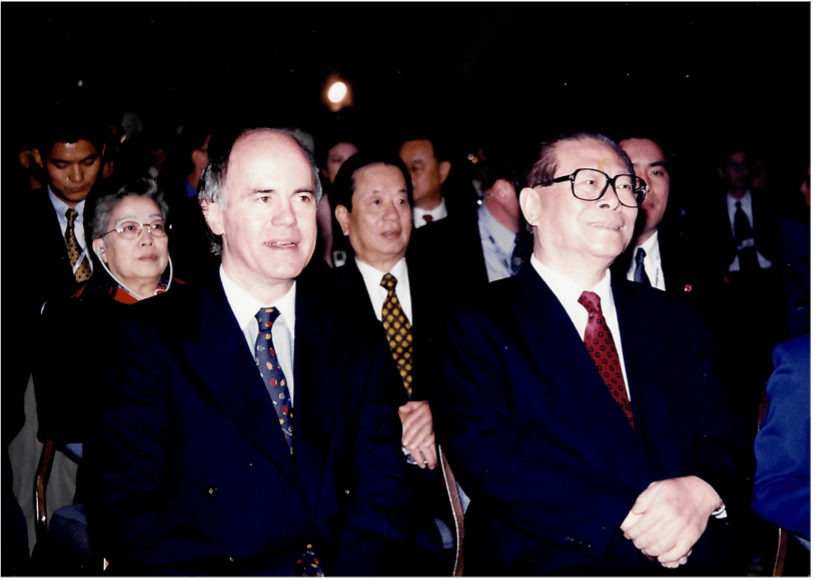 Thomas d’Aquino with President Jiang Zemin at the APEC CEO Summit in 1997/Courtesy
This is a huge disappointment for me and no doubt to citizens in both countries who expected better — much better. I do not have the time to analyze the reasons for this failure. You in this room know them all too well and I expect would agree with me that there is fault on both sides. Clearly, the relationship is in need of a thoughtful reset based on mutual respect and a frank and clear-eyed pragmatism.
Let me offer what in my view are the seven guiding principles of a reset.
- We must aspire to rebuild our relationship, drawing on decades of positive achievements. And make no mistake, there are many in the political, economic and cultural domains. Importantly, we are not strangers to one another. Rather we are partners who have suffered an estrangement due to misunderstandings, miscalculations, and at times, clumsy and insensitive diplomacy. The time to fix this is overdue.
- We must see each other plainly for what we are, not what we would wish for. We possess two very different systems of governance supported by our respective peoples. We view democracy through different prisms. Our economic models are different. Our foreign policies are at odds, in particular in the matter of Russian aggression in Ukraine. But a true reset still finds room for common ground.
- Reciprocal economic benefits through the growth of trade and investment offer the greatest promise, especially in the domains of agriculture and agri-food, energy and minerals, forestry, clean technologies, health and financial services. Here our respective private sectors need to put our shoulders to the wheel and build momentum. Our governments can pave the way. But it’s up to traders, investors, and innovators to deliver results. But on one crucial economic issue, we must accept reality. China’s economic model and massive advantage over Canada in population size and state subsidized manufacturing necessitate that certain strategic sectors in Canada must be protected. In other words, managed trade rather than free trade, regulated investment rather than open investment. China, in its own right, is no stranger to these policies. Chinese understanding of Canada’s position is critical to moving forward.
- Guiding this mutual outreach must be a clearly defined, reciprocal acceptance of so-called “red lines”. Authorities in both our countries have told me they favour zero-tolerance for meddling in each other’s internal affairs. And so it should be. From a Canadian perspective, this means an end to cyberespionage, an end to intimidation of citizens of Chinese origin living in Canada, and an end to the unlawful appropriation of intellectual property.
- The reset in my view will have greater chance of success if negotiated under the umbrella of a comprehensive framework. This, after all was what the Canada-China Strategic Partnership of 2005 was meant to address, covering political dialogue, economic collaboration and social and environmental cooperation. Within such a framework, clear goals and progress targets are essential. Dispute avoidance and dispute-settlement protocols must also play a critical role so that we never again tumble unwittingly into a corrosive, tit-for-tat downward spiral.
- The reset must take into account the realities of the Canada-United States relationship. While Canada and the U.S. have deep historical, economic and defence ties, it would be a mistake for China to assume that Canada is an unquestioning vassal of America. The stance of the Carney government, fortified by public opinion, makes it abundantly clear that Canada values its sovereignty and independence above all else. This offers room for Canada to pursue its own international economic and foreign policy. The Carney government is wisely pursuing a strategy of diversification. This week, Prime Minister Carney pledged to double Canada’s non-U.S. exports over the next decade, an ambitious move I strongly support. Here, no doubt, there will be plenty of opportunities for Canada and China to explore.
- Finally, and most importantly, a Canada-China reset strategy must rely on trust, goodwill and understanding at the highest political levels. The recent meeting at the United Nations in New York of Prime Minister Carney and Premier Li Quiang was a promising start. And I am pleased that the visit of Foreign Minister Anand to China last week was productive. I hope that this leads to a visit of the Prime Minister to China in the not-to-distant future and to the laying of a strong new foundation for the reset. In the meantime, our two countries are mired in a severely damaging tariff dispute which cries out for resolution. We have work to do. Time is of the essence.
Policy Contributing Writer Thomas d’Aquino is an entrepreneur, corporate director, author, philanthropist and a member of the Order of Canada. He is the Founding CEO of the Business Council of Canada, Chairman of Thomas d’Aquino Capital and author of the national best-selling Private Power Public Purpose: Adventures in Business, Politics and the Arts.