
Budget 2025: Generational Investments Require Generational Scrutiny
 Shutterstock
Kevin Page and Lesley Burns
October 29, 2025
Budget 2025 will be tabled in Parliament on November 4, 2025. Expectations are high. In his pre-budget speech of October 22nd, Prime Minister Mark Carney said we need generational investments to meet this hinge moment in Canadian history.
Generational investments require generational scrutiny. Winston Churchill said, “however beautiful the strategy, you should occasionally look at the results”. To build confidence and trust, citizens need to be assured that their government oversight systems will be ready to meet the moment.
Chart 1
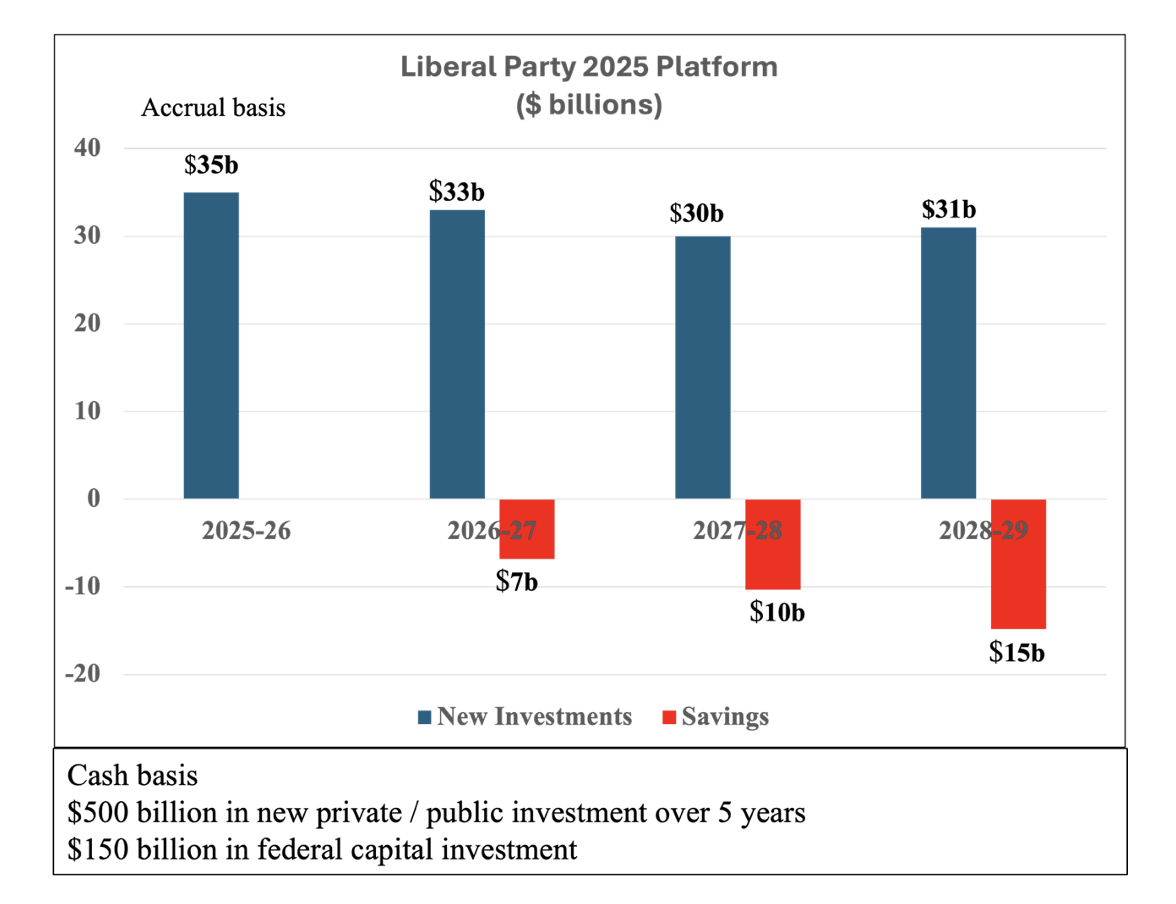
The Liberal Party platform included large spending commitments, offset in part by spending reallocations (Chart 1). Annual planned increments in new spending exceed $30 billion. In a $3 trillion economy, we are effectively adding a full percentage point of GDP of new government spending on an ongoing basis. To put this spending into perspective, in recent budgets, we have seen this amount of new spending over a five-year period, not over one year.
The mix of new spending is shifting sharply toward capital investment to promote economic growth through trade diversification, innovation, and national security.
Over the five-year planning period, spending on a cash basis for capital investment will exceed operational spending (transfers, operations) by a 2-to-1 ratio. The Liberal platform indicated that with the private sector contribution (a 3.5 to 1 private to public ratio), we could see $500 billion increase in investment over the next five years. That is significant for a $3 trillion economy that has seen business capital investment flatline in recent years. The magnitudes are indeed generational.
Chart 2
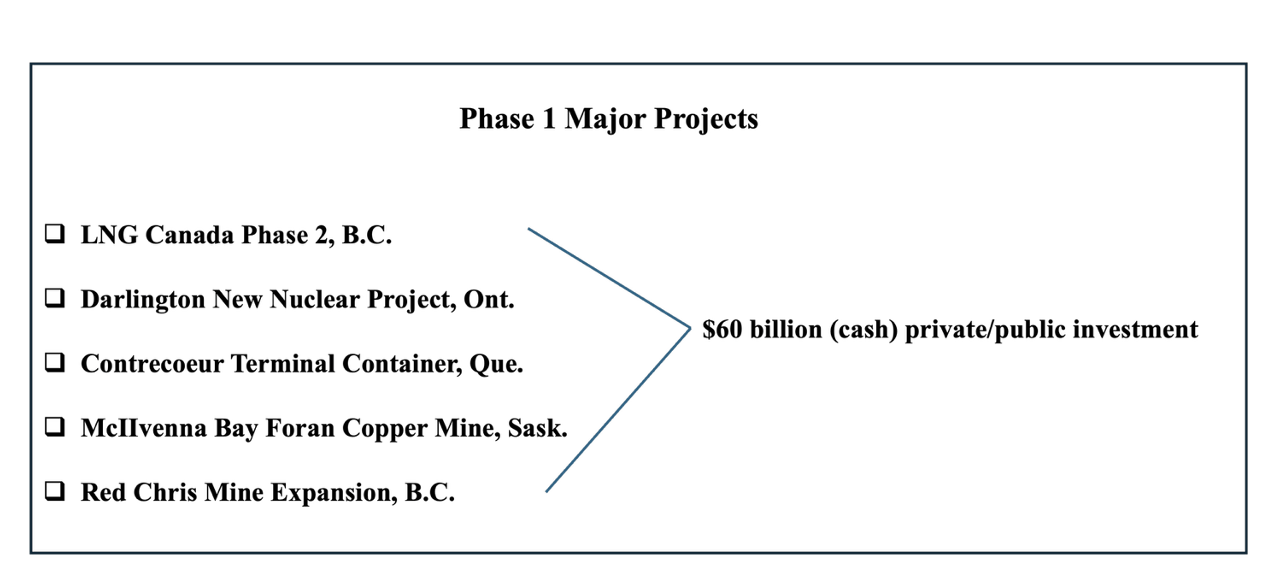
The Government has launched work on the first phase of capital investments (Chart 2). It has highlighted five projects focusing on energy and mining. The government estimates that private and public investment in these five projects could add $60 billion to total investment.
Will Canada’s legislative oversight systems (federal, provincial, and municipal) —from the scrutiny of new spending authorities by elected representatives to the review of spending and performance by public accounts committees — be ready and resourced for this moment?
Recent changes announced by the federal government are positive. A fall budget as opposed to a spring budget will promote better implementation of budget measures by departments for the next fiscal year. It also allows better alignment between the budget and the Main Estimates, greater transparency, and easier oversight by parliamentarians. A new, bifurcated operating and capital budgeting planning and reporting system to increase transparency on new capital investments and the implementation of new budget rules and targets that will limit deficit spending to capital investments.
The major projects listed above involve multi-level government collaboration, including First Nations and federal, provincial, and/or municipal governments. We are inspired by the federal government’s recent support for improved professional development for members of public accounts committees (PACs) across the country. The oversight work PACs do is unique and critical to effective, accountable, transparent government. Oversight work will become even more complex, and committees must ensure they have access to information, analysis, and experts who provide non-partisan support to meet their mandate.
Special processes exist for federal agents of Parliament, including the Office of the Auditor General and the Parliamentary Budget Officer, to submit budget plans and requests to the government. Parliament will need to ensure that the offices they rely on are appropriately resourced and ready to meet new demands, particularly in light of the new focus on capital investment.
On paper and, largely, in practice, Canada has robust legislative and internal audit procedures. Audits provide non-partisan, fact-based information intended to improve outcomes for Canadians.
Canada should strengthen the system that enforces audit recommendations—no better time than the present. The government can strengthen the system by ensuring that PACs —responsible for reviewing audit reports referred by Parliament—have the knowledge, resources, and incentives to act effectively. Their work is about to increase and get more complicated with large capital investment projects.
It also means working collaboratively with non-partisan senior public servants to support the implementation of recommendations from audit reports. In these new generational capital investment budgets, will governments (federal, provincial, and municipal) commit to a culture of transparency (documents) and openness (discourse between elected representatives and officials)?
The federal, provincial, and territorial governments have all undertaken large infrastructure projects in the past, and many have been the subject of audits. Not all have received the same level of oversight by PACs, and not all have strong track records of having recommendations implemented. This lack of consistency in oversight and implementation standards has resulted in inefficiencies, misspending, and unmet objectives that waste money and reduce trust in government.
We owe it to our fellow citizens to make sure their tax dollars are spent responsibly. We need to learn lessons identified in audits of past major projects—and couple increased investment with adequate scrutiny. While all orders of government are under pressure to do more with less, investment in audit delivers a strong return. Vancouver reports about $3 for every $1 spent on an auditor general, and Toronto as much as $11 for every $1.
The future of effective government spending in this hinge moment depends on Parliament, auditors, and senior public officials working together to uphold accountable government.
Kevin Page is the President of the Institute of Fiscal Studies and Democracy (IFSD) at the University of Ottawa, former Parliamentary Budget Officer and a Contributing Writer for Policy Magazine.
Lesley Burns is the Vice President for Oversight and Professional Development at the Canadian Audit and Accountability Foundation (CAAF), which supports public accounts committees in Canada and abroad.