
How Canada’s Prime Ministers Shaped its Identity
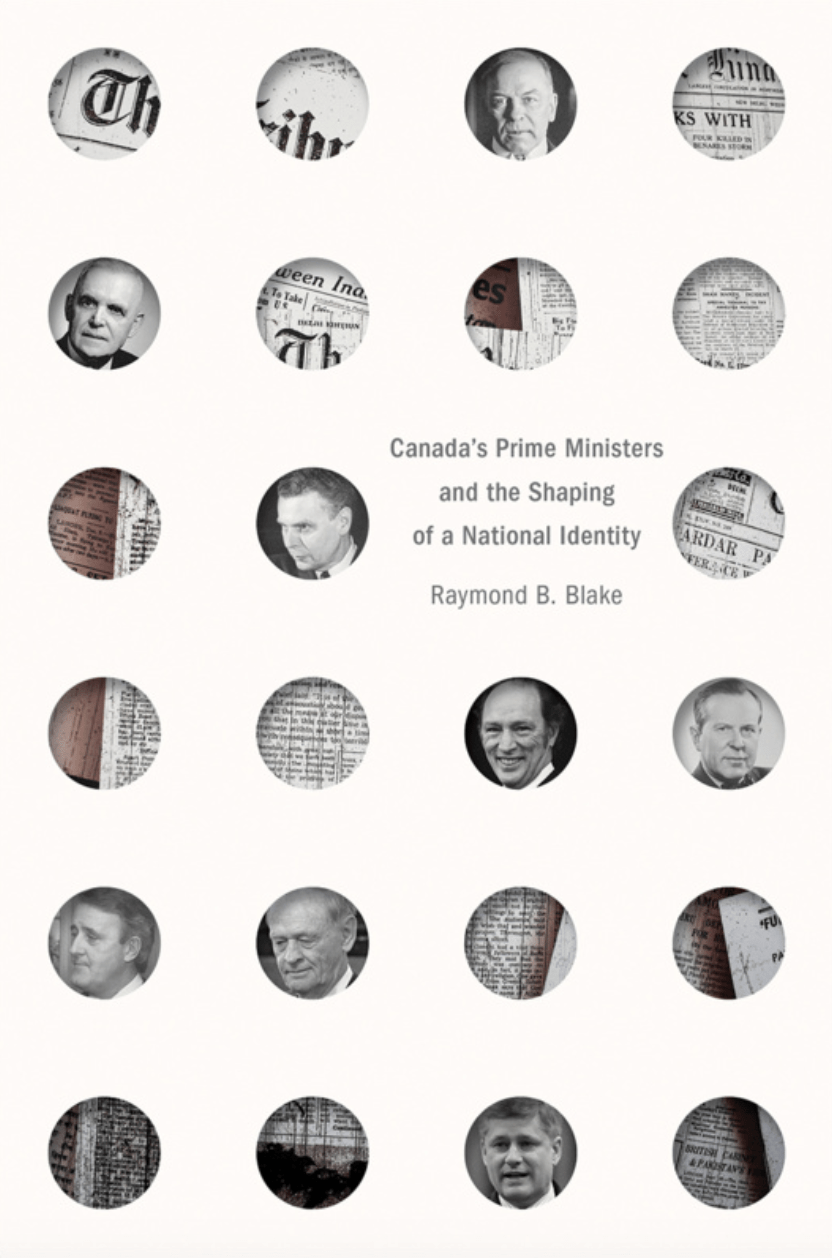
Canada’s Prime Ministers and the Shaping of a National Identity
By Raymond B. Blake
UBC Press, November 2025/414 pages
Reviewed by Colin Robertson
November 2, 2025
When it comes to defining what it means to be Canadian, leaders matter and so do their words. The most successful Canadian prime ministers have been as much storytellers as statesmen, especially those who adapted to master the medium of their time.
In Canada’s Prime Ministers and the Shaping of a National Identity, historian Raymond Blake draws on speeches, debates, writings, and offhand remarks to present a compelling argument about how our prime ministers — from Mackenzie King to Justin Trudeau — imagined, narrated, and projected their sense of Canada to the nation and the world.
For Mackenzie King and St. Laurent, the medium was radio and parliamentary speeches. Relationships with the media were almost fraternal. With the advent of television, personal style mattered and this worked to the advantage of Pierre Trudeau who was charismatic, good with the quick quip and projected a dynamic image. Today, social media has become the preferred platform for policy announcements, delivered online and in an almost telegraphic style. Whether this makes for coherent storytelling is questionable.
Winner of the 2025 Shaughnessy Cohen Prize for Political Writing, this volume by Raymond Blake provides yet another distinguished addition to the splendid C.D. Howe Series in Canadian Political History.
Blake opens with a reflection on the power of stories in shaping collective identity. “Crucial in communicating the ideas that are necessary for holding a nation together,” he writes, “stories provide citizens with meaning, allowing a type of self-identification.”
In the absence of a “common religion, language, and ethnicity,” Blake argues that Canadian unity rests on a “civic ideology” that must be “continually recreated and reinforced”. We look to our prime ministers to craft a story embracing regional, linguistic, and cultural differences sufficiently coherent to foster belonging.
For a country that is still nation-building, the challenge is perennial. “New national narratives and identities,” writes Blake, “are usually forged during periods of crisis, such as war, or to meet the challenge of some present or impending peril.” Unlike older, more homogeneous nations, the Canadian story must constantly be renegotiated as Blake explains in his chapters on our longer-serving prime ministers.
After witnessing depression and war, William Lyon Mackenzie King, our longest serving prime minister, sought “unity… to create a sense of belonging”. King asked Canadians “to accept a new relationship” with the state, offering social security, a citizenship act and constitutional reform. King recognized that “more robust engagement in world affairs” served the national interest.
King’s cautious transformation of Canada’s self-image was accelerated by Louis St. Laurent, who strengthened the political consensus around health and welfare, erecting the social security state. St. Laurent was a committed internationalist, aligning Canada with the Western alliance to “keep the evil communists at bay.”
For King and St. Laurent, says Blake, the story of Canada was about the “conjoining of two founding peoples”. Only gradually would they become three with the recognition of our Indigenous heritage. This recognition ran parallel with the postwar migration transforming Canada into a multicultural and pluralistic nation, internationally engaged, and defined by civic rather than ethnic identity.
Colin Robertson’s interview with Raymond Blake/CGAI
For John Diefenbaker, the key theme was independence from the United States. Diefenbaker’s “One Canada” reached beyond the traditional duality to include Indigenous people as well as to those previously considered “hyphenated Canadians”. His Canadian Bill of Rights and emphasis on individual freedom were arguably both nationalist and universalist.
Lester B. ’Mike’ Pearson called on Canadians to accept a bilingual and bicultural sovereign Canada expressed through the Maple Leaf flag, Medicare, and active multilateralism in world affairs as a mediator and peacekeeper. Pearson applied both hard and soft power to support “peace, order, unity, and stability”.
Pierre Trudeau gave Canadians a patriated constitution, including the Charter of Rights and Freedoms. Multiculturalism became official policy because Trudeau, “saw virtue in preserving ethnic differences and in the entrenchment of rights and freedoms, especially for minorities.” But, says Blake, his treatment of indigenous people was, “a policy failure of colossal proportions” and “a lost opportunity for reconciliation” while his rational, universalist vision alienated Quebec nationalists and Western populists, intensifying the divisions he sought to overcome. Trudeau’s was a unity, says Blake, built on law and reason, but at times tone-deaf to emotion and belonging.
Brian Mulroney embraced continentalism, globalism, and a market-driven economy. It meant developing a new national consensus around federalism, economic rationalization, globalization, and financial deregulation. Mulroney sought to position Canada as a mature trading nation and moral voice on apartheid and the environment. He persevered, despite deep divisions on free trade that were only decided with the 1988 election.
For Jean Chrétien, it was initially about avoiding a bailout from the IMF while contending with both resurgent separatism in Quebec and Western populism. Chrétien’s instinct was to avoid the notion of distinct societies and a decentralized federation. His was a pragmatic nationalism rooted in domestic stability and social cohesion. He balanced fiscal discipline with international engagement—joining NATO interventions in the Balkans, leading landmine and debt-relief initiatives, and opposing the Iraq War.
Stephen Harper did not dismantle what Liberal and Progressive Conservative prime ministers had achieved since the 1940s. Instead, he shifted from what he saw as an unhealthy fixation on the rights of citizenship, rather than its responsibilities. Fusing patriotism with pragmatism, writes Blake, Harper sought to “reclaim for Canadians a sense of their own history” that reinforced sovereignty in the Arctic and respect for our military history with less emphasis on multilateralism. He apologized for past treatment of Indigenous peoples.
Justin Trudeau, writes Blake, reemphasized diversity and reconciliation, making Indigenous history central to his rhetoric. Yet his claim that Canada has “no core identity” and is a “post-national state” rang hollow and did not jibe with the views of his father and other predecessors. Progressive, inclusive, and cosmopolitan he aimed to portray Canada as a champion of pluralism, but Blake asks: can a nation without a core still act meaningfully in the world?
Blake identifies several recurring principal themes: national unity, social citizenship and inclusion, and Canada’s place in the world.
The cumulative effect is a kind of moral patriotism — a belief that Canada’s legitimacy rests not on might or myth, but on fairness, decency, and diversity. From Mackenzie King’s social citizenship to St. Laurent’s liberal internationalism; from Diefenbaker’s One Canada to Trudeau’s Charter; from Harper’s history to Justin Trudeau’s pluralism; the story of Canada remains a conversation, not a creed.
Collectively, our prime ministers have fashioned an image of Canada as a modern, progressive, liberal state that embraces “the values of caring and sharing, equity and fairness for all”. But, warns Blake, unity is never automatic; it “takes effort to shape and mould just what is meant by the idea of Canada.”
For Canada to endure, our leaders must remind citizens that our country “makes a great deal of sense” not as a finished project, but as a shared story still being written, bult on compromise. And to which all must contribute.
Contributing Writer Colin Robertson, a former career diplomat, is a fellow of the Canadian Global Affairs Institute in Ottawa and host of the CGAI’s Global Exchange podcast. He is Policy’s principal global affairs book reviewer.