
Three Million Knocks: The Epic Ground Game of Zohran Mamdani
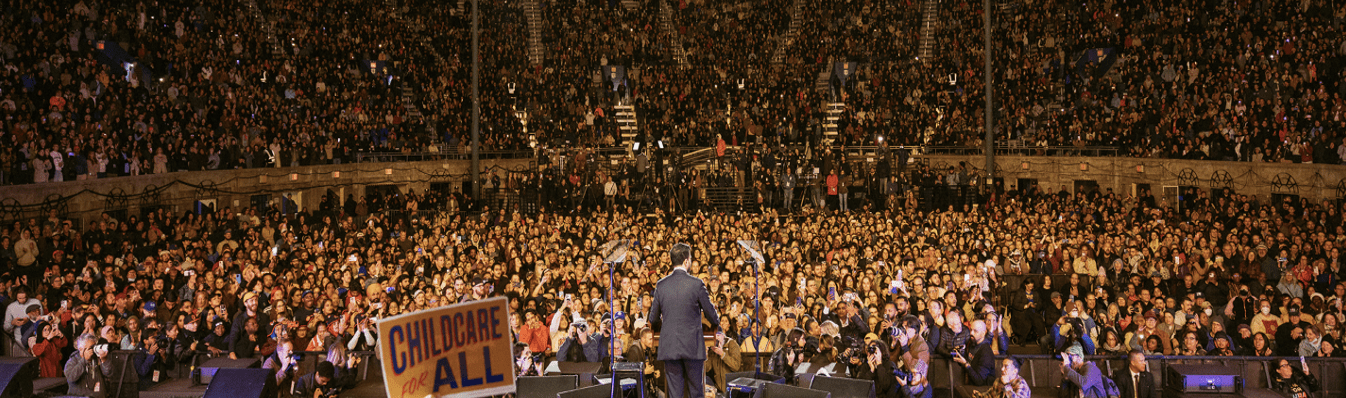 Zohran Mamdani at Brooklyn Paramount, November 4, 2025/Transition 2025
By Anil Wasif
November 5, 2025
“Together, we will usher in a generation of change. And if we embrace this brave new course, rather than fleeing from it, we can respond to oligarchy and authoritarianism with the strength it fears, not the appeasement it craves.”
November 4th victory speech by New York City Mayor-elect Zohran Mamdani.
If you were watching from a distance Tuesday night and were shocked by Zohran Mamdani’s victory in New York’s mayoralty election, it was only because you haven’t been listening.
Mamdani did something during his campaign that no other politician in America has done so effectively: he drew a straight line of cause-and-effect from Donald Trump’s tyrannical presidency to quality-of-life for the overwhelming majority of the people who live in the city that launched Trump’s career. In the process, Mamdani cast himself as the personification of relief.
Mamdani’s message was the political music. What it took to translate it into votes and victory was nothing short of formidable.
In a city facing record-high rents and stubborn food inflation, Mamdani’s message was aimed at bodega owners, line cooks, nurses, and taxi drivers, whom his campaign described as a working class being priced out of its beloved city. That message especially resonated with young New Yorkers, regardless of race, location or place of birth.
“These are hands that have never been allowed to hold power,” Mamdani, 34, declared in his victory speech Tuesday night, referencing the “callused” and “scarred” hands of workers. “Tonight, against all odds, we have grasped it.”
Mamdani’s victory, which will make him the city’s youngest mayor in over a century and its first Muslim-American leader, was the result of a two-pronged strategy. It combined a relentless, in-person ground game with a highly effective, at-times-annoying, social media operation, which together overcame a barrage of political attacks and a multimillion-dollar opposition campaign funded by some of America’s wealthiest billionaires.
The foundation of the effort was its volunteer operation. On Tuesday, the campaign announced that a volunteer had knocked on its 3,000,000th door. In his victory speech, Mamdani thanked the “more than 100,000 volunteers”—a figure that will now speak to one of the largest municipal field operations in modern history.
From the get-go, the operation was managed by field director Tascha Van Auken, a veteran organizer with experience on Barack Obama’s 2008 campaign and several key New York socialist victories. Van Auken described the strategy as a disciplined “leadership development model” that began last December. The campaign, she said, trained over 700 volunteer “field leads” to manage the influx of new recruits.
This army was coordinated using Solidarity Tech, a digital customer relationship management (CRM) platform originally designed for the labor movement to organize rideshare drivers. The system, according to campaign reports, proved highly effective at converting “viral attention into volunteer action.” When a user engaged with a video, the software funneled them to a sign-up page and automated the follow-up texts and calendar invites, freeing human organizers to focus on training and in-person engagement.
That viral attention was the campaign’s second front. Mamdani’s social media feed functioned as a non-stop policy-and-personality blitz. He explained his signature rent-freeze proposal while plunging into the freezing Coney Island water in a $30 thrift-store suit. He coined the term “halalflation” in a 90-second video while eating chicken over rice from a street cart. In it, vendors explained they were on a years-long waitlist for a $400 city permit, forcing them to pay upwards of $22,000 to “a random guy” on the black market.
When he hit the city’s fundraising cap, Mamdani posted a playful video imploring donors to ‘stop sending us money,’ signaling the strength of his small-dollar base.
Other videos showed him explaining ranked-choice voting in Hindi using cups of mango lassi or conducting earnest, on-the-street interviews with Trump voters on Hillside Ave. in Queens and Fordham Road in the Bronx. This digital-to-field pipeline proved potent. A briefing with 70 online “Creators for Zohran” reportedly blasted his message to 80 million followers. When he hit the city’s fundraising cap, Mamdani posted a playful video imploring donors to “stop sending us money,” signaling the strength of his small-dollar base.
This strategy of ground-up organizing was soon tested by its precise opposite. After Mamdani won the Democratic primary, former Gov. Andrew M. Cuomo entered the general election as an independent. Where Mamdani had built an army of people, Cuomo’s candidacy instantly galvanized a powerful coalition of capital—a formidable opposition built from the top down, uniting the city’s most powerful business and real estate leaders.
Super PACs like “Fix the City” and “Defend NYC” spent tens of millions of dollars on ads. According to campaign finance filings, these groups were funded by billionaires like Michael Bloomberg, who contributed over $13 million; hedge fund manager Bill Ackman, who gave $1.75 million; and Airbnb co-founder Joe Gebbia, who donated $2 million.
Cuomo and his backers argued that Mamdani was too inexperienced and that his “socialist” policies—including tax hikes on corporations and high-earners, and a proposal for city-run grocery stores—would be a “disaster” for the city’s economy, warning of capital flight and comparing his agenda to “Venezuela.” Ackman was a constant critic on social media, posting that Mamdani was a “socialist with no experience running anything.”
The ideology meme was a mainstay of the opposition campaign, with much of the disinformation around Mamdani’s self-identification as a democratic socialist playing on a demonization of socialism so baked-in to American political consciousness it dates back to McCarthyism and the conflation of socialism with communism that Trump predictably doubled down on in his social media post endorsing Cuomo.
It is a line of attack impossible to disentwine from the equally strip-mined, racist opposition fodder of Mamdani’s identity as a Ugandan-born Shia Muslim (he is the son of Oscar-nominated film director Mira Nair and Columbia academic Mahmood Mamdani). The attacks grew personal. Mamdani faced a Republican councilwoman’s call for his deportation, and bomb threats against his campaign. Trump threatened to cut federal funding to the city if Mamdani won.
Mamdani responded to attack after attack with a smile on his face, and relentless focus on policy. When a gunman killed four people, including Officer Didarul Islam, the event was seized by critics who resurfaced Mamdani’s old social media posts disparaging the police.
Mamdani cut short his honeymoon and, according to his campaign, traveled directly from the airport to the Bronx home of the slain officer’s Bangladeshi family, meeting with them privately for an hour. At a press conference later, he deflected criticism, stating, “I am not defunding the police.”, and as promised by his remarks he is opening up an “Office of Community Safety”, signalling his ability to learn from his mistakes and seize every moment in real time.
In the end, Mamdani’s coalition held. The Democratic establishment, wary of his politics, slowly consolidated behind him in a way reminiscent of the critical mass that ultimately ralllied behind President Obama’s candidacy in 2008. Gov. Kathy Hochul endorsed Mamdani in the New York Times in mid-September. But House Minority Leader Hakeem Jeffries, a powerful and more skeptical figure, waited until October 24, just before early voting, to jump onboard. Even the far-left, which criticized his stance on Gaza, shared videos of his victory last night.
Governing amid the warring political factions, interests and egos of New York City politics is so notoriously thankless that it has never once successfully served as a springboard to the Oval Office. But Mamdani — perhaps liberated by Article II, Section I of the Constitution stipulating that presidents be born in the United States — seems sanguine about the road ahead.
If his management of the improbable, massive underdog operation that got him elected was a preview, he may just end up confounding his critics.
Policy Columnist Anil Wasif is a public servant in the Ontario government. He serves on the University of Toronto’s Governing Council and the Advisory Board of McGill’s Max Bell School. Internationally, he serves on the OECD’s Infrastructure Delivery Committee. He co-owns and manages the Canada-born global non-profit BacharLorai. The views expressed are his own.