
Could Canada be the Next Ukraine? Russia is Our Neighbour, Too
 Geology.com
By Anastasia Leshchyshyn and Maria Popova
November 22, 2025
When Canadians think about our neighbours, we generally think only of one: the United States. But we also have a neighbour to the North: Russia, whose proximity has only been enhanced by the effects of climate change on the Arctic.
And we need to shift our assumptions quickly. With the terms of Ukraine’s future now being determined, the kind of Russia that emerges from the Russo-Ukrainian war is the one Canada will meet in the Arctic.
Canada has a long tradition of identifying itself as a northern nation – the “True North,” standing strong and free in relation to its North American neighbours. Donald Trump’s election and re-election to the US presidency has further focused Canadians’ attention southward, and his vexing trade war has reminded us of the importance of shared continental interests.
However, despite our mental maps fooling us otherwise, the North does not end with us; the Russian neighbour just across the Arctic Circle is much closer than we tend to realize.
Last week’s speech by CSIS Director Daniel Rogers should jolt Canadians from their North American preoccupations and reorient our attention to Canada’s Arctic with warnings that Russia and China have “significant intelligence interests” in the region.
Word of Russian prowling in the Arctic is far from revelatory, and it has been suggested that Rogers’ address was a timely effort to shore up public support for the Carney government’s recent increases in defence spending. Yet “significant” was also the adjective selected by Rogers to describe Russia’s military presence in the Arctic, and the state itself was notably characterized as remaining “unpredictable and aggressive.”
Canadians will likely recognize these descriptors as those frequently cited by Western leaders in their condemnations of Russia’s invasion of Ukraine.
To call Russia our neighbour would be to recognize that the outcome of the Russo-Ukrainian war has direct implications for Canadian security.
In a speech delivered in Kyiv on Ukraine’s Independence Day in August 2025, Prime Minister Mark Carney offered an assessment of Russia’s imperial ambitions in Ukraine: “We see this war clearly, as a horrific act of aggression, a maniacal quest to recreate a history that itself was filled with injustice, and we know that peace will only come through strength.”
Canadians are perhaps not as clearsighted in comprehending their own country’s proximity to this same aggressor, and even less so in their ability to predict or imagine how exactly Russian aggression might manifest to undermine Canadian interests.
Until recently, Russia’s place in Canada’s geostrategic map of the world — insofar as it registered in the public consciousness — was that of a potentially hostile actor separated from us east and west by the buffers of Europe and Alaska, and north by a wall of ice. That wall is melting.
A critical yet basic step towards more accurate conceptualization and meaningful assessment of the Russian threat should more openly involve Canadians, starting with politicians and other thought leaders regularly and correctly referring to Russia as our “neighbour.” To start calling Russia our neighbour would be to prudently underscore the relevance to every Canadian of Russia’s ambitions.
To call Russia our neighbour would be to recognize that the outcome of the Russo-Ukrainian war has direct implications for Canadian security, and that support for Ukraine is a direct investment in our own defence, rather than a donation to a distant cause.
To call Russia our neighbour would be to induce a shift in Canada’s broader political calculus, by illuminating the scope of our susceptibilities and expanding our understanding of what the defence of our interests entails.
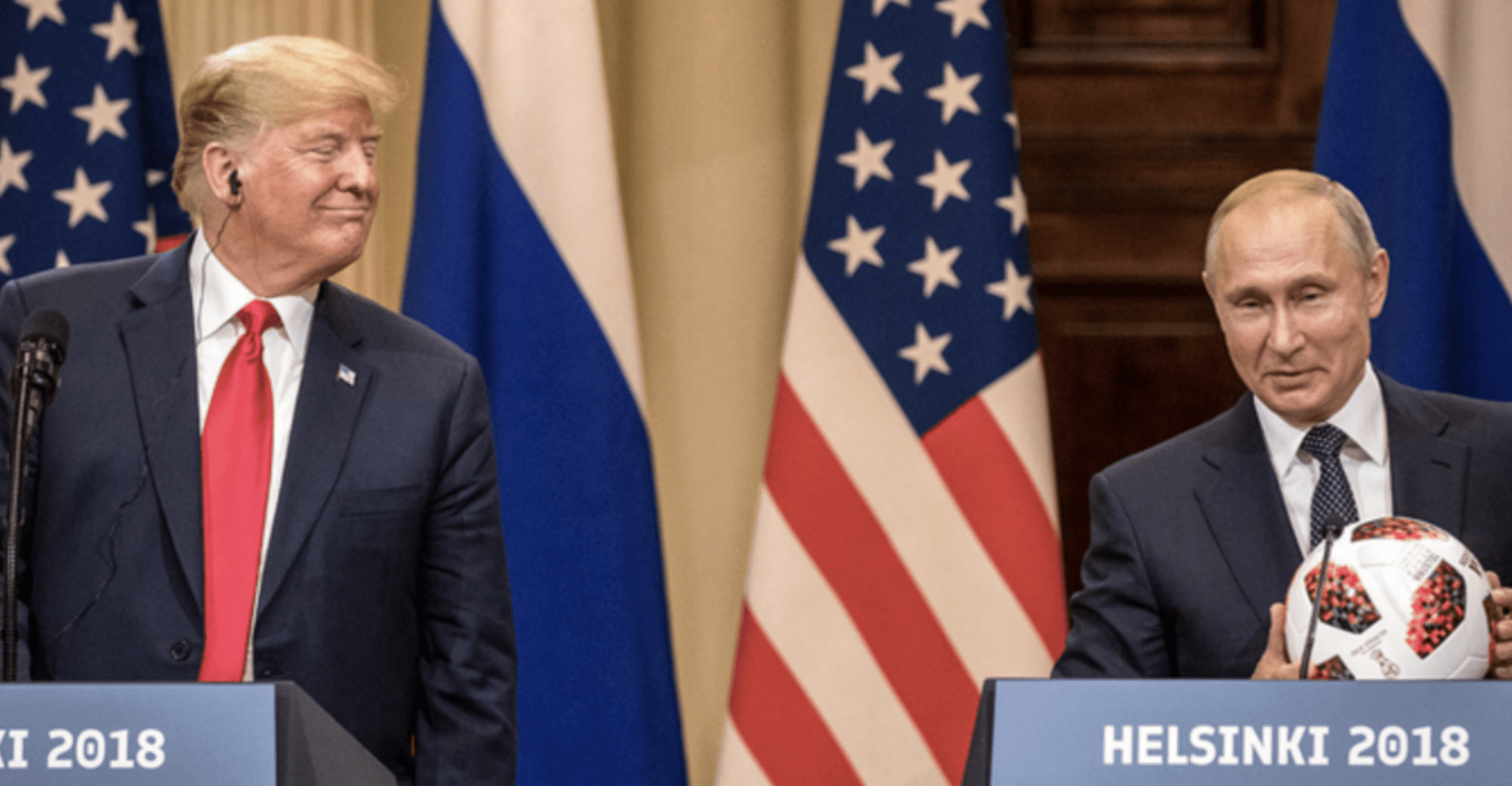 Canada risks being sandwiched between two expansionist autocrats, write the authors/AP
While enhancements to Canada’s military capabilities and infrastructure in the Arctic are essential, the experience of Ukraine underscores that Russia does not limit itself to military action in the pursuit of its ambitions. Russia will do whatever it can to undermine Canadian interests in the Arctic, and these efforts would not be contained to the physical realm of our northern border.
Indeed, what should worry Canadians right about now is not an invasion of “little green men” from the north. Russia is too bogged down in Ukraine to try that route, Canada is a NATO member, and Russia, which has attacked several of its neighbours over the last 30 years (Moldova and Georgia, in addition to Ukraine — twice) has never dared attack a NATO state.
What should worry Canadians are acts of sabotage and disinformation, known as “grey-zone tactics” or “hybrid warfare” intended to stoke discord, disunity, and mutual resentment among fellow citizens — an ideal scenario to distract from our ability to actively monitor the environmental and geopolitical volatility of the Arctic and broader considerations of our national defence.
In one of the more sobering assessments of Russia’s recent — and now frequent — incursions into NATO territory, Russia’s prospective opening of another front with Europe is expected to combine kinetic strikes with wide-ranging grey-zone tactics, deployed not to conquer territory but primarily to deflate public morale.
Although Trump’s threats to annex us unleashed a wave of patriotic backlash, sustained and aggressive grey-zone tactics threaten to deplete the morale required to keep our “elbows up.”
As if our obsession with the threat from the south wasn’t exhausting enough, the thought of being sandwiched between a budding (albeit fluctuating) Russo-American alliance — mutually emboldened by notions of imperial expansion — is enough to forget about our elbows and cover our eyes in horror.
If Ukraine is defeated, Canada risks dealing with an emboldened, expansionist neighbour — and not just the one to our south.
And should the leaders of these two states manage to implement their expressed desire to find a “solution” to the Russo-Ukrainian war — that is, one more suitable to their systemic, autocratic interests than to Ukraine’s — it’s not impossible that this morale booster to imperialist expansion would, in turn, lend credence to a similar solution to a hypothetical “Canadian question.”
Canadian government documents do reveal the occasional mention of Russia as the neighbour that it is. In a chapter on strategic challenges in the region, Canada’s Arctic Foreign Policy (2024) states early on that, “Canada must be clear-eyed about the implications of its geographic proximity to Russia.”
Notably, the document also admits that “Northerners” — presumably referring to the (predominantly Indigenous) inhabitants of Canada’s northern regions — have duly grasped “how close a neighbour Russia is.” The Canadian government has long relied on the presence of Indigenous peoples to assert our Arctic sovereignty, although ongoing deficiencies in northern infrastructure underscores that the protection has been far from reciprocal.
But we shouldn’t delude ourselves that the presence of Indigenous peoples in our northern territories would serve to deter Russia’s ambitions and designs in Canada’s Arctic. Indeed, in the case of Ukraine, the presence of the Indigenous Crimean Tatar population in Crimea — who are aligned with the idea of membership in a civic Ukrainian nation — has not deterred Russia in the slightest from seeking to legitimize its land grab of the peninsula.
The real threats in Canada’s neighbourhood must be discussed more openly by government officials and media in public discourse, not contained to policy documents circulating in expert circles.
The span of the Atlantic Ocean doesn’t preclude us from imagining that the Euro-Atlantic partnership meaningfully transcends geographical distance, and our relations with nefarious actors in the Arctic will similarly transcend, but in unwelcome ways.
It is imperative that Canadians take seriously Russia’s imperial ambition and realize that support for Ukraine serves to quell it. If Ukraine is defeated, Canada risks being squeezed between two emboldened, expansionist neighbours — north and south.
Maria Popova is Associate Professor of Political Science at McGill University and Co-Director of the Jean Monnet Centre Montreal. With Oxana Shevel, she recently published a book titled Russia and Ukraine: Entangled Histories, Diverging States.
Anastasia Leshchyshyn is a PhD Candidate in Political Science at McGill University. A comparative politics specialist, she works on the intersection of policy, law, and society, with a focus on Europe, the European Union, and Canada.