
Yes, it’s Still all About the Economy, but With a Big Difference

By Bruce Anderson
December 7, 2025
Other than tagging every scandal “something”-gate, it’d be hard to find a more overused phrase in modern political analysis than “It’s the economy, stupid”. In 1992, James Carville wrote it on a sign he put up in Bill Clinton’s Little Rock campaign headquarters to remind everyone that this was the surest way to stay focused on issues that would matter to voters.
The fact that it is overused doesn’t mean it’s wrong. Mostly, it’s been true that in one way or another, ballot boxes are filled with votes that are about economic hopes, fears, or both.
However, in Canada, something’s different today.
It used to be axiomatic that if people were down about the economy they would be angry at government. It’s more complicated right now.
Ask people what is responsible for economic challenges in Canada and a third (33%) blame poor government policies.
The rest are split between thinking our problems are a function of global changes and trends (31%), or pressures from the US (36%).
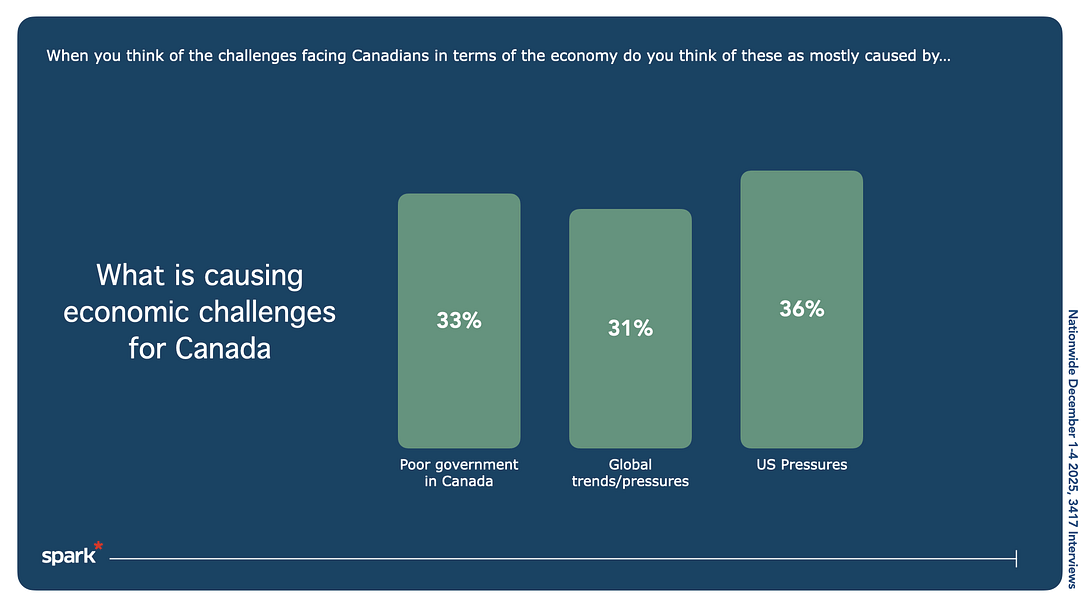
In other words, most people think our economic challenges are coming from outside, rather than self-inflicted.
Of course, that doesn’t mean that people let any government off the hook for dealing with today’s challenges, but it’s helps explain why many of those who say the economy is a deep source of pain for them think the Carney government is doing a reasonable job and, if an election were held today, would prefer a Carney government to a Poliievre government.
Here are a few findings from our latest Spark Insights nationwide survey of 3417 Canadians, fielded between December 1-4th.
- 41% of Canadians say the economy is “poor” for them and their household today. The rest say good (15%) or acceptable (44%).
- Among that 41% who are struggling in this economy, 33% say they approve of the performance of the Carney government, and if an election were held now, 40% would prefer to have a Carney government than a Poilievre government.
- Among the majority (59%) who feel the economy is good or acceptable today, 81% approve of the Carney government’s performance, and 75% would rather a Carney win to a Poilievre win, in an election today.
- Among those who think Canada’s economic challenges are caused either by global trends or US pressures, 76% would prefer a Carney to a Poilievre government.
- Poilievre is preferred by 70% of the minority who think Canada’s challenges are self-inflicted by Canadian policies.
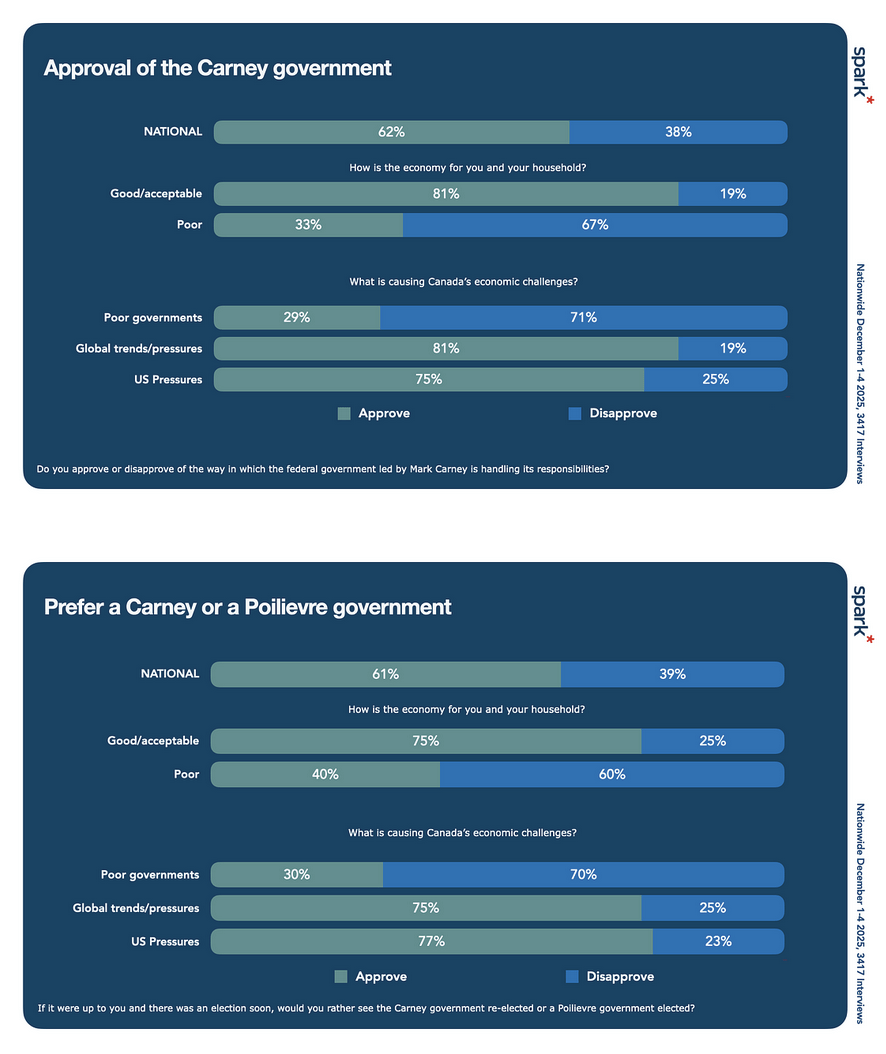
The bottom line is that, yes, politics today is mostly about the economy. But people are looking for a strategy and a leadership skill set that is fit for purpose in a time when our economy is challenged from new and largely external pressures.
Among those who think Canada’s economic problems stem from US pressures, 77% say Carney is doing a good or acceptable job of working to improve the economy, 73% offer the same ratings for “handling relations with the US” and “being concerned about the cost of living”.
Trump was elected President about 400 days ago, weeks later he announced that he was going to attack imports from Canada and many other trading partners.
In doing so, he created domino effects that are still dropping — perhaps accelerating — around the world. This turmoil has written a new chapter in Canadian politics, and a fundamentally different take on “It’s the economy, stupid”.
Policy Contributor Bruce Anderson has been a pollster, political strategist and communications advisor for more than 40 years. He is a frequent commentator on Canadian politics and public policy including on The Bridge podcasts. He is a founding partner and Chief Strategy Officer of Spark Advocacy. He supported Mark Carney during the 2025 federal election campaign.