
What the Defence Investment Agency Can Learn from the National Shipbuilding Strategy

COVE CEO Melanie Nadeau, Prime Minister Mark Carney, and MP Darren Fisher (Dartmouth-Cole Harbour) discuss the technical and data capabilities of the Kongsberg HUGIN autonomous underwater vehicle (AUV).
December 9, 2025
In early October, Prime Minister Mark Carney established the new, tellingly named, Defence Investment Agency (DIA) to accelerate military acquisitions and promote economic growth.
The emphasis on investment over procurement in the title of this new special operating agency was certainly welcome news from an industry perspective. It promises new approaches to old systems, returns rather than just massive outlays, and new economic partnerships.
Notably, the government announced that at least one of the new agency’s responsibilities is to execute a pivot away from spending three-quarters of Canada’s defence envelope in the United States.
In early November, with the “Canada Strong” Budget of 2025, the Carney government went a step further and provided the DIA and its hand-picked CEO, Doug Guzman, with a generational sum of money to work with, one that has the potential to be transformative not just for the armed forces and the Canadian defence industry, but for the entire Canadian economy.
The first eight procurements being managed by the DIA were confirmed on December 5th in response to a question from a Conservative MP. They include Canada’s next fleet of submarines, the Arctic over-the-horizon radar and a fleet of early warning-and-control surveillance aircraft.
With the latest announcement that Canada will be the first non-European state to participate in the Security Action for Europe (SAFE), the significance of the DIA’s role has become all the more apparent, and indeed all the more crucial to the execution of the overarching macroeconomic policy – one that is being fully revealed slowly but surely. We should expect the forthcoming Defence Industrial Strategy, due out before the end of the year, to provide still more details about how defence investments will unfold over the coming years.
Europe is rearming rapidly and on a massive scale. Over $1 trillion is expected to pour into the continental defence industry by 2030, including some $244 billion in low-interest loans through the SAFE fund to help members fill gaps in their high-intensity warfare arsenals.
SAFE is part of the Readiness 2030 initiative to construct a credible deterrent threat to Europe’s adversaries in light of Russia’s invasion of Ukraine and questions about the Trump administration’s hegemonic willingness to defend the rules-based international order.
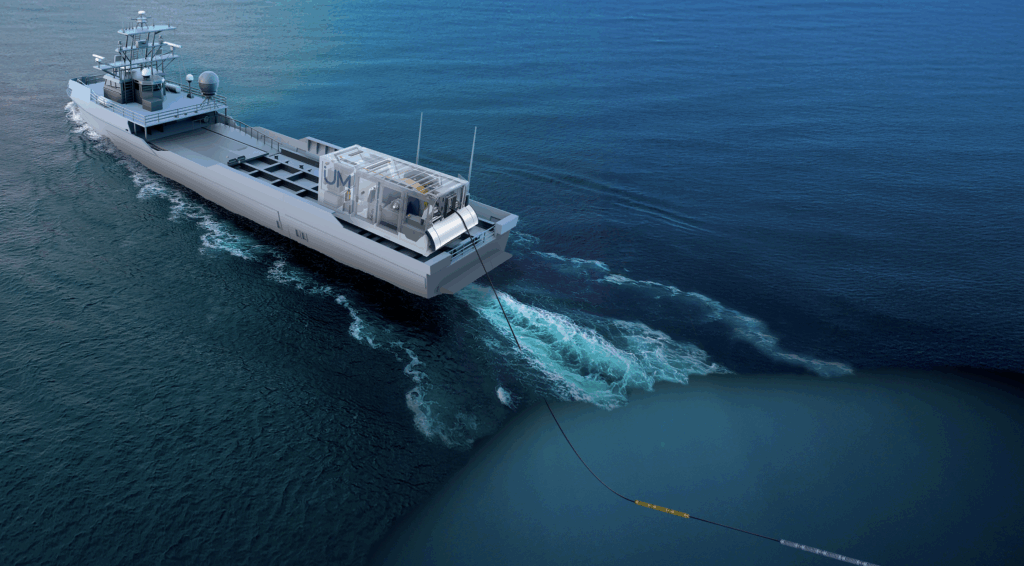 Ultra Maritime’s Sea Tracker system tests next-generation towed-array sonar for Anti-Submarine Warfare (ASW)/Ultra Maritime.
Through participation in SAFE, Canada will be able to undertake joint procurements with European partners at scales designed to reduce overall unit costs. Canadian companies, in turn, will be eligible to bid for contracts financed by the fund, which could see them supplying European allies with orders far larger than Canada has previously filled.
The DIA has been tapped to manage Canada’s participation in SAFE. This will require it to connect domestic industry into European market gaps, at the same time as it attempts to reengineer military procurements over $100M.
Much depends on the ability of the DIA to break through the complicated procurement knots the government has tied itself in over decades, and to find new markets for burgeoning and established Canadian defence firms. The directed investment that the DIA will be managing has few precedents in recent Canadian history, but the last 15 years of the National Shipbuilding Strategy offers an approximate proof of concept.
Those of us who have been part of the NSS understand the economic potential that the DIA’s emphasis on investment and diversification promises. The NSS has resurrected Canadian shipbuilding and economically transformed the cities that surround it, by creating thousands of high-paying jobs and generating billions in economic spinoffs.
The DIA can learn a great deal from the experience of the NSS to ensure impactful investments in the defence and dual-use sectors, enabling Canada to not only reach its NATO spending targets, but more importantly, to effectively equip the Canadian Armed Forces, grow a sovereign defence industrial base, and diversify Canada’s defence industrial partnerships.
In addition to reviving shipbuilding in Canada, the NSS has nurtured the growth of innovative dual-use firms in the maritime domain. I can speak to this directly, as the CEO of COVE, a not-for-profit that was founded with investment from offsets of the NSS. We at COVE have been creating the conditions for big and small firms to solve defence, security, and resilience challenges by opening up spaces for testing and collaboration that are vital for growing the marine economy.
As a NATO Defence Innovation Accelerator for the North Atlantic (DIANA), COVE has supported the development of a defence ecosystem that already stretches across the pond with strong partnerships forming between dual-use firms working out of our facility and through our programs. Our approach offers valuable lessons for the DIA and how future defence investments, particularly when it comes to emerging technologies and small and medium enterprises, can support Canada’s supply chain requirements.
Maximizing return on the generational investment that Canada has made is the essential mandate and role of the DIA. The lessons and insights from Canada’s success with the NSS can help the DIA live up to its promise.
Melanie Nadeau is the CEO of COVE, Canada’s official accelerator with NATO’s Defence Innovation Accelerator for the North Atlantic (DIANA) and Canada’s first Defence Innovation Secure Hub.