
Stephenson, William Stephenson: The Intrepid Canadian Behind the First ‘Maple Moment’
By Anthony Wilson-Smith
December 10, 2025
With questions of how we define Canadian character looming larger in a world of unfathomable challenges, our new Historica Canada series, Maple Moments, chose for its debut a subject known internationally for the wartime exploits that made him the real-life inspiration for James Bond, and who, we think, deserves a whole new moment.
Born in Winnipeg in 1897, Sir William Stephenson went on to become a First World War fighter ace; made a fortune through postwar inventions; moved to London and became a crucial player in the establishment of transatlantic intelligence coordination between Britain and America, working directly with Winston Churchill and Franklin Delano Roosevelt.
While we don’t know all the details of how Stephenson spent the Second World War, those that are known make clear his singular importance to the Allied effort.
Welcome to the story of one of history’s most interesting Canadians.
Most people know our charitable organization best via two of our programs; the Canadian Encyclopedia, and the iconic Heritage Minutes.
Our new series, narrated by the also-iconic Peter Mansbridge (a member of our Historica board), and put together by longtime CBC News producer Mark Bulgutch, is done in mini-documentary style, combining video, photographs, occasional interviews, and rigorously fact-checked information.
The question of whether “Intrepid” was Stephenson’s code name or just his telex handle has been debated for decades.
Much like the Minutes, but in a different format, the aim is to spotlight remarkable Canadians in just a little more depth than our beloved, 60-second dramatic re-enactments.
Unlike the Minutes, which we generally produce twice a year and can cost up to $250,000 to put together, we plan more frequent releases of Maple Moments to help meet the growing appetite for inspiring stories. And that appetite is real: with relatively little promotion, and despite lacking the brand familiarity of our Heritage Minutes, the new Moment has already been viewed close to a million times.
In the case of Stephenson, who died in 1989, the greatest challenge wasn’t so much lack of information as the fact that the information that does exist is somewhat murky — to be expected of the biography of a secret agent — and even that record has been questioned and retroactively counter-narrated, which is also to be expected from an intelligence world that never appreciates the disclosure of trade secrets.
What we do know is compelling enough. At the onset of the Second World War, Stephenson was placed in charge of British counterespionage in the Western Hemisphere, based in New York. The office’s telegraphic address was INTREPID.
The bestselling 1976 biography by the similarly named author William Stevenson was titled, A Man Called Intrepid, but as with most matters involving espionage, the question of whether “Intrepid” was Stephenson’s code name or just his telex handle has been hotly debated for decades.
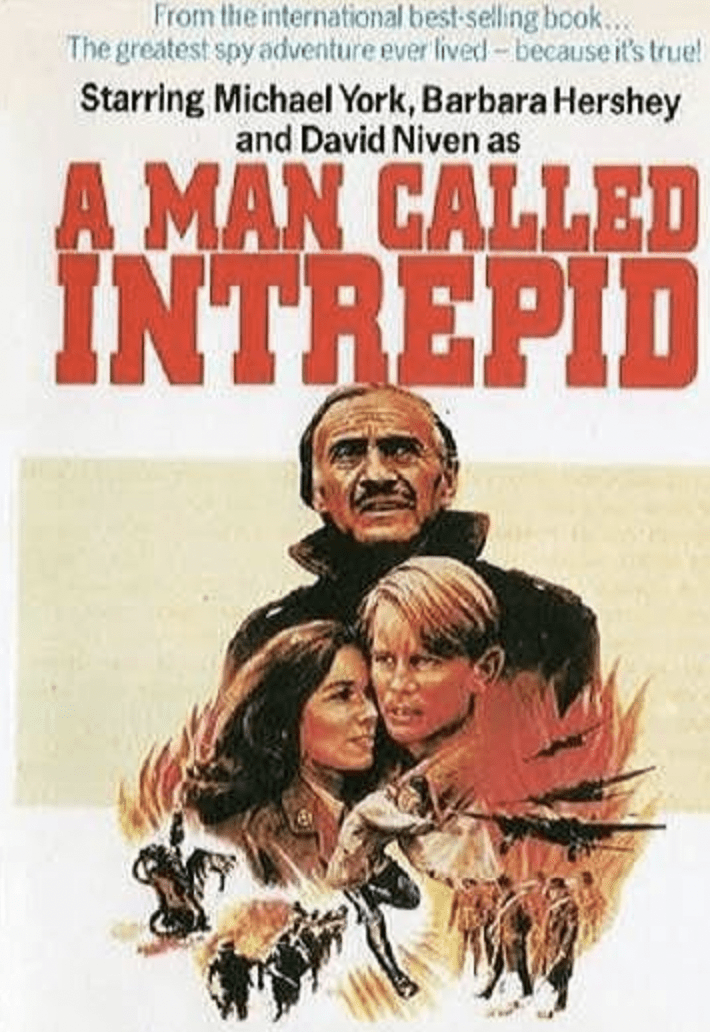
Poster for the 1979 miniseries/IMDB
Stephenson became a close associate of the legendary William ‘Wild Bill’ Donovan, a fellow WWI fighting ace and founder of the American Office of Strategic Services (forerunner to the Central Intelligence Agency) following a meeting with Churchill arranged by Stephenson in 1941.
Stephenson’s friendship with both Churchill and Roosevelt made him the natural choice to establish Camp X, the WWII intelligence training facility near Whitby, Ontario. The site, built with British, American and Canadian participation, was chosen for its then-relative isolation – away from prying eyes – as well as proximity to the U.S. border.
Over the war years, more than 500 prospective agents from those countries as well as anti-Nazi European and South American nations were trained at Camp X. As the Canadian historian Bruce Forsyth wrote: “Trainees at the camp learned sabotage techniques, subversion, intelligence gathering, lock picking, explosives training, radio communications, encode/decode, recruiting techniques for partisans, the art of silent killing and unarmed combat.”
It also became the home of ‘Hydra’, a sophisticated listening post for sending and receiving secret radio transmissions as well as intercepting and decoding enemy communications. It is widely believed – and reported as fact in several media outlets – that spy-turned-novelist and James Bond creator Ian Fleming, a friend of Stephenson’s from London days, spent time observing and training at Camp X.
Fleming once described how Stephenson ‘used to make the most powerful martinis in America and serve them in quart glasses’.
Much of the information about the camp’s activities – and those of Stephenson individually – remains classified. (In fact, at the time of its opening, Canadian prime minister Mackenzie King was not informed of its activities.) The last of the Camp X buildings was torn down in 1969, although artifacts continue to turn up on-site and the CBC wartime drama X Company revived interest in the project. The area where the facility operated is now known as Intrepid Park.
Though Stephenson’s contribution to the war effort was largely covert, he was knighted by King George VI, awarded the US Medal for Merit, and in 1979, made a Companion of the Order of Canada – our country’s highest honour. A statue in Winnipeg’s Memorial Park pays tribute to the hometown hero.
Stephenson did not remain in Canada after the war. He moved to Bermuda, where he remained until his death in 1989. In fact, very little was known about his wartime activities until 1962, when the Irish biographer and politician Harford Montgomery Hyde published The Quiet Canadian – the first recounting of his efforts. Several books by other authors later followed.
With a running time of two minutes and 51 seconds, our mini-documentary on Stephenson answers some questions, and raises others. One of the most fascinating: Was Stephenson truly the inspiration for Fleming’s Bond? Like the fictional spy, he was expert at hand-to-hand combat, sophisticated, and an enthusiast of martinis. Fleming once described how Stephenson “used to make the most powerful martinis in America and serve them in quart glasses”.
Most convincingly, Fleming himself is widely quoted as having said, “James Bond is a highly romanticized version of a true spy. The real thing … is William Stephenson.”
Stay tuned for our next Maple Moment: Canada’s Father Goose, Bill Lishman.
Anthony Wilson-Smith is President of Historica Canada and former Editor-in-Chief of Maclean’s magazine.