
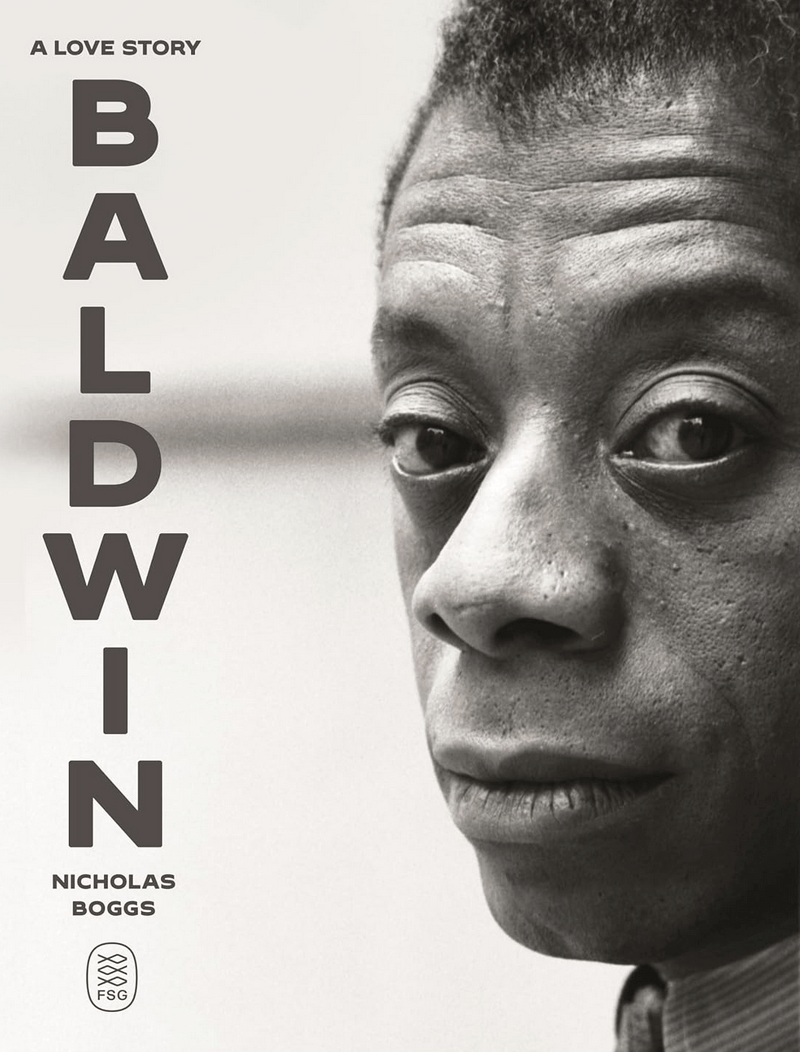
‘Baldwin: A Love Story’. What James Baldwin Still Teaches Us About Life and Love
By Nicholas Boggs
Macmillan, September 2025/720 pages
Reviewed by Gray MacDonald
December 16, 2025
James Baldwin never wanted to be the spokesman for either the Black or gay communities, eschewing as he did the constriction of labels and preferring to think of himself as a witness.
But the disproportionate weight of history that came with that intersectional role has meant that Baldwin’s life, both public and personal, is rightfully the subject of enduring fascination and historical study by scholars like Nicholas Boggs.
Boggs’s Baldwin: A Love Story, does an excellent job of synthesizing the legend of an author with the practical reality of a man’s life.
Clocking in at over 700 pages, this brick of a book may seem daunting, but Baldwin’s was a big life, and the source material he left behind was both ample and eloquent.
When the subject is someone who spent his life honing not just the craft of writing but the language with which to express the inexpressible, it would frankly be a shame not to use as many of Baldwin’s own words as possible.
Boggs painstakingly arranges those words into a consuming narrative, pulling not only from the finished work of novels and essays but also from epistolary communications and drafts that were abandoned or transformed into other works.
Baldwin’s work was always influenced by the person he was yearning for, whether the distance was provided by the Atlantic Ocean, a difference in sexual orientation, or a single door while he worked at his desk.
It helps that Boggs himself can turn a phrase; at one point he exquisitely describes Baldwin’s time in Istanbul as “soaking in the uniquely contradictory inspiration provided by the city’s haze of historical gloom and seaside hopefulness.”
But the author mostly takes a back seat for the course of the book, stepping out from the wings to speak over Baldwin only on topics on which the man himself did not or could not have left any recorded opinions.
These detours — notably about the nature of his relationships — aren’t mere gossip and in fact feel vital to the subject’s personal history, since Baldwin’s work was always influenced by the person he was yearning for, whether the distance was provided by the Atlantic Ocean, a difference in sexual orientation, or a single door while he worked at his desk.
Hence, the aptness of the book’s subtitle; Baldwin’s writing is always entwined not only with his current relationship, but with the very idea of love as a concept. His struggles with, and ruminations on, romantic love speak to something perhaps not universal, but certainly not limited to the queer experience.
At many points, he puts into words truths that we all know, maybe wordlessly but deeply, particularly the conflicting desire to see and be seen that defines love as the dropping of masks. “And everyone is afraid of that,” Baldwin wrote. “Afraid of being seen as he or she is. But that’s the price, you know. That’s why love is so frightening, I’m sure.”
Boggs, a gay white man, has written movingly about the role that reading Giovanni’s Room played in his own coming out, and in a way, these 700 pages feel like not just an extension of his scholarship but a kind of tribute. This is especially true of his excavation and editing of Little Man Little Man, a children’s book written by Baldwin and illustrated by Yoran Cazac, which was re-published in 2018.
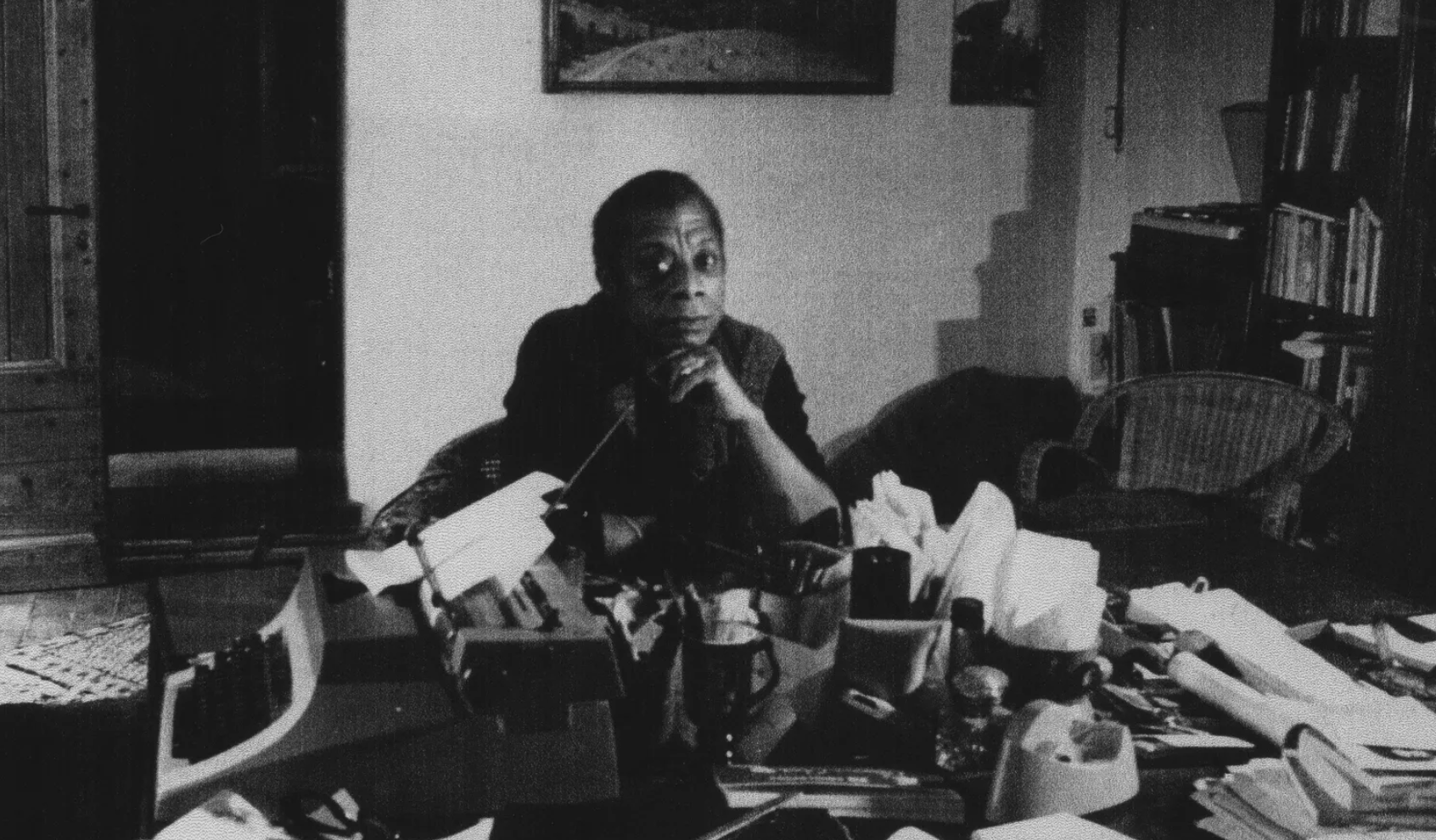
James Baldwin in his office in Saint-Paul-de-Vence/Courtesy Yoran Cazac
As he grew as both a writer and a person (and Boggs does an excellent job of making clear that these are deeply intertwined), Baldwin found himself better able to express his meditations on not only romantic love but the platonic – in both senses – ideal; a love for, and kinship with, humanity.
He struggled with this in America, particularly on and around his oft-postponed visits to the South during the turbulence of a Civil Rights movement whose methods he criticized early on yet wrote passionately about.
But his need for distance from America, particularly after the assassination of Martin Luther King Jr., didn’t diminish his fundamental love for his homeland. “I love America more than any other country in the world,” Baldwin once wrote, “and, exactly for this reason, I insist on the right to criticize her perpetually.”
As such, he spent most of his life bouncing between various locales (and their associated social circles) in America and Europe, pulled in both directions by his twin needs for companionship and isolation so he could work.
“I think I must reconcile myself to being a transatlantic commuter—and turn to my advantage, and not impossibly the advantage of others, that I am a stranger everywhere.”
There is a gulf between the term “immigrant” and the more genteel “expatriate” — the latter long the domain of the white and affluent — which Baldwin was allowed to cross, first due to his connections and later due to his fame.
That status can only ever be a partial shield from racism is evident throughout his path from being hungry in Harlem, to hungry yet respected in Paris, to respected and locally beloved in Istanbul, and in his processing of the wider societal struggle when he visited the American South.
Those visits make especially clear the enmeshed nature of essayist, novelist, and witness to history. While Baldwin’s fiction was influenced by his nonfiction, the reverse is also true, and certainly all of his work was influenced by his personal experiences as a Black gay man both in and outside of America.
That status can only ever be a partial shield from racism is evident throughout his path from being hungry in Harlem, to hungry yet respected in Paris, to respected and locally beloved in Istanbul, and in his processing of the wider societal struggle when he visited the American South.
While there are individual moments of triumph over systemic racism internalized and not, it’s clear that Baldwin, in his own words, “… ached for acceptance in a culture which pronounced straight hair and white skin the only acceptable beauty,” especially in his youth.
This experience gave him the perspective to use his talent, as have so many other Black writers of his generation and since, to parse the racism of a white-dominated culture and its skewed ideals of beauty and value.
While Baldwin’s meditations on race aren’t something that I can speak to from personal experience, I can relate to his insights on gay identity and expression, and the observations on and from a queer life of his generation are fascinating. I’ve always felt it important to remember the community history, including the price that was paid in an era when most expressions of homosexual identity were illegal.
These reminders feel vital, in the same way the records of his Black experience illustrate the evolution of racism and the fragility of progress. That catalogue of human rights history is of immeasurable value — to all of us.
At the same time, the book is a testament to the importance and power of the written word, not only between individuals at the time of writing, but for scholars and historians later. The modern versions of these letters and diaries may well be social media and blogging; and now, of course, with the ever-increasing accessibility and focus on video formats, vlogging.
And while few people may be quite as articulate as Baldwin, the essential nature of his witness testimony is a reminder that freedom of speech isn’t just about now.
“On paper is the best way for me to put a certain record which hopefully will be of some value to somebody, someday,” Baldwin wrote.
It is now someday; and you are somebody.
Gray MacDonald, a freelance writer and editor, is copy editor of The Week in Policy.