
What’s Worse than Tariffs? A Rogue Superpower
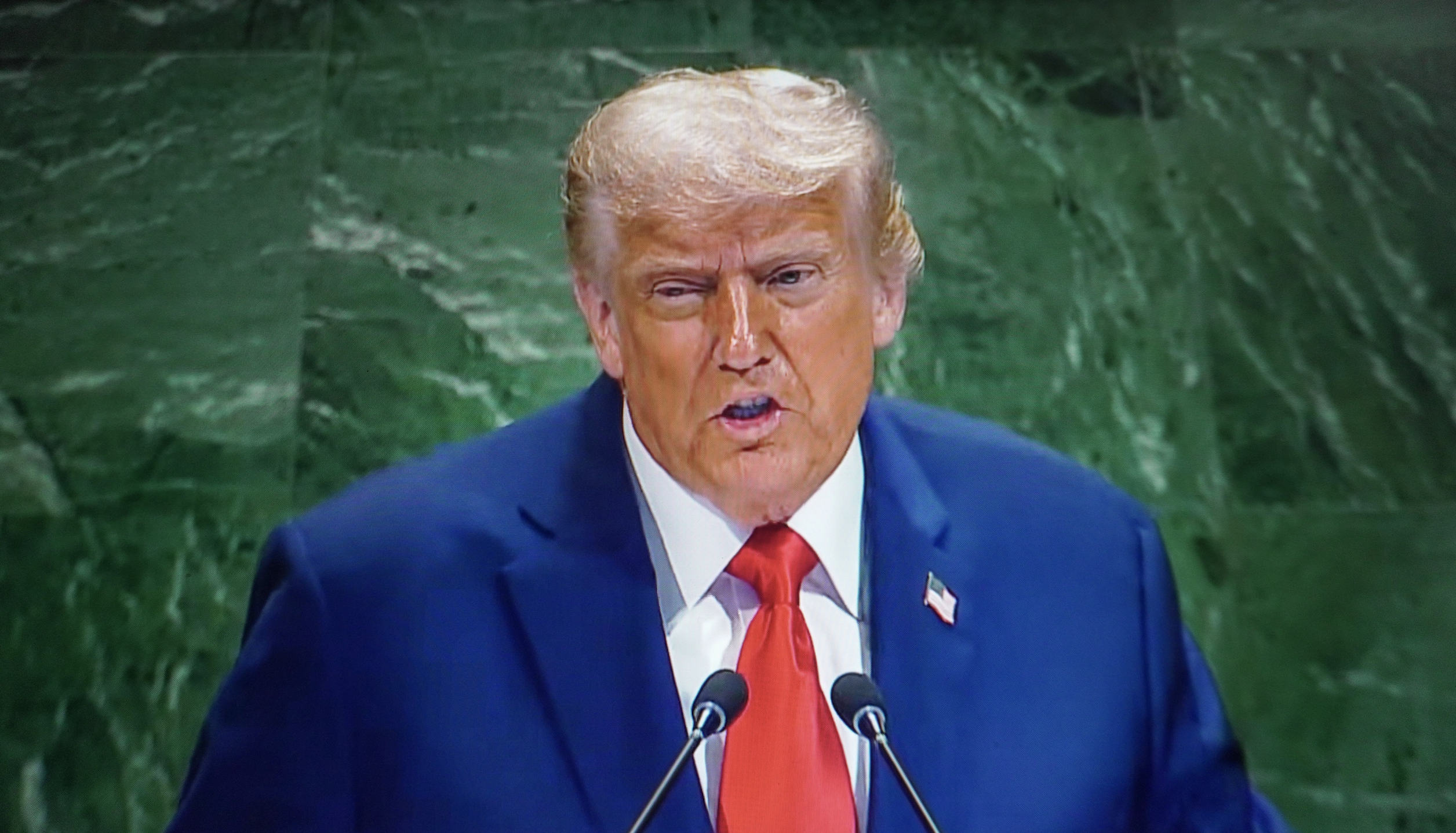 Donald Trump at the United Nations General Assembly in September, telling representatives that their countries “are going to hell”/Shutterstock
By Derek Burney
December 28, 2025
While this may come as a shock after the trade chaos of the past year — especially coming from a former ambassador to the United States who helped negotiate the Canada-US Free Trade Agreement — Donald Trump’s new National Security Strategy is more derogatory to Canada than his tariff war.
Trump’s NSS is a marked departure from decades of values-inspired and bipartisan-supported foreign policy that defined America’s global leadership and anchored the shared values of the Free World.
The new strategy harkens back to the Monroe doctrine, when the U.S.’ prime security concern was the Western Hemisphere. A “Trump corollary” essentially asserts a neo-imperialist presence in the hemisphere and reduces all other states within it, including Canada, to something approaching vassal status.
“The U.S. must be pre-eminent in the Western Hemisphere as a condition of our security and prosperity…The terms of our alliances and the terms upon which we provide any kind of aid, must be contingent on winding down adversarial outside influence…” Trump presumably includes his dubious claims for annexing Greenland in his plans for the Western Hemisphere.
This is isolationism wearing a new dress. Previous administrations featured China and Russia’s desire to “shape a world antithetical to U.S. values and interests,” as a leading foreign policy concern. China was a long-term “pacing challenge” in the competition for global influence, whereas Russia was an “acute threat” actively engaged in “subversion and aggression.”
The new doctrine instead offers soft, if not conciliatory language towards competitors and rejects “the ill-fated concept of global domination in favour of global and regional balances of power.” Strategic competition, terrorism and other traditional threats are relegated to secondary status.
In other words, the desire to “shape a world antithetical to U.S. values and interests,” is now coming from inside the White House.
If nothing else, this explains America’s efforts to undercut Ukraine while markedly moving to normalize relations with Russia. Trump coerces unilateral concessions from Zelensky but is reluctant to exercise any real pressure on Putin.
Europe, and presumably NATO, get short shrift.
Canada is mentioned only as a place to limit trade to China.
North Korea is not mentioned at all.
There is, however, a troubling stipulation that nations “dependent” on the U.S. must require “sole-source contracts for (U.S.) companies.” This should make for interesting debate in the forthcoming CUSMA negotiations.
Mass migration is regarded as the “major external threat” to the U.S. (not China or Russia or terrorism) and is causing Europe to confront “civilization erasure.” This can only intensify European concerns about U.S. security guarantees. Shattering any remaining illusions in Europe about this administration, the strategy called for “cultivating resistance” to a European centrism that’s committing “civilizational erasure.”
In other words, the desire to ‘shape a world antithetical to U.S. values and interests,’ is now coming from inside the White House.
Former Swedish Prime Minister Carl Bildt rejected this attitude, bluntly saying in a recent op-ed published by The Globe and Mail: “Few places on earth provide a better quality of life for a larger share of the population than Europe does. Rather than placate Donald Trump’s America, we must stand taller, recommit to our own values, and hope that the ideological confusion across the Atlantic soon passes. Barring that, it is not us who will be committing civilizational suicide.”
The strategy’s concern about immigration goes deeper, with overtones of racism in the language on NATO: “Over the long-term it is more than plausible…that certain NATO members will become non-European. As such, it is an open question whether they will view their place in the world, or their alliance with the U.S., in the same way as those who signed the NATO Charter.”
The strategy acknowledges correctly that “strength is the best deterrent”, echoing Ronald Reagan’s “Peace Through Strength” doctrine. The Trump version stresses that economic vitality is central to strength but ignores the damage being inflicted by its lawless tariffs. It also fails to recognize that undermining rules that have governed global trade for seven decades is straining alliances, undercutting the dollar’s global reserve currency status and the capital markets that are central to America’s economic strength.
Nonetheless, the NSS strategy asserts that the U.S. should be concerned about the affairs of other countries only if their activities “directly threaten our interests.” Muscular isolationism.
A key phrase emphasizes a desire for “the continued survival and safety of the U.S. as an independent sovereign republic whose government secures the God given natural rights of its citizens and prioritizes their well-being and interests.” (Italicized for emphasis.) In a clear signal to MAGA followers, gone are references to “universal values,” as used by Obama and Biden, among others.
U.S. diplomacy is meant primarily to identify business opportunities and help American companies succeed. Thirty U.S. career Ambassadors were re-called shortly after the strategy emerged.
Without shared values or an international system of rules, and unless economic incentives align, why should other nations, notably Canada, assist or accept U.S. interests?
The new NSS is a document intended primarily to bolster Trump’s diminishing base of popular support. It may help consolidate his MAGA base and bolster as well the prospects for his putative successor (Vice President J.D. Vance.)
Republicans in Congress have been curiously and predictably reluctant to criticize the new strategy, preoccupied more with concerns about health care and affordability which are likely to dominate the 2026 elections. Polls indicate that only 2% of Americans see foreign policy as a priority concern.
Secretary of State Marco Rubio — the one-time China hawk and architect of the “Uyghur Forced Labor Prevention Act (UFLPA)” and the Hong Kong Human Rights and Democracy Act”, causing Beijing to sanction him twice — has moderated his tone in a recent press briefing, explaining, “I represent the President. I think I’ve been nice to China…in terms of the work we have to do with them. I had another job then; my job now is to represent the U.S. in foreign diplomacy.” His evaluation now mirrors that of Trump, who consistently refers to President XI as a “respected leader” and “a friend.”
A National Security Strategy is not law unless Congress sanctions it. But it is clearly indicative of the administration’s intent and how it sees its role in the world. The shock waves will reverberate for months if not years to come.
The implications for America’s allies, like Canada, are ominous. Even if a Democrat eventually wins the White House, relations with the U.S. are likely to be more brittle than benign. If we ever needed greater incentive to broaden and diversify economic and security interests with other countries, especially in Europe and Asia, this bombastic document is a timely catalyst.
Derek H. Burney is a former 30-year career diplomat who served as Ambassador to the United States of America from 1989-1993.