
From North of North to Rideau Hall: A Canadian Journey
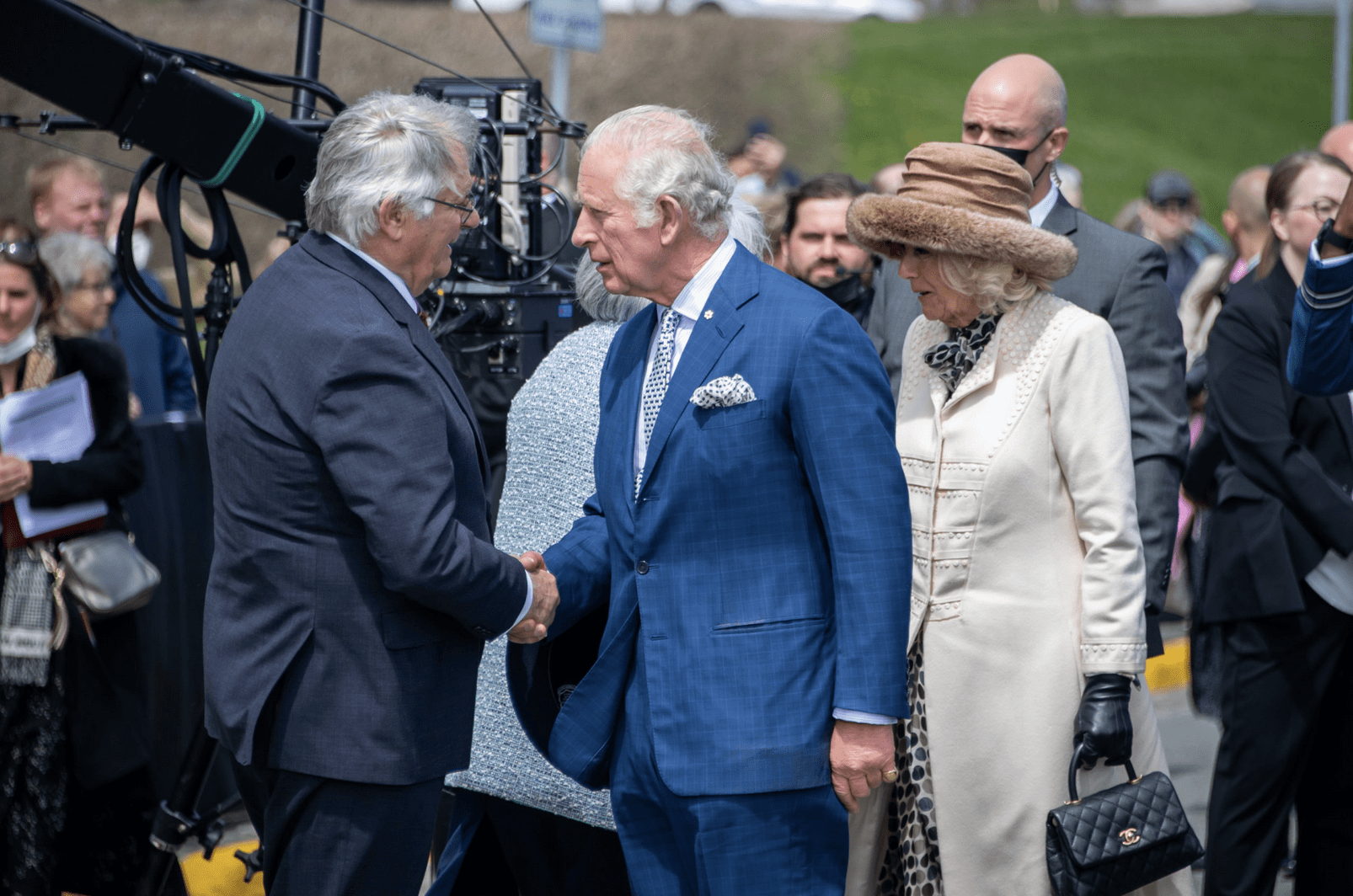 On official duty in St. John’s, May 17th, 2022/Sgt Mathieu St-Amour, Rideau Hall ©OSGG
This piece is part of our Policy series On Being Canadian.
By Whit Fraser
December 28, 2025
I am a better Canadian today than I was in 1961, as an 18-year-old enlisting in the RCAF, placing my hand on the Bible and swearing to serve and protect Canada.
Decades of journeys that touched Canada’s four extremities — from the true North Pole, southerly to Pelee Island, from Cape Spear in the east, to our most westerly point, Komakuk Beach, where Yukon and Alaska meet — have imbued in me a deep personal sense of place, community, and belonging.
To be clear, there was no plan to this process; just luck, timing, and circumstance; mostly driven by far-flung reporting assignments and the gifts that came with “marrying well”, in my case to the amazing Mary Simon, who, as fate would have it, went on to be named Canada’s 30th Governor-General.
Was it fate that set my course on my long-ago first day at CBC Frobisher Bay — now Iqaluit — when the manager, Ted Morris, declared “You’re going to be our new reporter”?
How could he know that reporting was in my DNA? Today, in my mind, I remain a reporter — even when I’m greeting foreign dignitaries and especially when I’m meeting regular Canadians.
Canada was always my beat — from Frobisher to Parliament Hill — and my best stories emerged not from officialdom but from the bush and beyond.
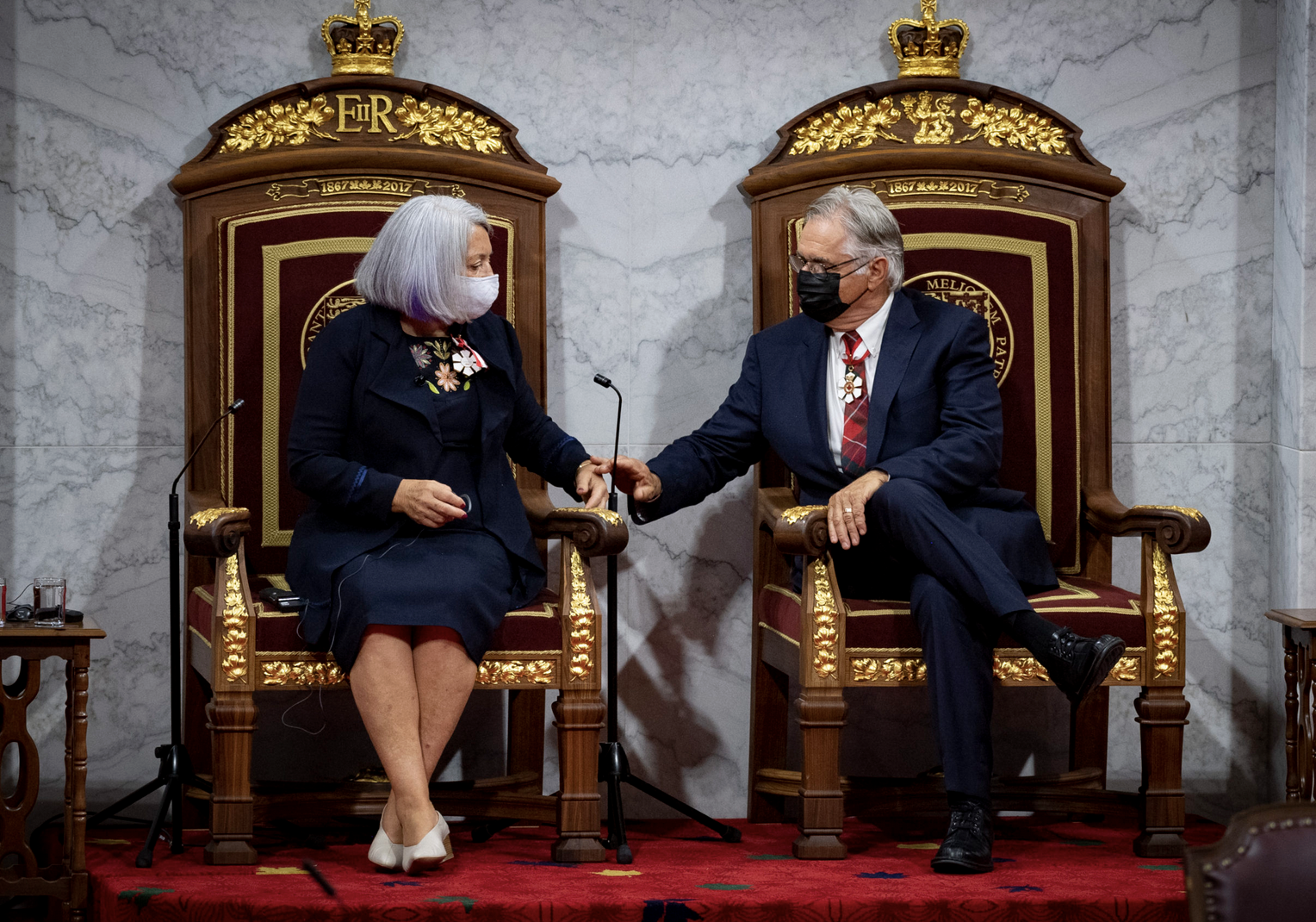 Mary’s installation ceremony, July 26, 2021/Sgt Johanie Maheu, Rideau Hall © OSGG, 2021
Magically, the last four and a half years with Mary at Rideau Hall have brought so many of them full circle.
I am among the dwindling number of Canadians who heard the Toronto Maple Leafs win their last Stanley Cup in 1967, listening to a scratchy shortwave radio with a group of locals in the tumbledown Quonset hut that housed the Canadian Legion in Frobisher Bay.
Wearing heavy parkas and clustered in three small cheering sections — the English Leafs fans, the French and the Inuit-united behind the Habs. The place was so damn cold, we kept the beer in the fridge to keep it from freezing.
In my memory now, it’s the Inuit fans who stand out in that long ago-game — Nuukingak, Teemotee and old Davudee — artists and soapstone carvers, all three with numbers instead of last names, and the ever-smiling school bus driver, Charlie Sageeaktuk.
None could speak more than a few words of English, yet they followed Foster Hewitt’s play-by-play with amazing precision.
Fast-forward to September 2022. I’m with Mary in one of the grand Rideau Hall state rooms, celebrating the 50th anniversary of one of Canada’s greatest hockey triumphs, the famous Soviet Summit series of 1972.
We are saluting those who gave a hockey nation its greatest glory: Paul Henderson, brothers Frank and Peter Mahovlich, the late Ken Dryden and a dozen others.
One moment stands out.
Beneath the portrait of former Governor-General Lord Stanley, who presented a cup bearing his name right here at Rideau Hall, stands Montreal Canadians and Team Canada legend, Yvan Cournoyer,
Now in his late 70s, is Cournoyer worshiping Lord Stanley? Or is old Lord Stanley worshiping this diminutive but speedy forward who hoisted the Stanley Cup over his head 10 times during a storied career.
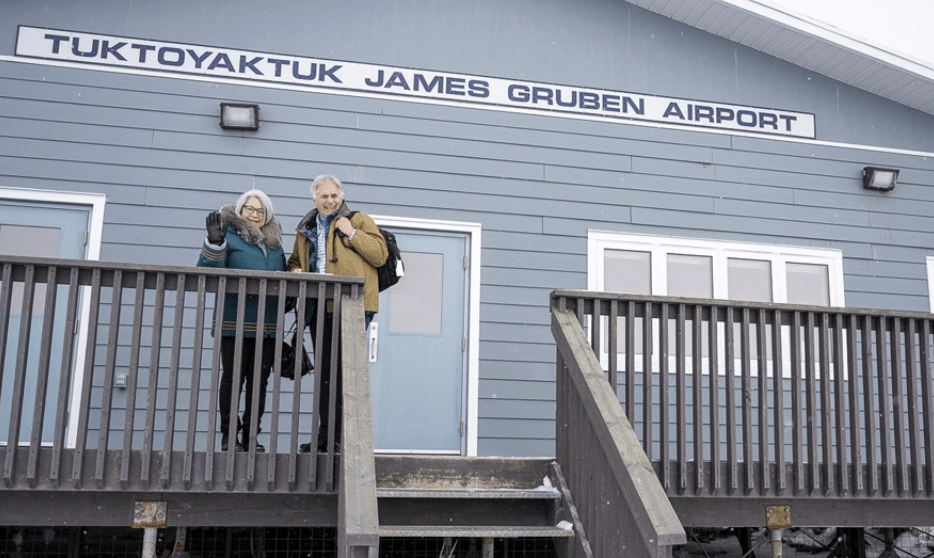 During a trip “home” in April, 2023/MCpl Anis Assari, Rideau Hall ©OSGG
I was certainly in Tuk in the mid-70s for many days when the community faced another threat, this one from the world’s major oil companies, which wanted to build what at that point was the world’s biggest and longest pipeline.
So many memories — so many gifts that only Canada and Canadians can bestow.
In the mid-1980s, hunting caribou with cherished friend Joe Tobie, a Dene and CBC colleague, travelling by snowmobile, about 70 kilometres northeast of Yellowknife.
Traversing a narrow portage through the black spruce, we reached a large lake about 20 or more kilometres long and the huge Bathurst Caribou herd, mid-migration. At the time, its population was estimated at about 300,000. It was a wildlife spectacle that would be envied the world over.
We became part of the splendor, driven slowly parallel to the herd as hundreds of thousands of beating hearts, a million hoofs on the ice, and the ice itself, frozen-down a meter thick, gently swaying with the shifting weight. And, above, the massive herd emitting clouds of breath into the -25 Arctic air.
I don’t know how long we sat silently on our Ski-Doos, in astonished wonderment.
I wasn’t silent in 1985, when two Inuit and two fair-haired students from Alberta dropped the Canadian flag squarely on the deck of the intruding United States icebreaker, the Polar Sea, from a low-flying Twin Otter. In a patriotic breach of objectivity, my camera crew and I joined the victory shouts and fist pumps.
My sense of being Canadian includes an unabashed “True North” bias.
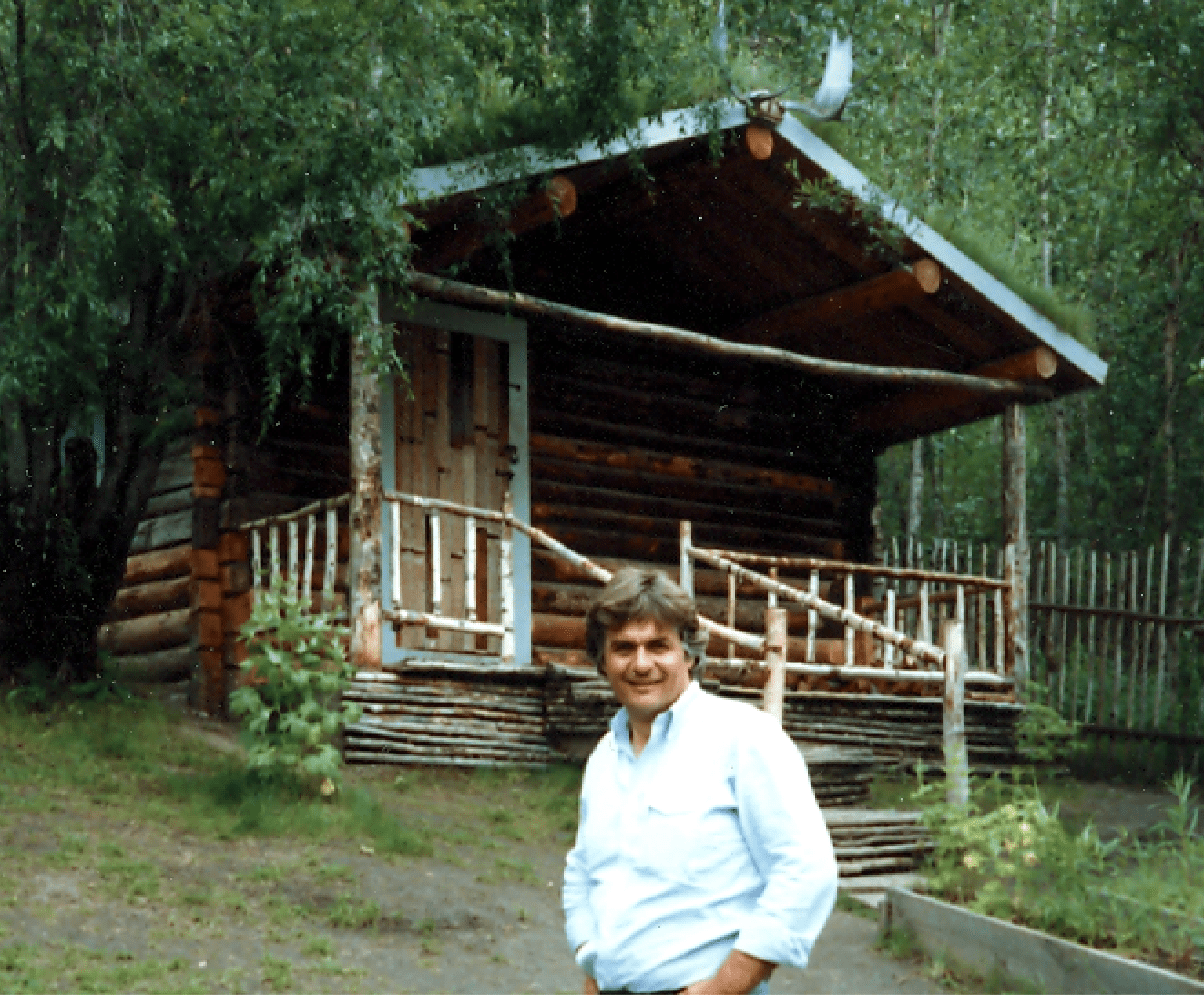 Outside Robert Service’s cabin, Dawson City, Yukon
In my sunny Rideau Hall office that I share with our yellow Lab, Neva, there is a 40-year-old snapshot, from Dawson, Yukon, in front of Robert Service’s cabin, where from boyhood memory I recited his The Law of the Yukon, “Lofty I stand from each sister land… wild and wide are my borders.”
There’s a larger photo of the long-abandoned RCMP detachment on Devon Island, in the Northwest Passage. In the 1920s, Canada posted Mounties — human flagpoles — to otherwise uninhabited Arctic islands to assert our sovereignty.
The island’s Dundas Harbour is special. I’ve visited six times, and it inspired my novel The Cold Edge of Heaven.
In contrast is a colorful painting by Yukon artist Ted Harrison — I loved visiting him in his Whitehorse gallery.
The memories are many and vivid, but nothing says Canada and Canadians more than the Order of Canada ceremonies at Rideau Hall.
No event inspires Mary and me more. This is where Canada honors our most dedicated, most brilliant and most committed to a better country and world. Recipients are from every corner of the country, and every field of endeavour; science, medicine, sports, the arts, building, and philanthropy.
As much as their enormous, natural gifts and intellect, inductees share a common love of Canada, invariably citing the ceremony as the greatest moment of their lives.
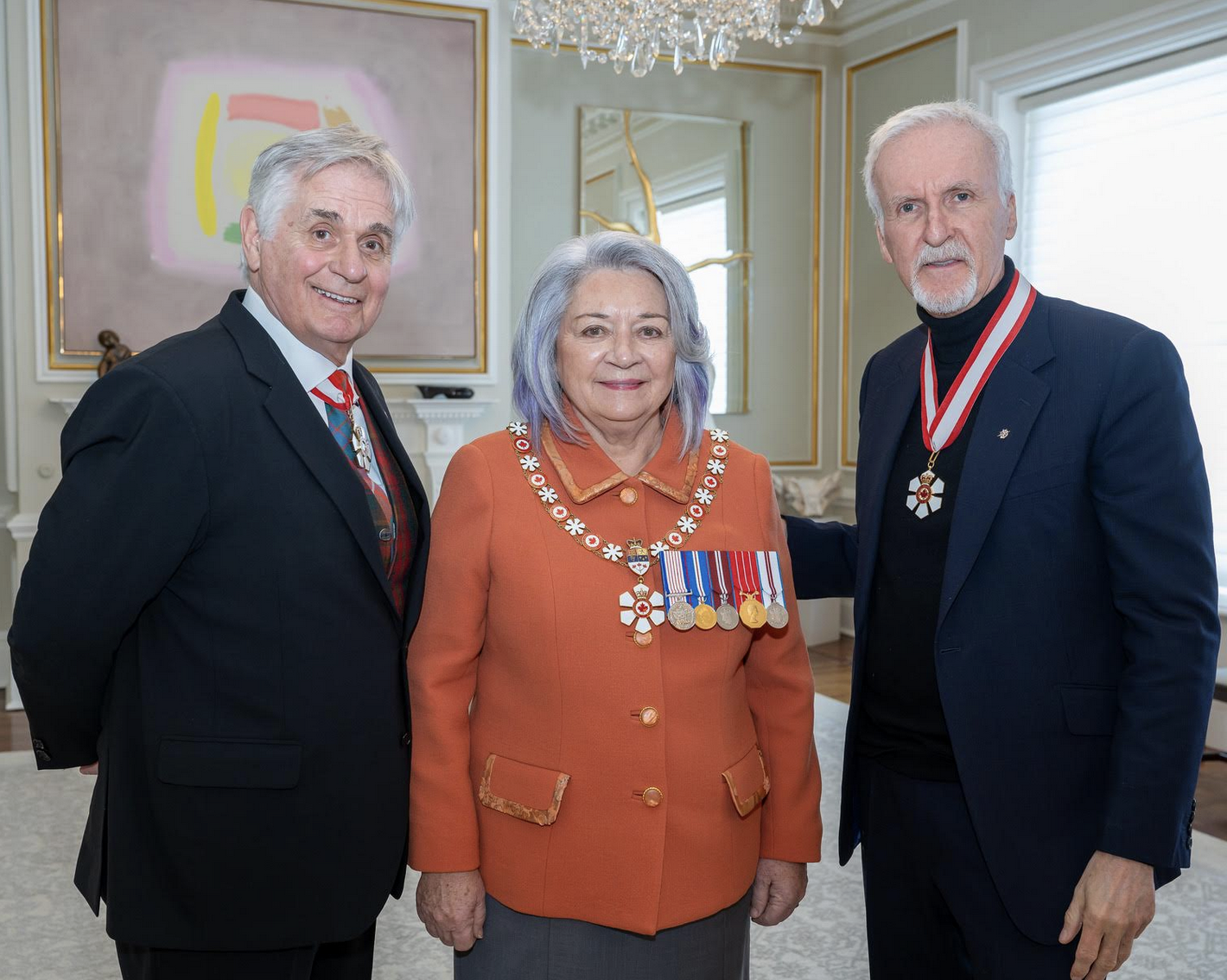 With James Cameron during his investiture as a Companion in February, 2024/MCpl Matthieu Racette, Rideau Hall ©OSGG
James Cameron, one of the world’s most creative film directors, was invested as a Companion of the Order in 2024. Responding to a compliment on the stylish black sweater under his suit jacket, Mr. Cameron admitted his choice was calculated — his iconic Order of Canada medal would stand out more against the black. That he had put so much thought into it was deeply touching.
The ceremony concludes with O Canada performed by a soloist, and everyone — especially those like me, a little older and a little stooped — stands a little straighter and a little taller.
There are always tears. Rarely does anyone feel the need to wipe them away.
Whit Fraser’s latest book, From Ragged Ass Road to Rideau Hall: Stories of Canada, will be released by Douglas and McIntyre in April 2026.