There Goes the Hemisphere: History, Diplomacy, and Trumpian Intervention

January 6, 2026
Operation Just Cause in Panama. Operation Midnight Hammer in Iran. And now, Operation Absolute Resolve in Venezuela. The American branding of military interventions is its own propaganda sub-specialty.
Of course, that last one — Donald Trump’s January 3rd removal of Venezuelan President Nicolás Maduro from office and rendition to Brooklyn to face drug trafficking charges — comes with its own context and potential consequences, including for Canada and, more immediately, Greenland.
The context is defined first and foremost by the exceptional nature of an autocratic American president citing a re-booted Monroe Doctrine — as, if not a casus belli at least a normalizing precedent — for hemispheric military intervention.
The context is also defined by an element that was not a factor in Trump’s previous military operations: the legacy of U.S-driven, often covertly-secured regime change in Latin America during the 20th century, and how the collective sociopolitical trauma of that legacy impacts the regional responses to Trump’s actions — both immediate and going forward.
Mexican President Claudia Sheinbaum’s comment on Operation Absolute Resolve and Trump’s subsequent threats against Mexico, among other countries in the region, illustrates the point: “The history of Latin America is clear and compelling: intervention has never brought democracy, never generated well-being, nor lasting stability.”
In fact, there is an absence of a coherent succession plan in Caracas, despite Trump’s pithy assertion that “we will run Venezuela”, later walked back by Secretary of State Marco Rubio, then walked forward again by Trump.
While this vagueness may be tactical, it has not reassured an international community — the democratic core of which has just met in Paris at this writing to determine the future of Ukraine — that Trump’s intentions include a truly “Venezuela-led” transition to democracy via free and fair elections, especially given his role in degrading democracy in his own country and, by extension as the democratic superpower, globally.
Indeed, Edmundo Gonzalez — widely recognized as the legitimate winner of the 2024 presidential election — has not been mentioned by Trump. The power behind Gonzalez, 2025 Nobel Peace Prize winner María Corina Machado, has been dismissed by Trump as not having enough gravitas to lead. As I have witnessed in multilateral settings, Trump does little to hide his ambivalence toward women leaders.
Instead, the Americans are dealing with Delcy Rodriguez, Maduro’s long-serving associate and vice-president, now acting president. Rodriguez’s public statements suggest that her compliance may not be guaranteed, despite recent comments referring to a willingness to cooperate.
Rodriguez’s mixed messaging, aside from any other exigencies it betrays, underscores the difficulty in balancing whatever arrangements have been made between the Trump administration and the post-Maduro Maduro regime — including the possibility of preventing a transition to democracy — and politically validating the enduring anti-American sentiment in the region. Rodriguez has already been rounding up civilians and foreign journalists in the capital, which may endear her to Trump.
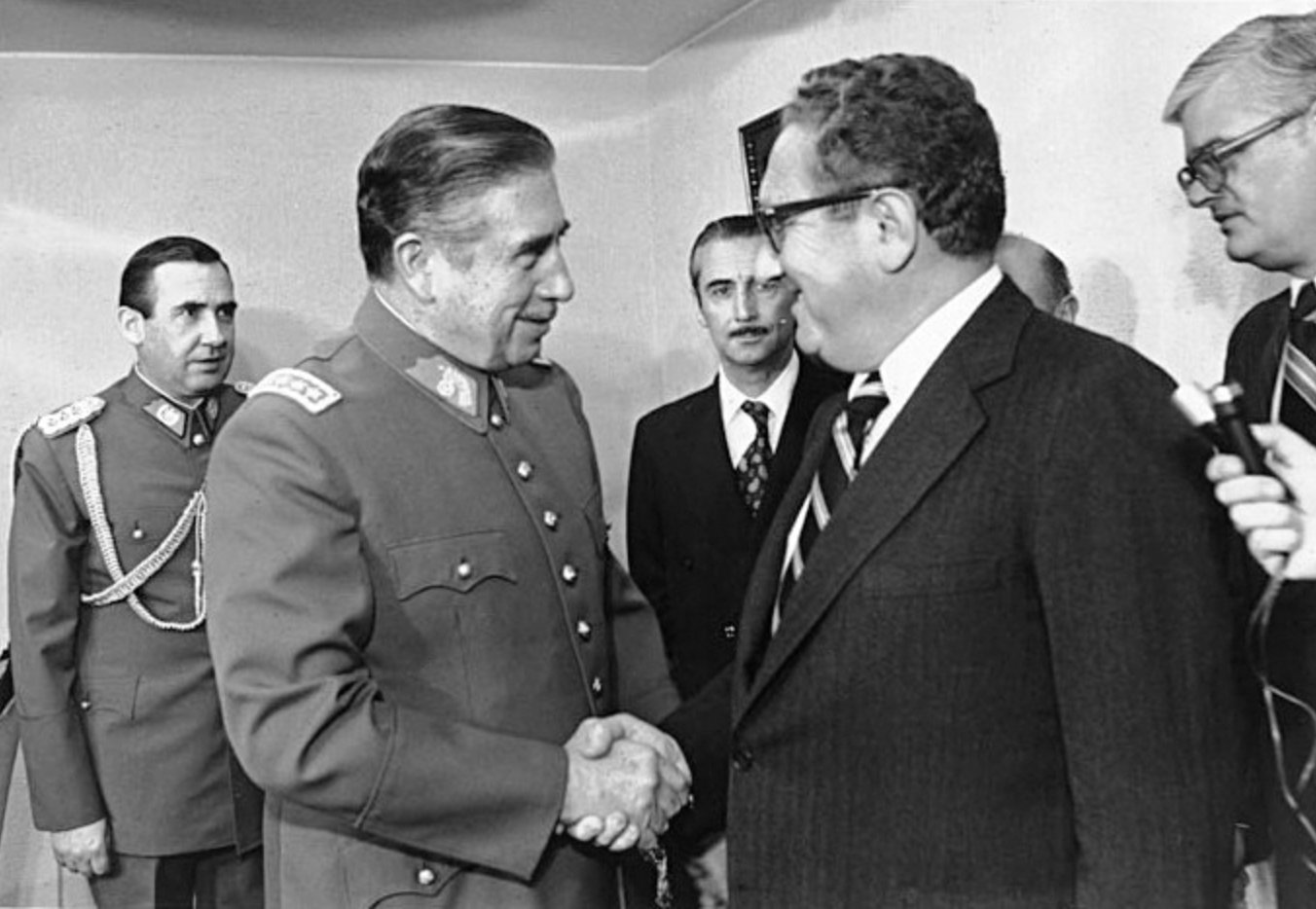 Dictator Augusto Pinochet and U.S. Secretary of State Henry Kissinger in Santiago, 1976/Ministerio de Relaciones Exteriores de Chile
As a diplomat who served in both Latin America and as Canada’s permanent representative to the Organisation of American States in Washington, I am deeply familiar with the mistrust that is now woven into the social fabric of a region that saw a parade of brutal dictatorships inflict generational damage over decades.
The U.S. contribution to that history was justified during the Cold War by ideology, but as with Trump’s removal of Maduro, was often undergirded by economics.
I was involved on the periphery of Just Cause — the American invasion of Panama in 1989 — which had the objective of removing strongman Manuel Noriega from power and re-establishing a US-friendly government.
Operating out of our embassy in San Jose, Costa Rica since we did not then have a diplomatic presence in Panama, I was the first Canadian diplomat into Panama City post-operation, charged with verifying the safety of Canadian citizens and our interests.
When I arrived in Panama City, it looked like a war zone; there were still bodies in the streets. I stayed in the same hotel as the U.S. military, the Mariott, and in a classic diplomatic Zelig moment, gave directions to US soldiers in a Jeep who were headed for the Nunciatura — the Vatican embassy, where Noriega was holed up — to set up the speakers for Noriega’s notorious music torture.
That carefully curated psy-ops playlist included The Clash’s I Fought the Law, Van Halen’s Panama, and in a priceless Can-con detail, Bruce Cockburn’s If I had a Rocket Launcher. I worked with our honorary consul, of course, regarding the safety of Canadians and our interests.
Understanding the recent history of our hemisphere is now both important and necessary, particularly in the United States, as it tries to operationalize its controversial National Security Strategy. At a time when global trends in power consolidation are tilting ominously away from democracy and the rule of law, the entire concept of sovereignty is also trending.
The principle of sovereignty is embedded in Latin American memory, to the extent of being regularly leveraged as nationalism by populist politicians, none more so than Venezuelan President Hugo Chávez, whose anti-American Chavismo defined Venezuelan politics, economics and foreign policy from 1999 until his death in 2013.
My dealings with Chávez over the years ranged from his visit to Ottawa as president-elect in January 1999 to his address to the OAS Permanent Council in September of that year in the Hall of the Americas at OAS headquarters in Washington.
When Chávez came to me in the traditional post-speech hand-shaking rounds, he paused and told me how much he had enjoyed his trip to Ottawa and throwing snowballs at the back wall of 24 Sussex with Prime Minister Jean Chrétien (Venezuelans love baseball). We then had a brief word on participatory democracy.
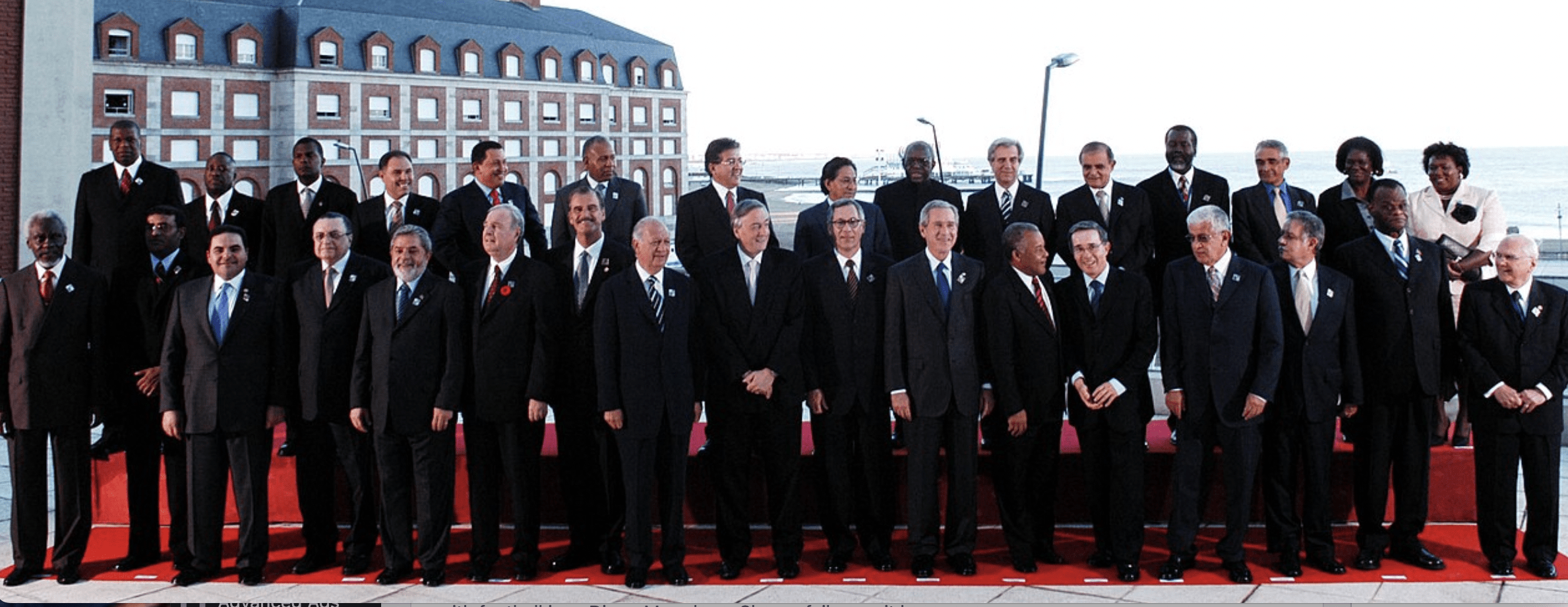
The Fourth Summit of the Americas, Mar de Plata, Argentina, November 4, 2005/: Presidencia de la Nación Argentina
At the OAS Summit of the Americas at Mar del Plata, Argentina, in November 2005, Prime Minister Paul Martin asked me to set up a bilateral meeting with Chávez (Martin, above, sixth from left, with Chavez directly behind him). I did not have much luck with Chávez’s people, ended up speaking with him directly (he remembered me as “el alto compañero Canadiense” — “the tall Canadian comrade”) and he agreed to a meeting.
It fell apart after Chávez received a better offer: a stadium appearance with football icon Diego Maradona. Sherpa failure — it happens.
Maduro’s doubling down on Chávez’s authoritarian populism, embrace of China, Cuba, and Russia, and brutal economic repression of his fellow citizens represented one of the starkest authoritarian spirals of this century, with the asterisk that we have yet to witness the full import of Donald Trump’s improbable trajectory.
There are now 2.8 million Venezuelan refugees in neighbouring Colombia, 1.7 million in Peru, and high numbers in other Latin American countries, including Mexico. Canada has been among the top 10 destinations. About 8 million Venezuelans have left their country during Maduro’s rise to power and his consolidation of Chavizmo, representing the largest displacement crisis in hemispheric history.
That the Trump administration has removed Maduro but so far kept his government in place may represent the most ironic twist in Trump’s long line of strange-bedfellows alliances. For Trump, the more pressing issue is likely mergers and acquisitions — as in oil — than working towards the restoration of democracy.
Venezuelan heavy crude may be destined for Texas refineries; our oil sands bitumen is still shipped to the northern United States. Nonetheless, searching for markets for our heavy crude has become more urgent.
What will suffer over the medium and long term will be the inter-American system — again, like most international postwar institutions, a creation of the United States. The Trump administration has made no public reference to a future role for the Organization of American States to support democratic development, whether in making the electoral apparatus impartial, stimulating dialogue among political factions, or the eventual observation of elections.
Nor have there been any suggestions as to what the Inter-American Development Bank could do to assuage the serious economic crisis in Venezuela. The OAS has its detractors, but it has proven itself as a useful vehicle on democratic development, especially elections, at various times in the past decade.
Indeed, it was Canada, just after joining the OAS in 1990, that created the Unit for the Promotion of Democracy. It was controversial among some member states at the time in that they saw its emphasis on observable elections as a potential infringement on sovereignty. As the largest contributor to the OAS (Canada is in second place), the US could still think creatively about partnerships.
But with Trump’s own stated aversion to multilateralism and complaints about US support for such institutions, this is unlikely. The Dominican Republic postponed if not cancelled its hosting of the next Summit of the Americas, originally scheduled for last month, because of the chaos fomented by Washington, to say nothing of a US aircraft carrier group in the Caribbean.
Where does all this leave Canada, and what is our role? In keeping with the best of our diplomatic traditions, our political statements have placed us squarely on the fence. But that is just a marker. Prime Minister Mark Carney has spoken with María Corina Machado, as well as with other regional and European leaders.
Carney should cement his relationships with Sheinbaum and Brazilian President Lula da Silva, begun at the Kananaskis G7 Summit. We should double down on and accelerate our trade negotiations for a free trade agreement with the countries of MERCOSUR and in fact see whether in the medium term a reformed, restructured Venezuela could form part of a future deal.
Finally, with the U.S. actions over the past several days it is clear that the Trump administration has embarked on a new, unrestricted and adventurist path in the western hemisphere from the south to the north (if the Greenland threats hold true).
Our foreign and international trade policy must become more agile, and those small, focused-issue and like-minded country coalitions that Mark Carney has talked about need to take flight.
Finally, and I say this as someone who sits independently in the Canadian Senate without political affiliation, the events in Venezuela should be a rallying cry to all our politicians: We need to think and act in less partisan, more unifying terms.
Not just for the future of Canada, but for the future of the free world.
Policy Contributing Writer Sen. Peter M Boehm is Chair of the Senate Standing Committee on Foreign Affairs and International Trade and a former ambassador and deputy minister. In the hemisphere, he has served in Cuba and Costa Rica and as Ambassador and Permanent Representative to the Organization of American States in Washington DC. He also served as as Canada’s Sherpa for six G7s.