Welcome to Davos 2026: High-Altitude Damage Control in a Risky World
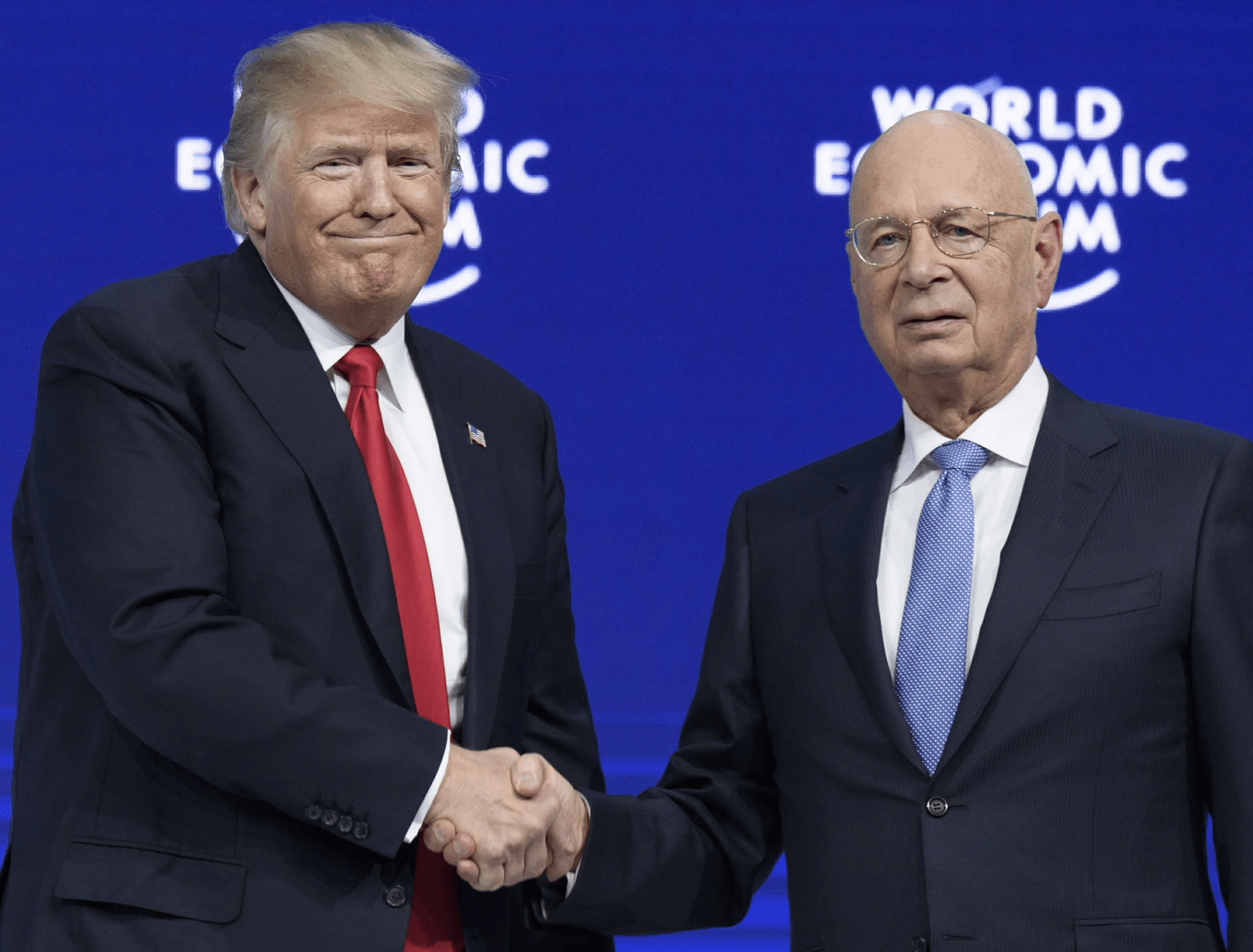 Happier times: U.S. President Donald Trump and WEF Founder Klaus Schwab in 2018/AP
By Kevin Lynch and Paul Deegan
January 18, 2026
The 2026 edition of the World Economic Forum that begins Monday will be notable for the attendance of Prime Minister Mark Carney in his first Davos appearance as head of government, and what will presumably be the dominance-marking presence of President Donald Trump the next day.
The Swiss must be praying that Trump doesn’t decide that its luxury goods industries, exclusive resorts and prime geographical location constitute a national security threat to the United States if the Alpine financial haven were to fall into hostile hands.
With Trump the disruptor on hand, other world leaders, including Prime Minister Mark Carney, will also be present and accounted for, presumably to minimize the damage as Trump continues to act as the main accelerant of a global power shift.
Accompanied by President Volodymyr Zelensky, they will hold meetings with Trump on the future of Ukraine. The U.S. President will no doubt also trumpet his new “Board of Peace” for Gaza and elaborate on his threat of punitive tariffs on European countries that do not support his take-over of Greenland. It should be quite a week on the mountaintop.
Besides the Trump dynamics, the agenda for the annual Davos meetings is a subtle indicator of what is hot and what is not in government, business and civil society circles. The overreach award goes to a panel titled ‘Governments as Economic Super Actors’, where Canada’s François Philippe Champagne is one of the speakers, while the last-minute addition award clearly goes to the panel on “Venezuela: What Next?”.
Sessions on ‘The Future of War’, ‘Is Democracy in Trouble’ and ‘Can Europe Defend Itself’ are a sign of the times. Numerous panels on advanced technologies such as AI and quantum computing, including one captioned ‘Factories that Think’, provide a glimpse of a future with jobless productivity. What is noticeably absent is also illuminating: there are few sessions this year on DEI and climate change.
In advance of Davos, the World Economic Forum released its annual Global Risks Report. The WEF surveyed 1300 global leaders in business, government and civil society in August and September of 2025 to compile their annual top 10 global risks for the year ahead, asking the question: “Select one risk that you believe most likely to present a material crisis on a global scale in 2026”.
We are now in an era of radical uncertainty, to use the evocative term of Margaret MacMillan.
This year’s report begins with the warning: “As we enter 2026, the world is balancing on a precipice.” The two top risks were: geoeconomic confrontation (18% of respondents) followed by state-based armed conflict (14% of respondents). High single-digit responses identified extreme weather events, societal polarization and misinformation and disinformation risks. The rest of the top 10, which ranged from 5% to 3% of respondents, included economic downturn, erosion of civic freedoms, adverse AI outcomes, cyber insecurity, and inequality.
Since the survey was conducted before the scary new US National Security Strategy was issued as well as before the armed incursion into Venezuela to capture President Nicolàs Maduro and the Trump drumbeat threatening to take over Greenland by force, it is unlikely that concerns about state-based armed conflict have lessened.
Fears of geoeconomic confrontation were fuelled by Trump’s Liberation Day global tariff attacks, his aggressive neo-imperialism and his open disdain for legally binding trade agreements such as CUSMA. In addition to Trump’s destructive tariffs, the report also cites the increased use of state sanctions and capital restrictions and the weaponization of supply chains. This rise of multipolarity without multilateralism risks leading to geopolitical spheres of influence, such as Trump has suggested with his so-called “Donroe” doctrine, and deglobalization.
As a sign of these tumultuous times, environmental concerns were less prominent among the near-term risks. Demographically, those under 40 cited misinformation and disinformation as the top risk. A theme connecting many of these risks — including misinformation and disinformation, adverse outcomes of AI, and cyber insecurity — was the perspective that technological risks are growing and largely unchecked.
Amplifying the misinformation concerns, the report cites global survey data from the Reuters Institute which indicates that 34% of Americans now look to social media as their primary source of news while 58% globally worry about misinformation amidst growing fears that AI will “make the news less transparent, less accurate and significantly less trustworthy.”
We are now in an era of radical uncertainty, to use the evocative term of Margaret MacMillan. The Global Risks Report’s mapping of risks provides a timely and helpful perspective for what governments, businesses, investors and citizens need to be prepared for this year. It certainly will shape the public and private discussions among political and business leaders at Davos.
These risks have clearly influenced the thinking of Prime Minister Carney as Canada pivots to a “strategic diversification” away from the United States. The imperative appears to be building national resilience, and his new trade relationship with China can certainly be viewed in this context. Strengthening growth and productivity are part of creating this resilience. New defence relationships with Europe and South Korea must be part of Canada’s security pivot in addition to increased military spending.
With NATO troops deploying to Greenland to defend a NATO country against another NATO country, perhaps Davos will provide an opportunity to organize a common front against Trump’s outrageous actions threatening the sovereignty of Greenland. That would be a valuable Davos contribution to reducing global risks in 2026.
Kevin Lynch served as clerk of the Privy Council and vice chair of BMO Financial Group.
Paul Deegan is CEO of Deegan Public Strategies and was an executive at BMO and CN.