
As Canada Sides with Greenland and Denmark, a Reminder of the ‘Whisky War’
 From left: Canadian Department of National Defense, Polfoto/via New York Times
By Daniel Béland and Klaus Petersen
January 19, 2025
Prime Minister Mark Carney has made clear Canada’s support for both Greenland and Denmark in the escalating crisis over Donald Trump’s stated determination to “acquire” Greenland against its — and Denmark’s — will, and amid the latest, shocking triangulation to weaponized tariffs as a form of coercing silence from critics of his plan.
Carney met with Danish Prime Minister Mette Frederiksen when he was in Paris in early January for a meeting of the Coalition of the Willing on Ukraine.
The Prime Minister stressed Canada’s support for the joint statement on Greenland by Denmark and key European countries issued earlier that day, affirming that: “Greenland belongs to its people. It is for Denmark and Greenland, and them only, to decide on matters concerning Denmark and Greenland.”
Carney also announced that, in early February, Foreign Affairs Minister Anita Anand and Governor General Mary Simon, “who is of Inuk decent,” would visit Greenland, where they are “expected to open a consulate in Nuuk”.
Clearly, Canada is showing support for Denmark and Greenland at a time during which President Trump claims that the U.S. must “own” Greenland, a threat that is creating a crisis within NATO, an organization that Canada, Denmark, and United States help create in 1949.
For Canada, this is a no-brainer. Our distance from Greenland is a mere 26 kilometres at Ellesmere Island. But Canada and Greenland also share a land border. It is located on tiny Hans Island (Tartupaluk in Greenlandic), in the centre of the Kennedy Channel of the Nares Strait.
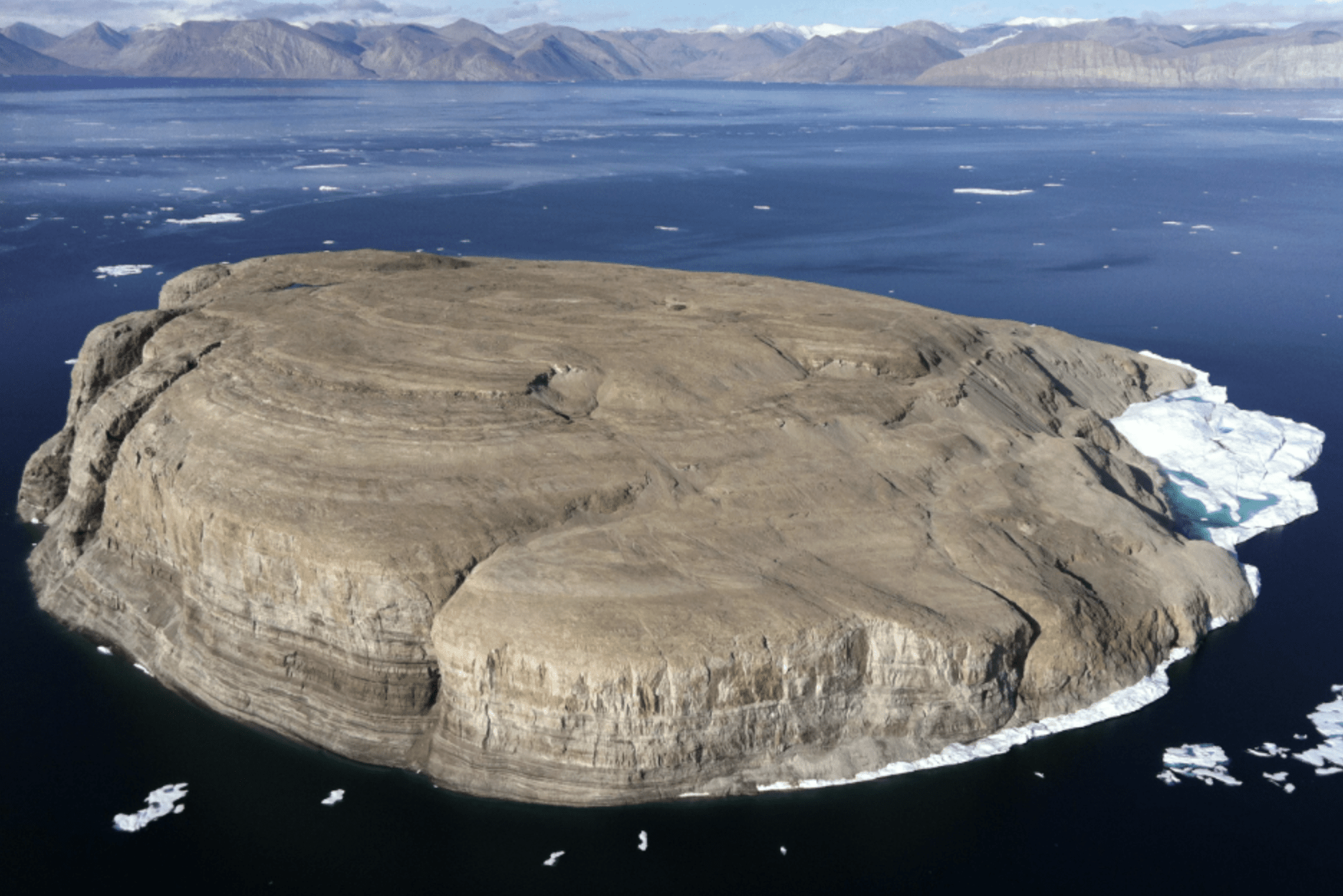 Hans Island: The international border runs approximately from the top left to the lower right, with Denmark on the left and Canada on the right/Toubletap via Wikipedia
Although it is a barren, uninhabited “1.3-square-kilometre rock,” Hans Island’s strategic location within the arctic region and exactly between Canada and Greenland makes it important with respect to controlling a future sea route north of Canada to the Pacific Ocean and access to natural resources (oil, gas, and minerals) in the Arctic Ocean. This explains why it was at the centre of diplomatic wrangling between these two NATO allies for half a century.
In 1973, Canada and Denmark ratified a treaty delineating a continental shelf border in the Nares Strait but deliberately left unresolved the status of Hans Island. Then in 1984, what we do know amid the conflicting accounts of “who started it” is that Danish Minister of Greenland Tom Høyem landed in a helicopter and planted the Danish flag on Hans Island, with a note saying, “Welcome to the Danish Island” and a bottle of Schnapps. Canadian soldiers also visited the island that year and left a bottle of Canadian whisky, also implying a unilateral declaration of sovereignty. (There are conflicting accounts of the sequencing of those two visits, but Høyem insists his was the first drop).
This launched a peaceful tit-for-tat that continued over a couple of decades with the tradition that replacing the flags was accompanied by a note saying “welcome to the Danish island” or “Welcome to Canada” and a bottle of national liquor (Gammel Dansk bitter or Canadian Club Rye). It became known as the Whisky War, and a cheeky model for calm, cool conflict.
In 2005, things started to escalate as the geopolitical importance of the Arctic increased. In July of that year, Minister of National Defence Bill Graham made a highly symbolic visit to Hans Island, which was followed the next month by a report from the Danish Geological Institute finding that, geologically, Hans Island was part of Greenland.
Yet, to avoid further escalation, the two countries quickly established a mediation process that led to scientific cooperation, and, in 2012, a border agreement that explicitly avoided the issue (on the map Hans Island was marked with a circle on its borderline to signal that it remain in contention). In 2022, the issue was finally resolved through the signing of a bilateral agreement that allocated Canada 40 percent, and Denmark 60 percent of the island, and stated the importance of securing Inuit access to and control over Hans Island.
So, Canada’s support for Denmark against Trump’s unprecedented threats isn’t just reflexive support for another democracy under attack. It comes with the moral authority of two former belligerents whose only war was waged with what The New York Times favourably compared to nastier border disputes measured in bloodshed. “That’s not how Canada and Denmark roll,” wrote Dan Levin in 2016. “Their way of contesting ownership of an uninhabited island in the Arctic would better suit a dinner party than a battlefield: It comes down to B.Y.O.B.”
The peaceful resolution of the Hans Island dispute and the two countries standing side-by-side against the U.S. administration’s territorial expansionism points to the ongoing strength of the diplomatic relationship between Canada and Denmark.
These two founding members of NATO are now collaborating with their other allies to rein-in the Trump White House’s arctic and Western Hemisphere ambitions, to make sure that a teetotal U.S. President never plants a third flag on Hans Island, with or without a bottle of Kentucky bourbon.
Daniel Béland is professor of political science and director of the McGill Institute for the Study of Canada at McGill University.
Klaus Petersen is professor of History at the University of Southern Denmark and in the Danish Centre for Welfare Studies.