
Poll Shows Canadians Support Higher Defence Spending, but Not to Buy American
 A new Nanos poll has good news — and a caution — for the Carney government on defence spending/Shutterstock
Jean-Christophe Boucher and Philippe Lagassé
January 22, 2026
Prime Minister Mark Carney’s government has promised to massively augment Canadian defence spending. The level of spending proposed, which would see the Canadian defence budget increase to $150 billion per year by 2035, is unusual for Canada.
The last time Ottawa spent this much on the military as a portion of GDP was the early Cold War. Given the deficits, debts, and potentially higher taxes that Canadians will have to carry to cover the cost of these outlays, it is worth asking whether and why Canadians support these increases.
The answers are surprising, but are good news for the Carney government overall — except when it comes to how Ottawa will have to balance its relationship with the United States and future acquisitions of American defence capabilities.
As part of the Canadian Defence and Security Network, the University of Calgary in collaboration with Nanos Research, conducted surveys of Canadians in 2020 and 2025 to gauge their knowledge, perceptions, and attitudes toward defence and security issues.
The 2020 survey included 1,504 Canadians, with a margin of error of ±2.5 percentage points, 19 times out of 20. The 2025 survey, conducted in October-November, included 1,529 Canadians, with a margin of error of ±2.5 percentage points, 19 times out of 20.
First, we asked Canadians to assess international threats to Canada. The change over the past five years is striking. In 2020, only 41% of Canadians believed Canada faced international threats to a high degree. By 2025, this figure had jumped to 58%.
This suggests that Canadians are keenly aware of the deteriorating international security environment marked by Russia’s invasion of Ukraine, Chinese foreign interference and aggressive actions in the South China Sea and Taiwan Strait, and, most recently, President Trump’s rhetoric about Canada as a “51st state” and expressed desire to acquire Greenland.
Second, we measured the sources of this perceived international threat. In an open-ended question, we asked Canadians to identify the most important threats to Canada. Here again, the shift between 2020 and 2025 is extraordinary.
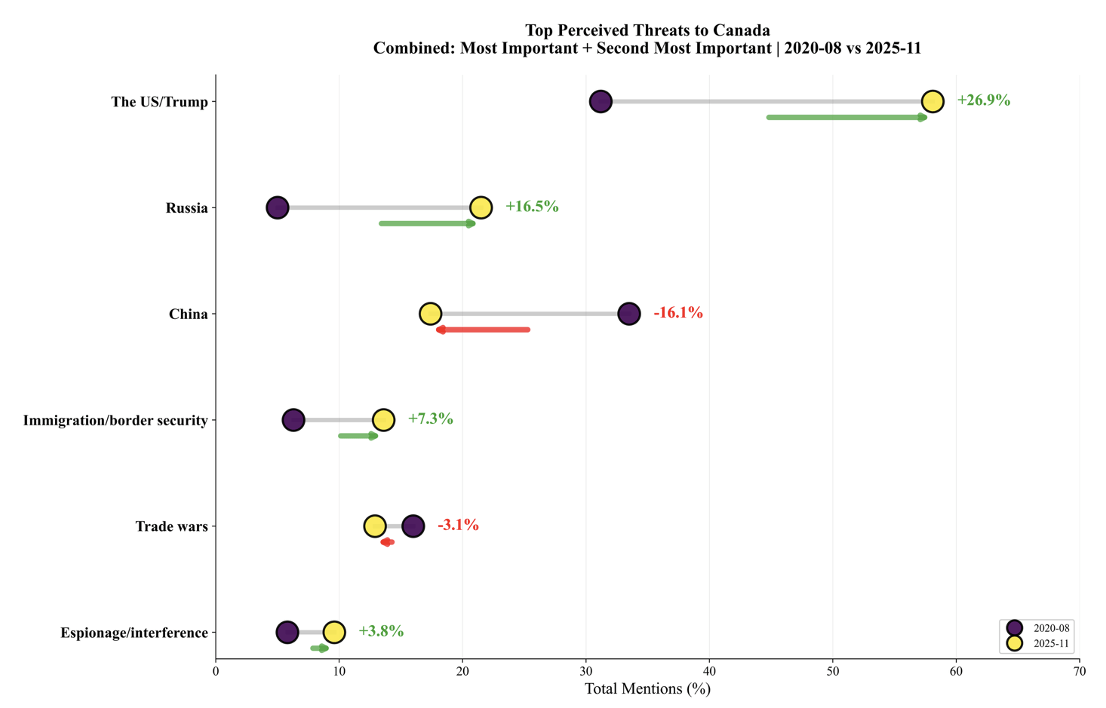
In 2020, China was considered the most or second-most important security threat to Canada at 33.5%, with the United States a close second at 31.2%. What about Russia? In 2020, they registered at just 5%. By 2025, the responses had flipped.
The United States or Trump now tops the list at 58.1%—a staggering 26.9 percentage-point increase from 2020. Russia vaulted to second place at 21.5%, up 16.5 percentage points. Meanwhile, threat perceptions of China dropped to 17.4%, a decrease of 16.1 percentage points, despite revelations of Chinese foreign interference in Canadian elections.
We then asked Canadians about their views on defence spending and military procurement. The shift here is equally remarkable. In 2020, 41% of Canadians believed we should spend more or much more on military spending—already a high share by historical standards. By 2025, this figure had reached 62%.
This suggests that Canadians are aware of the instability of the international threat environment. More importantly, Canadians are willing to make sacrifices to increase military expenditure. This is good news for the Carney government, which has committed to meeting the NATO target of 2% of GDP by March 2026 and further pledged at the 2025 NATO summit to increase defence spending to 5% of GDP by 2035.
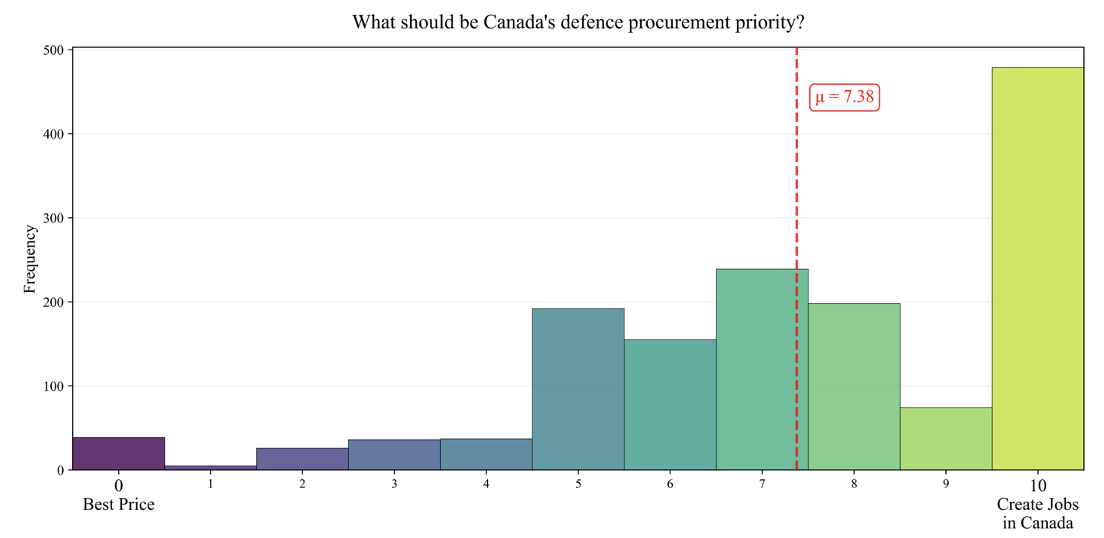
We also wanted to know about Canadians’ military procurement priorities. First, we asked Canadians whether the focus should be on securing the best price for military equipment or creating jobs in Canada. 64% prioritized job creation, which aligns with the Carney government’s position that defence expenditures can be a driver of economic growth.
Second, when asked specifically about purchasing military equipment from the United States—Canada’s longstanding preference—the results were surprising. 62% of Canadians disagreed with buying from the United States.
This result is a mixed blessing for the Carney government. On the one hand, Canadians support the Prime Minister’s argument that Canada should no longer spend 75 cents of every defence procurement dollar on American capabilities. On the other hand, future defence procurements that do come from the United States may face greater scrutiny, even as the percentage of capabilities bought from the United States declines.
The Carney government may need to carefully explain and justify additional purchases of American military equipment, especially if the price tags are particularly high or if an alternative capability from Canada, or from a European or Asian country, can be acquired.
These results point to another dilemma for the Carney government. The United States may expect, and perhaps demand, that Canada acquire American capabilities for a joint defence of North America. Washington may even make sticking with American capabilities a prerequisite for future trade deals.
That will be a tough sell for the Carney government at home.
Jean-Christophe Boucher is an associate professor at the University of Calgary.
Philippe Lagassé is an associate professor at Carleton University.