
The Big Split: How Canada and the United States Pulled Together, Then Apart
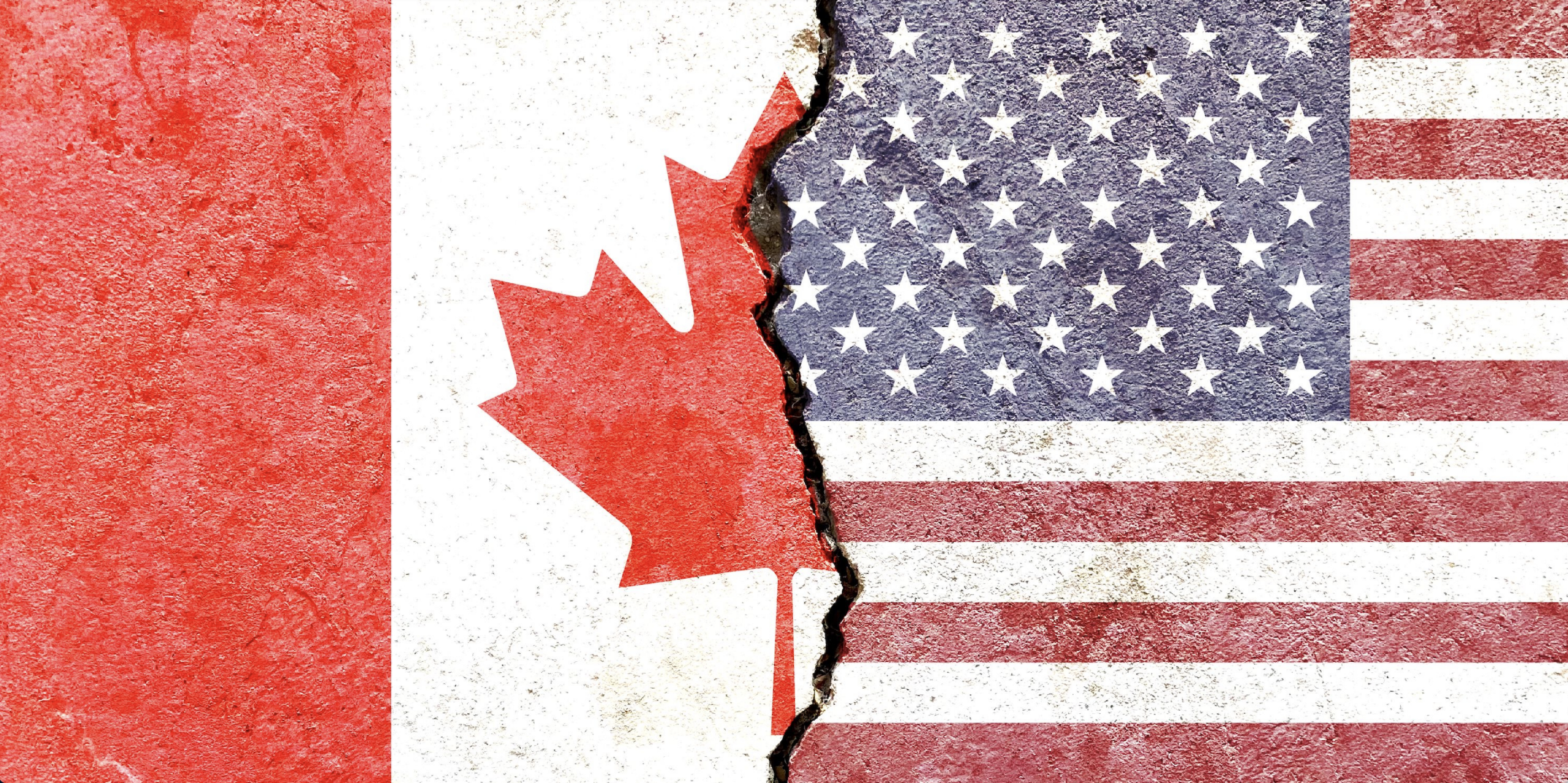 Shutterstock
By Drew Fagan
February 15, 2026
Dean Acheson, who served as U.S. secretary of state during the Truman administration, once said of Canada-U.S. relations: “Americans assume Canada to be bestowed as a right and accept this bounty, as they do air, without thought or appreciation.”
This notion of Canada being taken for granted by a neighbour not only more powerful — in an echo of asymmetrical bilateral dynamics across the globe — but by the most powerful country on Earth, has been a dominant theme of the relationship for a century.
But for the better (or worse) part of a decade, thanks to Donald Trump’s first and second presidencies, something else has been in evidence: an almost inconceivable opposition to Canada.
As the president said last fall, the very contiguity of the two countries means there is a “natural conflict” in their interests, particularly economic. (Prime Minister Mark Carney’s response, naturally enough, has been to seek counterweights.)
Canada hasn’t experienced this perspective since the late 19th century, when Washington essentially offered Ottawa a binary choice: Canada could enjoy free trade (or unrestricted reciprocity), if it joined the republic. If not, there would be tariffs.
Mr. Trump hasn’t put it quite so bluntly, but this seems to reflect his thinking.
Canadians are angry at Mr. Trump, and with reason. They see a man plainly unfit for his position messing around with bedrock Canadian matters and interests. But his Canada-sceptic views didn’t arise from thin air. To a sizeable extent, he has put an exclamation point on something that’s been building in Washington since the September 11, 2001, terrorist attacks — that the United States no longer has room for special treatment for anyone, even Canada.
The premise that Mr. Trump is mostly an amplifier and not an originator on changing Canada-U.S. relations is a subset of the premise that Mr. Trump isn’t the ur-source of the fire in domestic U.S. politics and global U.S. positioning. Instead, he identified average Americans’ rage over the financial crisis, China trade and never-ending wars and capitalized on it with appeals to U.S. nationalism and protectionism, often unscrupulously.
The late Canadian diplomat Allan Gotlieb summed up Canada’s age-old perspective on bilateral relations in a sentence in a 1991 speech: “Our overriding national preoccupation has been about how to limit U.S. power over our national destiny while deriving maximum advantage from our propinquity.”
At the time, the second part of the sentence — deriving maximum advantage — was waxing. The breakthrough 1989 Canada-U.S. Free Trade Agreement (FTA) was new. Further economic integration appeared an “inevitability,” Mr. Gotlieb said. And why not? The two countries had much in common. But U.S. unipolar dominance lasted barely two decades, brought down by the rise of China and America’s own miscalculations. Now, the need to limit U.S. power over Canada —the first part of the sentence — is waxing as economic relations wane.
How did we get to a place where relations are perhaps at their worst since the War of 1812? There are four distinct phases of Canada-U.S. relations that might be encapsulated as existential, normal, close, and then the shock of 9/11 and a decline in connections and cognizance amid a changing United States. It remains to be seen whether there will be a fifth stage where Mr. Trump forces more radical change still, as he has threatened to.
1867 to 1911: One Country or Two?
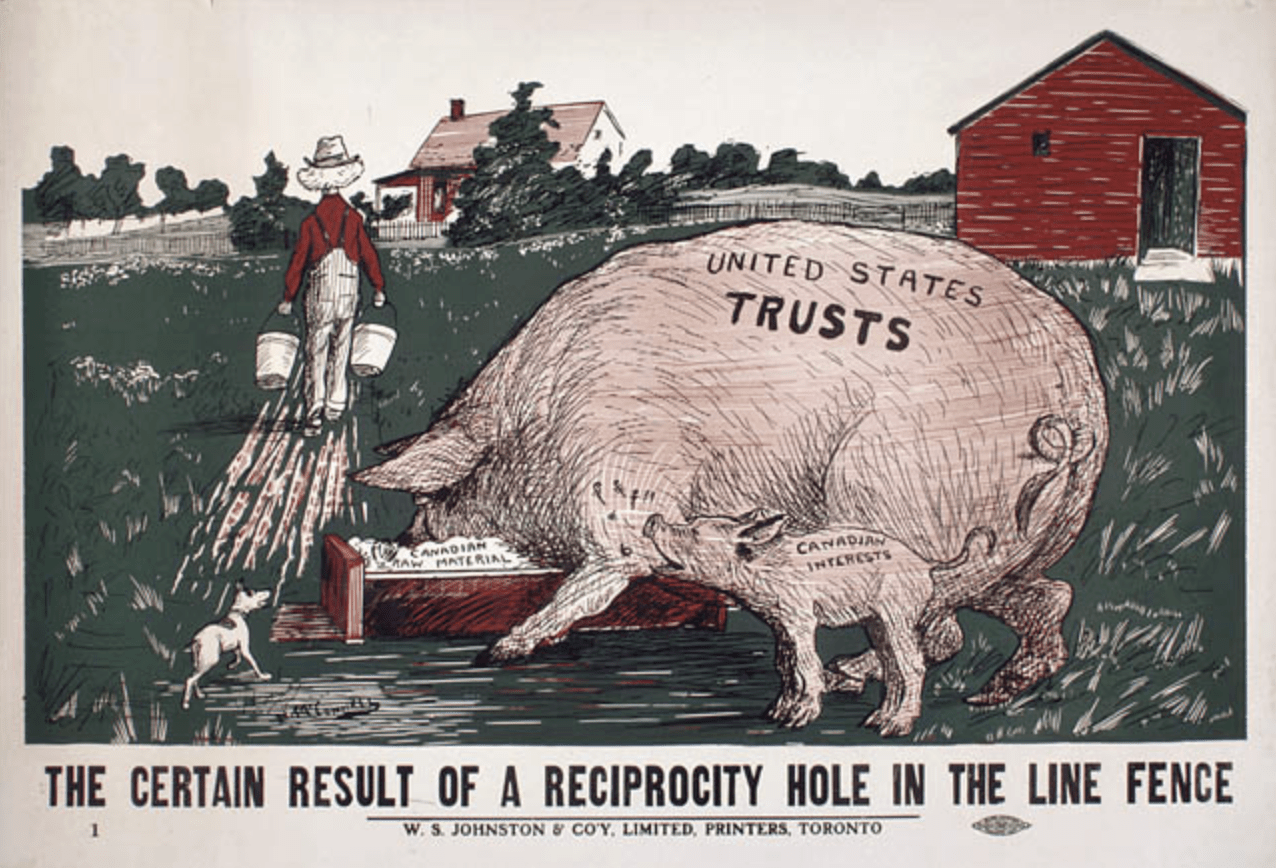 A 1911 Conservative campaign poster warns that big American companies will hog the benefits of reciprocity/LAC
The thumbnail sketch of Canada’s early years as a country reads like this: Confederation brought together four disputatious colonies after the United States ended limited reciprocity. Sir John A. Macdonald implemented the National Policy of tariffs that nurtured manufacturing in central Canada at the expense of Western farmers who benefitted from north-south trade. The policy limited U.S. influence. As Macdonald said in his final election victory in 1891: “A British subject I was born. A British subject I will die.”
But this misses important aspects. Macdonald thought of the National Policy as Option B and tried repeatedly without success to rekindle Washington’s interest in reciprocity. Washington calculated that Canada wasn’t viable without trade advantages and would seek political union soon enough. Of course, Canada never did. Meanwhile, Sir Wilfrid Laurier ran on a reciprocity platform twice and lost twice — in 1891 at the beginning of his career and in 1911 at the end.
Canada rejected annexation but many Canadians annexed themselves by moving south. In 1870, about 15% lived in the United States. By 1900, it was about 20%. Immigration grew with the settlement of the West but so did emigration, which didn’t slow until the Depression. The Dominion Statistician (the forerunner to the head of Statistics Canada) reported in 1937 that “perhaps a third of us are south of the line, whilst certainly not more than 1 per cent of the Americans are north.”
Mr. Trump — with his Gatling gun of tariffs and threats — is reprising an era that Canada can no longer consider dead and past, to paraphrase William Faulkner. As Mr. Carney suggested at Davos, Mr. Trump seeks to monetize the bilateral relationship. Studies show that the smaller party tends to gain the most in trading relationships among countries of different sizes. But both parties gain.
Mr. Trump is unlikely to get what he wants as Canada-U.S. economic ties are too intimate to be unwound significantly. Even if he triggered an end to free trade, which could happen on six months notice, global trading rules would ensure much continuity. There are many more mutually beneficial points of compromise now on the continuum between free trade and political union than there were after Confederation. Still, Mr. Trump seems at times to be imitating the thinking of William Seward, the secretary of state who bought Alaska in 1867 and distrusted Canada as a part of the British Empire. (Mr. Seward, who was one of the most accomplished and articulate leaders of the era, wouldn’t appreciate the comparison.)
1912 to 1946: Allies and Accommodation
In the first half of the 20th century, war brought the two countries together, but so did trade. Canada’s economy grew rapidly as did the U.S. economy, which had become the world’s largest. Canada’s close ties to London started to give way to Washington — if not de jure, then de facto. Canada financed its debt in New York and the two countries pooled military production.
Peacetime brought a new everyday comfort. Hollywood and radio meant U.S. entertainment entered Canadian homes. This led to the creation of the CBC, but the die was cast for cultural Americanization to the present day. Tariffs went higher during the early years of the Depression, but the threat of annexation was long gone.
Former prime minister Stephen Harper describes himself as probably Canada’s most pro-American leader. Others would say it was Brian Mulroney. But the title probably should go to William Lyon Mackenzie King, who spent many formative years in the United States and was decidedly North American in attitude at the expense of the old ties of empire.
After returning as prime minister in 1935, King signed a trade agreement with Washington — the first since before Confederation — that soon meant a major mutual cut in tariffs. The United States overtook Great Britain as Canada’s closest trading partner. Agreements providing for permanent mutual defence of the continent and coordinated military production during the Second World War went far beyond those of the later stages of the First World War. They were the flip side of economic alignment.
1947 to 2001: Continentalism Amid Pax Americana
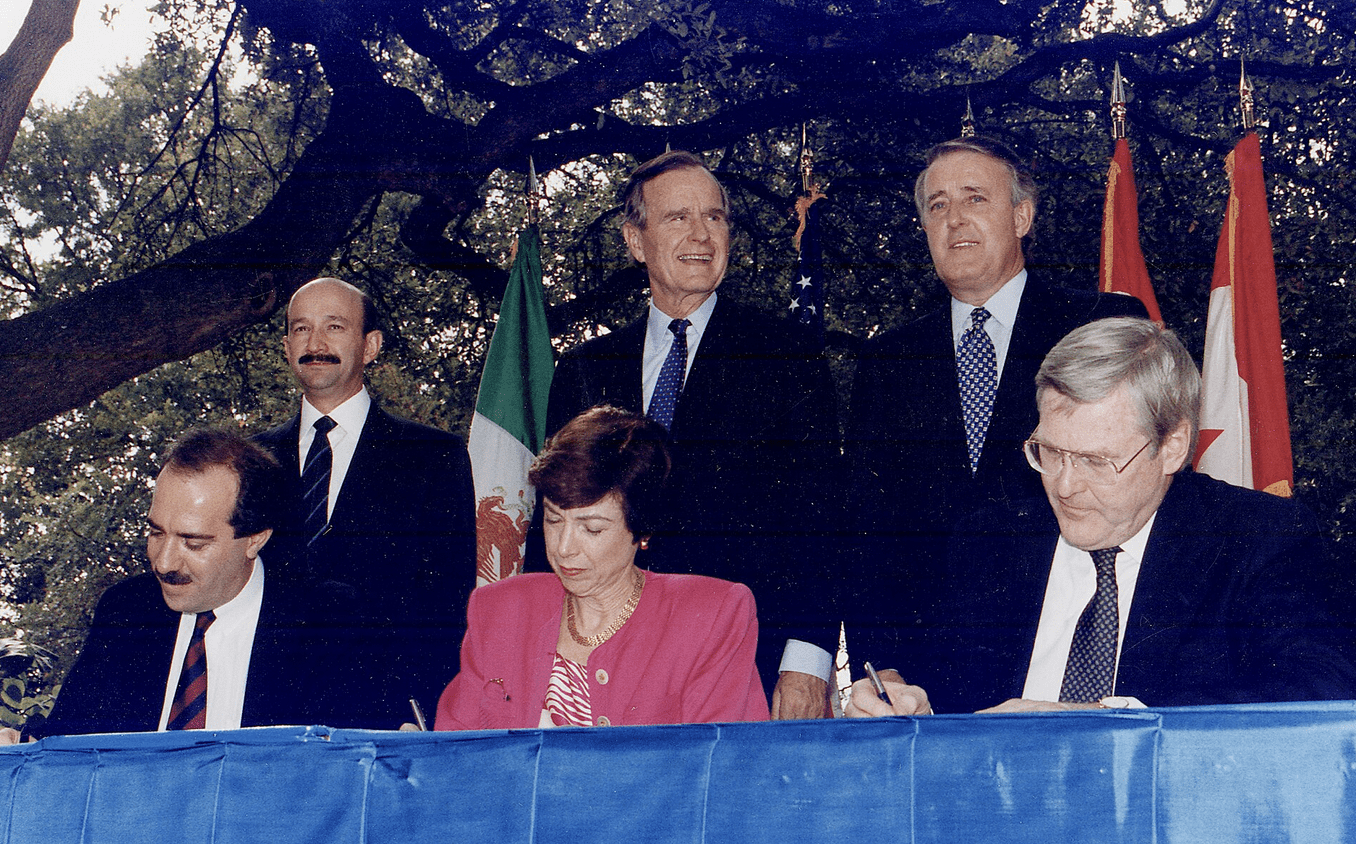 The NAFTA signing ceremony in 1992, San Antonio, Texas/US National Archives
King oversaw two trade agreements with Washington, though neither are well-known. The second one, in 1948, was never implemented.
The tentative deal deserves attention because it bears a resemblance to what Canada faces now, though in very different circumstances. The deal would have established free trade by eliminating tariffs. But it also would have established a customs union whereby the two countries coordinated their trade policies with other countries. The Trump administration is suggesting something similar.
Even without the 1948 pact, bilateral trade waxed for decades, especially on an intra-corporate basis. The coincident creation of the multilateral General Agreement on Tariffs and Trade (GATT) helped.
By the early 1970s, 75% of Canadian exports went to the United States, as it was when free trade with the United States took effect in 1989 (followed by the addition of Mexico with NAFTA in 1994). It was roughly the same last year too under the 2020 Canada-United States-Mexico Agreement (CUSMA) that Mr. Trump approved and that succeeded NAFTA.
The 1989 FTA was a seminal achievement, marking the first all-encompassing trade deal. (The Reciprocity Treaty of 1854 to 1866 was limited to natural resources, including agriculture and fisheries.)
The FTA eliminated tariffs. The United States also made an unprecedented concession in terms of its closely guarded sovereignty. The two countries agreed to resolve their disputes through a bilateral settlement process.
This was the key demand by Ottawa throughout the talks – to sheathe U.S. protectionist sentiment and power in rules. It was the last issue resolved and only with the involvement of then-president Ronald Reagan at the behest of Mr. Mulroney.
The process wasn’t perfect for various technical reasons, as critics emphasized. But it mostly worked, and just a small percentage of trade was disputed anyway as bilateral economic ties surged through the 1990s under the continental integration of NAFTA.
2001 to the present: Unstable Hegemon, Unbalanced Canada
Mr. Carney’s mantra is that ever-closer relations with the United States are now over and that Canada must react appropriately. But that era ended on 9/11. The years afterward were mostly about treading water.
A few statistics bear this out. In 1989, goods and services trade represented 50% of Canada’s GDP. In 2000, it was more than 80%, and 87% of Canada’s exports went to the United States. Free trade was working, perhaps too well.
This was the period when Canada – in the terminology of today – became “dependent” on the U.S. market. But few thought of it this way then. The relationship was asymmetrical in size as it had always been, but it was symbiotic in ways it had not been before, with major mutual benefit.
But the border closed for days after 9/11. This was the turning point. The line-up to cross became many kilometres long at the Ambassador Bridge in Windsor that is the subject of much controversy now as Mr. Trump rails at the planned opening of the nearby Gordie Howe International Bridge.
The Canada-U.S. border bristled with security-related protections in the years after 9/11. Ottawa and Washington worked on many initiatives with many acronyms to minimize the trade impact, with middling success.
Today, Canada’s trade in goods and services is less than 65 per cent of GDP and the share with the United States is back down to the average of the last 60 years. Peak integration, so to speak, was at the turn of the century.
More broadly, the struggling U.S. middle class and working class brought political pandering through protectionism. The crisis of U.S. democracy, building since the disputed 2000 election, reinforced this. Canada found it exceedingly difficult to win eligibility to bid on U.S. government contracts, for example, including stimulus contracts during the Obama and Biden administrations. It wasn’t just Mr. Trump.
The free-trade agreements that have bound Canada and the United States since 1989 were never meant to create an economic zone like the European Union. But they were meant to give Canada privileged access. U.S. protectionism today is much worse than it was before free trade.
Free trade was supposed to blunt the U.S. use of raw power, including through the dispute settlement process but also through a change in attitude in both countries. This certainly did occur for an extended time. But what was created bilaterally wasn’t equal to the subsequent rise in U.S. protectionist fervour and Mr. Trump’s determination to weaponize trade, and not just against Canada.
What Would Acheson Say?
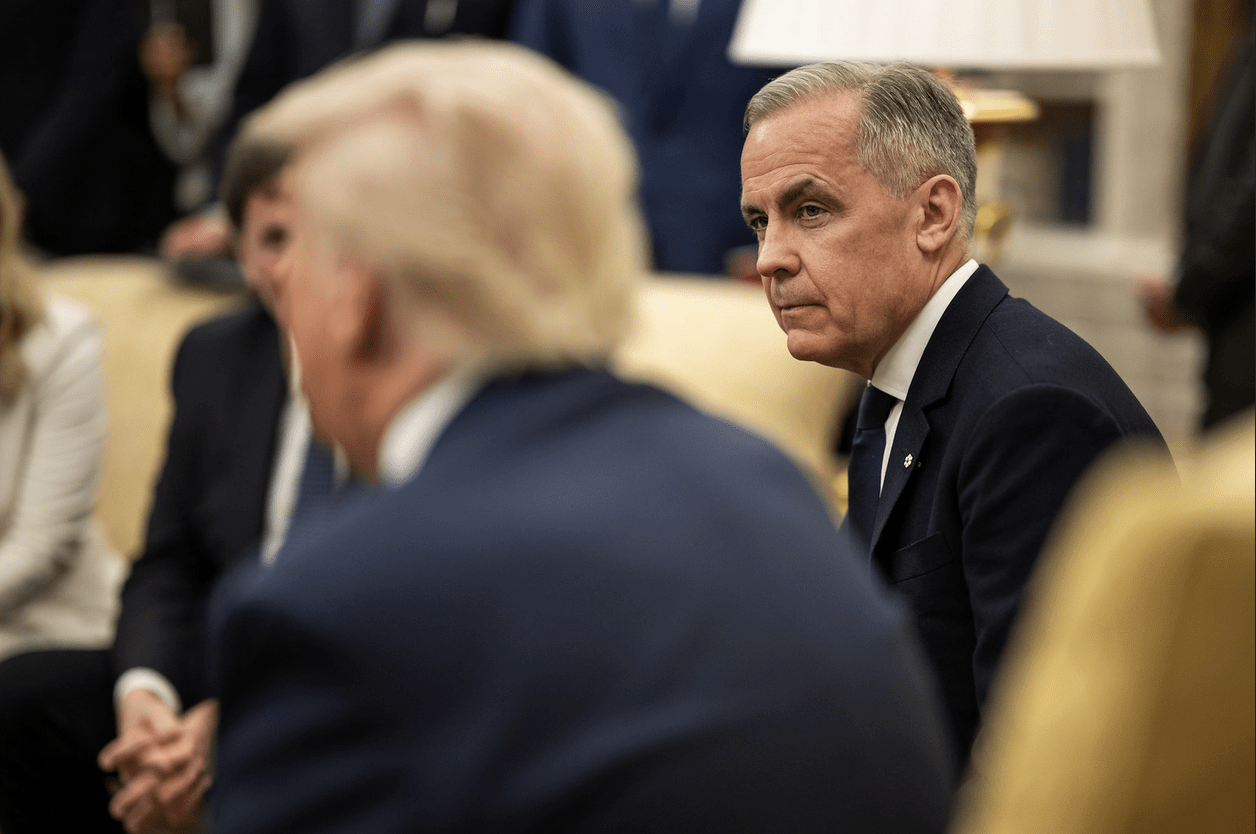 Prime Minister Mark Carney and President Donald Trump in the Oval Office, May 6, 2025/WH
Dean Acheson also once described Canada’s role on the international stage as “the stern daughter of the voice of God” — pious and moralizing, offering unsolicited advice, and free to do so because it was protected and not carrying the freight. It was a repurposing of the unironic opening line of William Wordsworth’s Ode to Duty.
Despite this, he dealt with Canada fairly and effectively, especially during the Korean War. One wonders what Mr. Acheson — whose parents emigrated to the United States from Canada — would have thought of Mr. Trump and of Mr. Carney.
Mr. Acheson was a professional of the old school — patrician and elitist — and a foreign policy realist. He also had more than a dollop of international idealism. He wouldn’t have thought much of Mr. Trump’s “everything is a nail to a hammer” routine. Mr. Acheson had more of a Swiss Army Knife approach.
Mr. Acheson was so involved in building the postwar global architecture now being dismantled by Mr. Trump that he titled his 1969 autobiography Present at the Creation.
As for Mr. Carney, Mr. Acheson was a staunch Democrat, and today’s senior Democrats have praised Carney’s Davos speech. Given the circumstances, Mr. Acheson probably would have considered Mr. Carney’s measured pivot to be appropriate for Canada’s changing circumstances.
But he especially would have found today’s dire state of Canada-U.S. relations to be unfathomable. How, Mr. Acheson would have asked, could an administration possibly think of Canada as an adversary? The American way is to take Canada for granted and no worse.
And so, we await Mr. Trump’s next gambit.
Drew Fagan is a professor at the University of Toronto and a visiting professor at Yale University, where he is teaching a graduate degree course on policymaking in Canada and the United States. He is a member of the Expert Group on Canada-U.S. Relations.