
Canada’s New Defence Culture and the Winning of Hearts and Minds
 Can Canadians embrace a national culture of defence?/Shutterstock
This piece is published by Policy in cooperation with McGill University’s Max Bell School of Public Policy as part of our Emerging Voices program, which provides an editorial platform for students in public policy.
By Shane Joy
February 24, 2026
After years of Canadian leaders failing to deliver on defence spending commitments, Prime Minister Mark Carney has — including with the recent release of his government’s Defence Industrial Strategy (DIS) — broken that record, effectively asserting that this time is different.
To a certain extent, Prime Minister Carney is correct: Canada faces mounting pressure from a United States whose president has signalled a desire to control the Western Hemisphere, an autocratic Russia across the Arctic, and more systemically, an ambitious China eyeing unipolar dominance.
At the NATO summit in June, Ottawa pledged to increase defence spending to 5% of GDP by 2035, marking what would be the largest peacetime military build-up in Canadian history.
The scale of the transformation underscores the magnitude of the fiscal shift that will be required. Most of Canada’s NATO commitment consists of core defence spending, which would reach $159.1 billion in 2035, far surpassing the projected size of major federal transfers, including the Canada Health Transfer and elderly benefits.
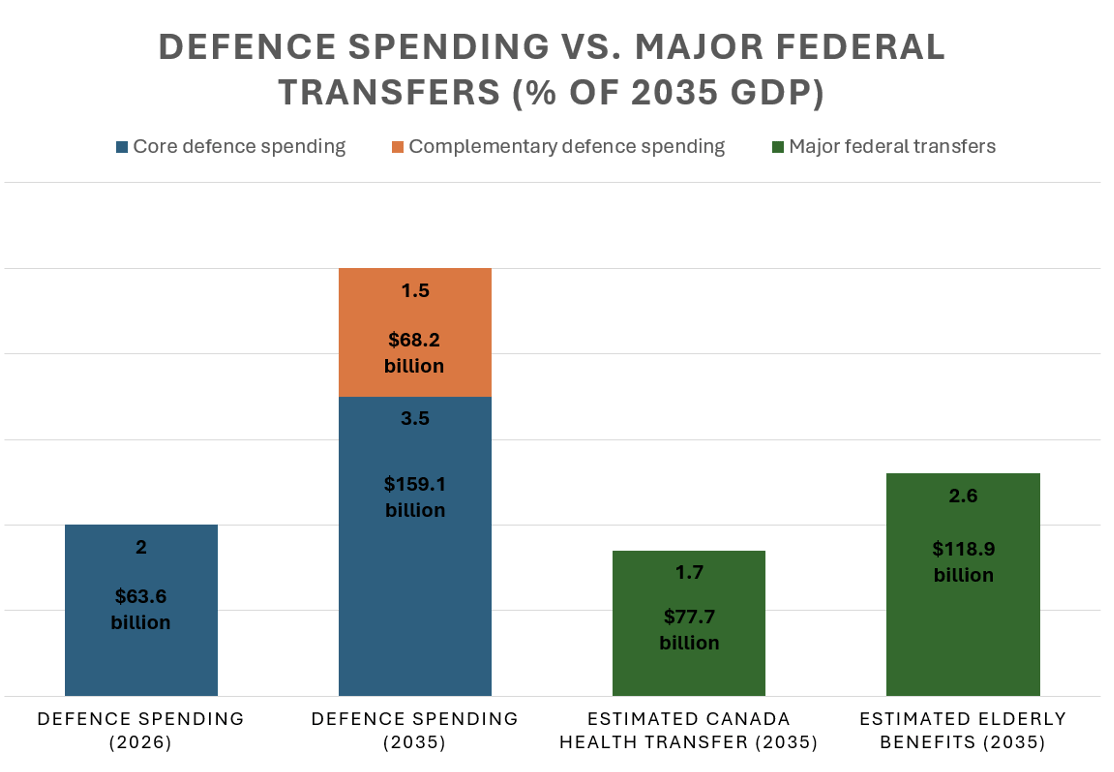
Significant trade-offs will follow. The Parliamentary Budget Office predicts that the plan would increase federal deficit by $63 billion and raise the net debt-to-GDP ratio by 6.3% by 2035.
Despite these glaring fiscal obstacles, however, the true challenge facing Canadians is cultural.
For decades, Canada’s defence policy has been shaped by assumptions of geographic insulation and alliance dependence. Shielded by three oceans and a superpower neighbour, defence was treated as something to surge in moments of crisis and neglect in calmer years.
Procurement delays became normalized, strategic reviews lagged, and defence planning remained divorced from broader Canadian industrial and economic affairs. The commitment to 5% of GDP represents a departure from this generational posture.
Recent polls show that Canadians broadly support the planned transformation. According to a recent poll from EKOS, 72% of voters across the political spectrum are in favour of reaching 5% of GDP by 2035.
Still, this snapshot doesn’t tell us how much of a real cultural shift is underway or whether the support of Canadians, whose relationship to defence and war tends to surface annually with the wearing of poppies and viewing of commemorations around Remembrance Day, is sustainable.
The success of Canada’s European allies offers useful lessons in this regard. The Prime Minister’s addresses on national security, defence, and the perils of shifting geopolitics at the Munk School last June, at the Council on Foreign Relations in September and more recently in Davos have marked Canada’s zeitenwende moment.
Canadians can’t be expected to provide durable social license for a massive defence buildup when they haven’t clearly been told who the enemy is, and if the enemy is our longest-standing ally, that radical shift in our security context should be addressed clearly and comprehensively.
But several Nordic states have gone further, cultivating the cultural adaptation that Canada has yet to mobilize. Finland’s 2024 defence policy review highlights the concept of “comprehensive security,” which promotes societal resilience by involving all sectors in defence activities.
Helsinki’s Security Strategy for Society encourages participation through public awareness campaigns and education, enabling Finland to boast of a force of approximately 900,000 reservists.
These measures are shaped by Finland’s proximity to Russia and its historic exclusion from NATO’s collective security guarantee prior to 2023. As Canada faces increasingly similar circumstances, it may take some inspiration from its Arctic neighbour.
The recently published DIS charts a path forward for industry, projecting $180 billion in direct defence procurement, $290 billion in defence-related infrastructure investment, and $125 billion in downstream economic activity. Yet it offers limited clarity about how these figures were derived or how procurement priorities flow from an updated articulation of Canada’s national security interests.
It is also largely divorced from Canada’s now-outdated defence and foreign policies in the absence of a new National Security Strategy tailored to the new reality Prime Minister Carney described in his Davos speech.
Canadians can’t be expected to provide durable social license for a massive defence buildup when they haven’t clearly been told who the enemy is, and if the enemy is our longest-standing ally, that radical shift in our security context should be addressed clearly and comprehensively.
The long-term legitimacy needed for a defence buildup of this magnitude will require Ottawa to foster a durable sense that it is no longer discretionary.

A WWII appeal to patriotism/LAC
As it works to release a new National Security Strategy, Ottawa must begin institutionalizing the culture shift by embedding a deeper sense of civic responsibility for defence.
From 2022-2025, a Finnish pollster found that 4 in 5 Finns are willing to participate in military operations if attacked, reflecting a security culture long rooted in the comprehensive preparedness for defence that comes from living next door to a historically hostile power.
By contrast, an Angus Reid survey last July found that only 19% of Canadians would unconditionally volunteer if they were called upon (as opposed to 30% who said they would if they agreed with the reasons for fighting). This disparity reflects the extent to which defence has long been top of mind in one society and peripheral in the other.
Additional structural changes may also be required over the coming decade.
Expanded senior-level engagement through, for example, an annual threat assessment speech by the deputy minister of DND or the National Security and Intelligence Advisor could further contribute to the development of a stronger security culture by fostering informed public debate. Transparency could also be improved by making DND’s reporting more accessible, taking CSIS’ public reports as a model.
Ottawa must shift the paradigm so that the country’s strategic culture parallels the world Canadians now live in. A defence transformation of this scale will only succeed by convincing Canadians that security is not optional, and that sovereignty now carries a permanent price.
Shane Joy is a graduate student at the Max Bell School of Public Policy at McGill University.