
Ukraine’s Gift to Humanity

February 25, 2026
The most memorable line in Aaron Sorkin’s script for David Fincher’s 2010 film The Social Network was uttered by Jesse Eisenberg as Mark Zuckerberg, addressing the legal claim by the Winklevoss twins that he’d stolen their idea for Facebook: “If you guys were the inventors of Facebook, you’d have invented Facebook.”
As the fourth anniversary of Vladimir Putin’s unlawful Ukraine invasion was observed on Tuesday, his shamelessly false casus belli — that Ukraine is not a real country — had long since succumbed to the undeniable reality of a geopolitical twist on that line: if Ukraine were not a country, he wouldn’t have invaded it.
We know Putin’s invasion failed because the war it unleashed is still ongoing not just four days later — which already defied the predictions of both the invader and US intelligence as to how long it would take for Kyiv to fall — but four years later.
In that sense, Tuesday’s anniversary really marked not four years into an invasion, but four years of successful Ukrainian resistance.
Which is another way of saying that Putin found out Ukraine is a country the hard way. Countries are full of human beings who embody national characteristics expressed in myriad ways, including through art, language, literature, music, food, dress, temperament, outlook and attitude.
One of the first expressions of Ukrainian national character Putin’s unlawful invasion encountered on February 24th, 2022 was the final message issued by Ukrainian Snake Island border guard Roman Hrybov to the Russian missile cruiser Moskva after its captain demanded that he and his 12 fellow soldiers surrender.
That message was: “Russian warship, go **** yourself.” This eloquent bit of diplomacy set the tone for the Ukrainian resistance.
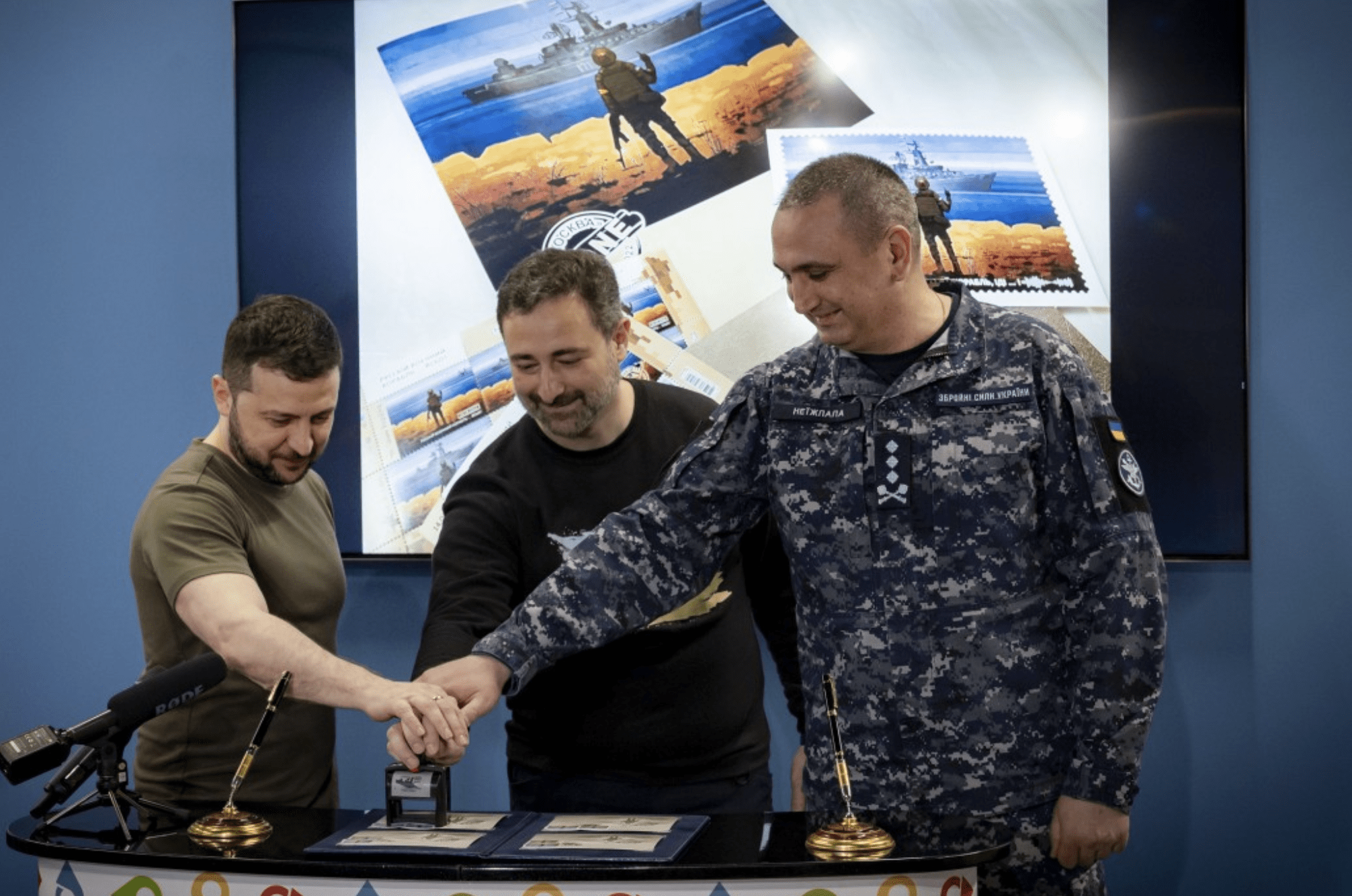 President Volodymyr Zelensky officiating at the launch of the ‘Russian warship: Go **** yourself!’ stamp/Office of the President of Ukraine
A commemorative stamp bearing the quote superimposed over an image of the warship was issued by Ukrposhta, the Ukrainian postal service. The day after the stamp was unveiled, the Moskva was sunk, and a new stamp was swiftly issued with the Russian warship removed, leaving just the quote.
For students of military strategy, it was an invaluable lesson that the great masters from Sun Tzu to Clausewitz to Vizzini had somehow missed: never invade a country whose president is a comedian.
What Ukrainians have done since then in further mobilizing their volia (the “superpower of resilience”) as a weapon against an invading erstwhile superpower — from the daytime raves to the mastery of drone deployment against major targets to the battlefield adaptation of Muhammad Ali’s rope-a-dope — has been a master class in asymmetrical warfare.
In more universal terms, the Ukrainians have defied two concurrent, terribly ugly 21st-century trends: the disempowerment of human beings and the normalization of abuse of political power.
The contempt for humanity expressed in both those trends has been evident in the disinformation, deception and propaganda operations that have accompanied New World Order power consolidation from Putin’s invasion of Ukraine to Jair Bolsonaro’s destruction of the Amazon rainforest to the brazen cluster***k (for lack of a more accurate word) of Brexit to Donald Trump’s brutally allegorical demolition of the East Wing of the White House.
This new power doesn’t ask permission, it doesn’t brake for boundaries or norms, it commodifies shock and moral revulsion as psychological warfare dividends and it has absolutely no respect for the intelligence of its audience.
As The New York Times put it in a recent headline, this is ‘Diplomacy Without Diplomats’ — as though surgery without surgeons is still surgery.
In the ongoing Ukraine peace negotiations fronted by the Trump administration, that cynical approach to power is obvious in the protection of Vladimir Putin’s interests above and beyond the usual face-saving concessions granted a belligerent for domestic consumption, and far above and beyond any concessions that would normally be granted a unilateral instigator and violator of the United Nations Charter.
This irregular dynamic is due to a shift in context whereby Trump’s loyalty to Putin as a fellow anti-democracy actor has overtaken the previous U.S. administration’s loyalty to Zelensky as the leader of a fellow democracy.
It is enabled by the relative inexperience of the negotiators in this case, or, as The New York Times put it in a recent headline, this is “Diplomacy Without Diplomats” — as though surgery without surgeons is still surgery.
In this case, Steve Witkoff and Jared Kushner’s status as amateurs has rationalized the protracted indulgence of intractability on the part of a dictator who started an illegal war he can’t finish, killing 1.8 million people in the process (10 times the number who perished under Slobodan Milosevic), 1.2 million of them his own citizens. In any previous moment of the past half-century, Putin would have been compelled to a ceasefire months ago and would likely now be in The Hague.
But whatever the outcome, Ukrainians have already proven that this century’s brand of unhinged, abusive political power can be defied, confounded and thwarted with the power of human character and ingenuity.
In that sense, when the greater role of the Ukraine resistance in protecting Europe from Putin’s madness is cited, it shouldn’t be limited to geopolitics. The Ukrainians have forged a culture of resistance for a new century and a badass beachhead against industrialized evil.
They’ve done it partly with indomitable national character, and partly with a leader who already knew enough to respect the intelligence of his audience.
Policy Editor and Publisher Lisa Van Dusen has served as Washington bureau chief for Sun Media, Washington Columnist for the Ottawa Citizen, international writer for Peter Jennings at ABC News, and as an editor at AP National in New York and UPI in Washington.