
Game Theory vs. ‘Death and Destruction’: Mark Carney’s Trumpian Dilemma
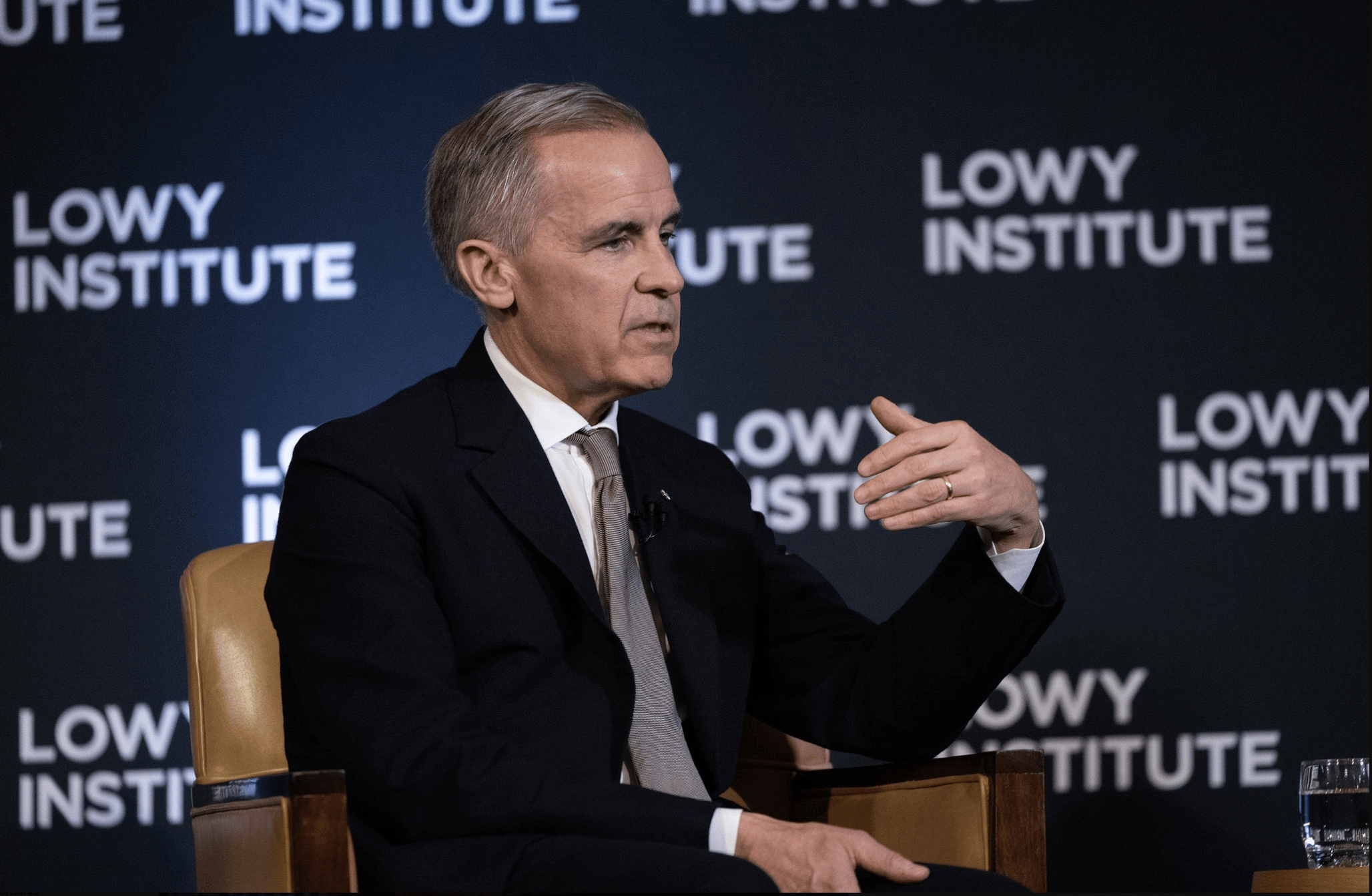 The Lowy Institute
March 4, 2026
One of the many things that could be said of the rules-based world order is that it was designed so that countries — including middle powers — would not have to rely on their wits, in the manner of a Hobbesian geopolitical Hunger Games, to survive in the face of hegemonic aggression.
“The world will always be driven by great powers,” Prime Minister Mark Carney said in his address to the Australian Parliament on Wednesday evening (Thursday morning Canberra time). “But it can also be shaped by middle powers that trust each other and act with speed and purpose.”
In the rules-based order, the rules were intended to apply to everyone in part so that questions of which regimes warranted military intervention, containment or punishment and which did not wouldn’t be left to the whims of mercurial, twice-impeached, aspiring autocrats not generally known for their discernment, or their restraint.
As Mr. Carney has made his way from India to Australia this week before heading to Japan, he’s been dogged by the difficulty of both describing and navigating the rogue behaviour of the rules-based order’s erstwhile democratic superpower.
At the Lowy Institute in Sydney on Wednesday (Tuesday evening Australia time), the Prime Minister further recalibrated his position on Donald Trump’s New World Order (post-democracy, diplomacy disdaining, UN eschewing, international-law flouting) war in the Middle East.
“Geostrategically, hegemons are increasingly acting without constraint or respect for international norms or laws, while others bear the consequences,” he said in his opening statement ahead of the Q&A with Lowy’s Michael Fullilove. “Now, the extremes of this disruption are being played out in real time in the Middle East.”
After nuancing his government’s earlier, controversial support for the U.S.-Israel military operation with an expression of regret on Tuesday, Carney re-positioned his position on Wednesday within the context of his Davos speech.
“Australia and Canada can’t compel like the great powers,” Mr. Carney said, “but we can convene, we can set the agenda, shape the rules, organize and build capacity through coalitions that deliver results at speed and global scale.”
When one of the great powers driving the world starts behaving like the rules no longer exist, that’s not a failure of the existing order, it’s a systemic assault posing as epic fury.
While it might be tempting to attribute the Prime Minister’s evolution on this question to his political inexperience, it is also the product of unprecedented circumstance; of the military and security version of dealing with a suddenly-more-Hyde-than-Jekyll superpower neighbour that has similarly stymied trade policy by violating all the rules of economic engagement.
But the greatest political peril for Carney is that Canadians interpret his rhetorical perambulation as moral ambiguity at best and moral ambivalence at worst — that in the attempt to reconcile the imperatives of condemning the unilateral use of force as an alternative to diplomacy, of condemning the Iranian regime’s abysmal human rights record and threats to regional security, and of avoiding provoking a tyrant, Canadian values are misrepresented or worse, abandoned.
In Thursday’s Lowy appearance, Carney further elaborated his doctrine of variable geometry, describing his now-widely cited antidote to 21st-century geopolitical chaos as “a multilayered game, if you follow game theory”.
On the one hand, this is reassuring because of what it says about Carney’s grasp of complexity and how that complexity might serve as camouflage against an unhinged predator.
On the other, given Trump’s preference for invading, decapitating, bombing and profiteering first and asking questions at no point whatsoever it also instantly evokes Mike Tyson’s first rule of bilateral relations: “Everybody has a plan until they get punched in the face.”
Indeed, Carney’s supremely rational position seems a little less reassuring articulated against a soundtrack of the status-quo obliterating bombing underway across the Middle East and Secretary of War Pete Hegseth’s Buck Turgidson impression.
Among other takeaways from this war, Trump is now laying down a marker for “hyperscaler” — to use Mr. Carney’s word for post-democracy hegemons — power consolidation in response to the impressive intellectual ingenuity of the Davos speech by using “unmatched power and unrelenting force” per the White House tagline of “Operation Epic Fury”.
In other words, Trump is responding to Carney’s intellectualization of the problem (in Psychology Today parlance, the defense mechanism of using excessive reasoning, logic, and abstract analysis to deal with a crisis) with, in Hegseth parlance, “death and destruction”.
When one of the great powers driving the world starts behaving like the rules no longer exist, that’s not a failure of the existing order, it’s a systemic assault posing as epic fury.
Which at least serves as a preview as we enter the second quarter of this turbulent century.
Policy Editor and Publisher Lisa Van Dusen has served as Washington bureau chief for Sun Media, Washington Columnist for the Ottawa Citizen, international writer for Peter Jennings at ABC News, and as an editor at AP National in New York and UPI in Washington.