
The Lowy Elaboration: Fleshing out Mark Carney’s Davos Doctrine
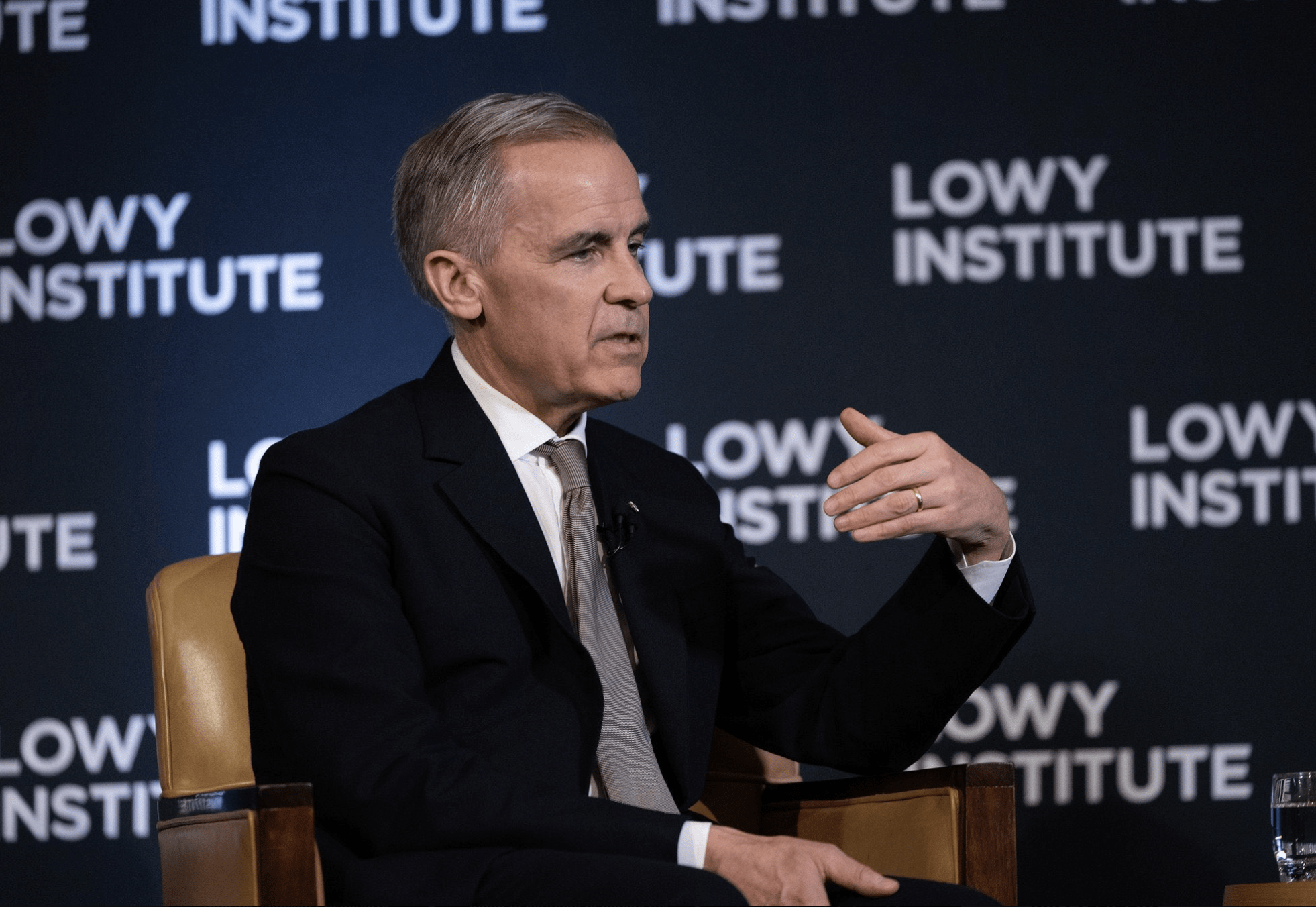 Prime Minister Mark Carney at the Lowy Institute in Sydney/Lowy Institute image
March 9, 2026
When Mark Carney spoke about middle powers and multilateralism last week at Sydney’s Lowy Institute, he further fleshed out the “values-based realism” approach to foreign policy he enunciated at the Davos World Economic Forum.
Mr. Carney’s starting point is blunt: “The old norms of the rules-based international order are being erased,” and the future order, “is yet to be built.”
Globalization itself has not disappeared, but it has become more strategic and more contested. Tariffs are deployed as weapons, supply chains as pressure points and financial infrastructure as leverage.
In this environment, the traditional built-for-consensus architecture of multilateralism – notably large institutions like the United Nations and the World Trade Organization – no longer function as the sole engines of global governance.
The future of multilateralism, Mr. Carney argues, will rely less on universal forums and more on networks of middle powers.
Instead of waiting for consensus among dozens of countries, Mr. Carney proposes overlapping coalitions among states with a “dense web of connections” based on shared interests and capabilities.
As “hegemons”, the United States and China retain unmatched influence, shaping markets, technologies and security environments, often forcing others to subordinate.
But middle powers, argues Mr. Carney, collectively possess enormous capacity: “If we work together in a variable geometry we can do more than protect our sovereignty. We can build something better.”
Rather than waiting for universal agreement, smaller groups of aligned countries would cooperate on specific issues: supply chains, artificial intelligence, clean energy, digital infrastructure and maritime security. Combining strategic focus with institutional flexibility, they define “variable geometry.”
One coalition of democratic middle powers – Europe, Japan, South Korea, Australia and Canada – said Mr. Carney, represents an economic weight greater than that of the United States. Their trade flows are roughly three times those of China.
They account for much of global research and development spending and host 62 of the world’s top 100 universities. Their cultural industries dominate global media.
If middle powers collaborate – economically, technologically and diplomatically – they can shape the next phase of multilateralism: a system built not just by the powerful, but by the capable.
Mr. Carney organizes his strategy around three principles.
First, sovereignty must be redefined because “a country that can’t feed itself, fuel itself or defend itself has few options.” In the 21st century, sovereignty is not only territorial. It also requires control over critical technologies, semiconductors, digital networks and the minerals that power modern economies. This also applies to AI systems, payment infrastructure and satellite networks.
Second, sovereignty cannot be achieved alone because, “When we only negotiate bilaterally with a hegemon,” says Carney, “we negotiate from weakness.” Middle powers must diversify partnerships rather than negotiate exclusively with dominant states.
Third, middle powers must use their comparative advantage — credibility, institutional trust and the ability to convene — to build coalitions capable of shaping the next international order.
This approach is already visible in Canadian diplomacy. Over the past year, to diversify partnerships and reduce strategic dependence, Ottawa has signed more than 20 economic and security agreements across four continents, most recently during Mr. Carney’s weeklong India-Australia-Japan tour.
In India, Mr. Carney stabilized relations with Prime Minister Narendra Modi, expanding cooperation in artificial intelligence, aerospace and clean energy, sectors where India’s scale and digital innovation make it an essential partner.
In Japan, which Mr. Carney describes as the model middle-power, discussions with Prime Minister Sanae Takaichi focused on advanced manufacturing, semiconductor supply chains and Indo-Pacific security.
Australia sits in a similar category. Cooperation centered on critical minerals, defence collaboration and supply-chain resilience.
China occupies a different space. Mr. Carney frames the relationship as one of selective engagement: cooperation where necessary, caution where strategic vulnerabilities exist. Mr. Carney said, during his conversation at the Lowy Institute, that President Xi told him that he wanted “no surprises…be clear…don’t lecture me…bring issues to me directly’.”
Perhaps the most delicate relationship to manage is the one with the United States which, under Donald Trump, uses existing integration as leverage, “monetizing their current indispensable position in a variety of economic relationships,” according to the Prime Minister.
Dealing with Donald Trump, said Mr. Carney, requires “respect, but not obsequiousness” and to be “careful in terms of the language that you use with him,” adding, “it’s quite different in private. He is more interested in your viewpoint on various things in private, and that creates an ability to work through things. But it’s not easy.”
Mr. Carney’s approach ultimately rests on a pragmatic bet. The future must not be defined solely by great-power rivalry.
If middle powers collaborate – economically, technologically and diplomatically – they can shape the next phase of multilateralism: a system built not just by the powerful, but by the capable.
Middle powers cannot compel the world’s direction, but they can convene, set agendas, and build coalitions capable of shaping the emerging order.
Whether Mr. Carney’s approach succeeds may determine not only Canada’s future role in the world, but also the fate of the broader liberal international system.
Policy Contributing Writer Colin Robertson, a former career diplomat, is a fellow and host of the Global Exchange podcast with the Canadian Global Affairs Institute in Ottawa.