
From Ireland to Ireland: The Rhyming of Hope and History
For this St. Patrick’s Day, a tribute to Ireland as a model not just of resilience but of policy-driven transformation.
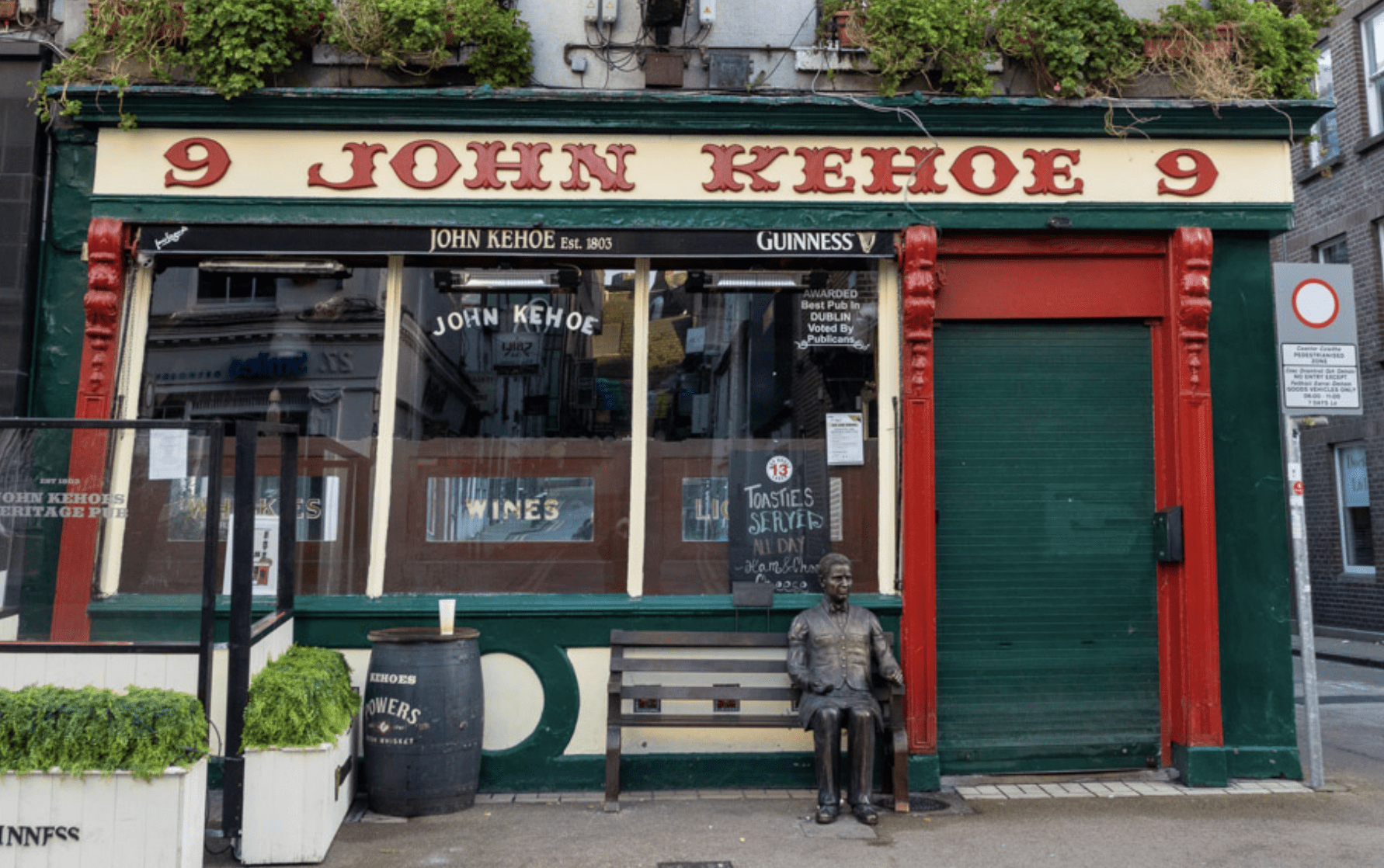 The statue of publican John Kehoe outside the pub that bears his name, Anne Street, Dublin/Kehoe’s Pub
March 16, 2026
I first travelled to Dublin in 1973 as an Oxford student, drawn not by politics but by literature.
Anyone who admired writers such as Jonathan Swift, Edmund Burke, W. B. Yeats and Oscar Wilde felt an almost magnetic pull toward the small country (still only 5.5 million people in 2025) that had produced such giants.
Dublin did not disappoint. As Ireland’s cultural vitality had spread in the 1960s–70s, bands in my hometown of Winnipeg began earning their chops with covers of Van Morrison’s Gloria and Brown-Eyed Girl. Edna O’Brien’s The Country Girls trilogy broke the 1950s Irish silence on social and sexual issues, and Seamus Heaney had begun publishing the work that made him the most important Irish poet since Yeats. I was arriving as a fan.
I remember laughing with Irish friends in pubs where Joyce once drank and singing along as musicians played the spoons. Dublin has many statues to the great and the good, but it is fitting that a statue has recently been placed outside Kehoe’s Pub on Anne Street. It is of legendary publican John Kehoe, as a monument to the man and to the role played by pubs in Ireland’s culture and social fabric; the community hub where all the problems of the world were discussed, fought over, and solved before the internet came along.
But the country I first visited in 1973 was economically unrecognizable to the Ireland I returned to recently — as if generations of of history have been telescoped into a half-century of sweeping change.
Since the formation of the Irish Free State in 1922, the Irish economic posture had been “sinn féin”, or “we ourselves”, with high tariffs, little investment in education and a national outlook tilted more toward history and the past than innovation and the future. The result was a culture of emigration draining away scores of young people every year in an an epic of national exile.
Colm Tóibín’s novel Brooklyn describes this movingly, as families endured “American wakes” for children moving away to seek a better life. And the violence of the Troubles in Northern Ireland cast a shadow across the island. The year before my first visit, 1972 had been the bloodiest year of the conflict, with 479 people killed in Northern Ireland.
In 1973, there were still donkey carts in the streets of Dublin. These were not tourist attractions but ordinary transportation and trade in a country that had yet to share fully in Europe’s postwar prosperity.
Few observers then would have predicted how dramatically Ireland would change.
The year I first visited was also the year Ireland joined the European Economic Community.
At that time, Ireland’s income per person was only about 60% of the EEC average, placing it among the poorest members. It was independent of the United Kingdom politically but still dependent economically.
Joining Europe changed all that. As John Fitzgerald argued in his seminal 1999 article Understanding Ireland’s Economic Success, it has proved to be one of the most consequential policy choices in modern Irish history.
Ireland’s transformation was not a miracle of luck, but the result of superior public policy sustained over several decades, all geared to allowing Ireland to take advantage of its EU membership.
Five such policies proved decisive:
— Education (1967): free secondary schooling dramatically expanded access to education and created a highly skilled workforce.
— Support for culture (1969): tax exemptions for artistic earnings reflected Ireland’s belief that cultural life is central to national identity.
— Openness to Europe (1973): membership in the European Economic Community anchored Ireland firmly in the global economy.
— Competitive corporate taxation (1990s–2003): the adoption of a 12.5 percent corporate tax rate attracted multinational investment, creating the Celtic Tiger tech boom and the Silicon Docks section of Dublin.
— Peace (1998): the Good Friday Agreement ended decades of violence and created the political stability necessary for sustained economic growth.
Taken together, these decisions—spanning more than three decades—demonstrate how sustained public policy can change the fate of a nation.
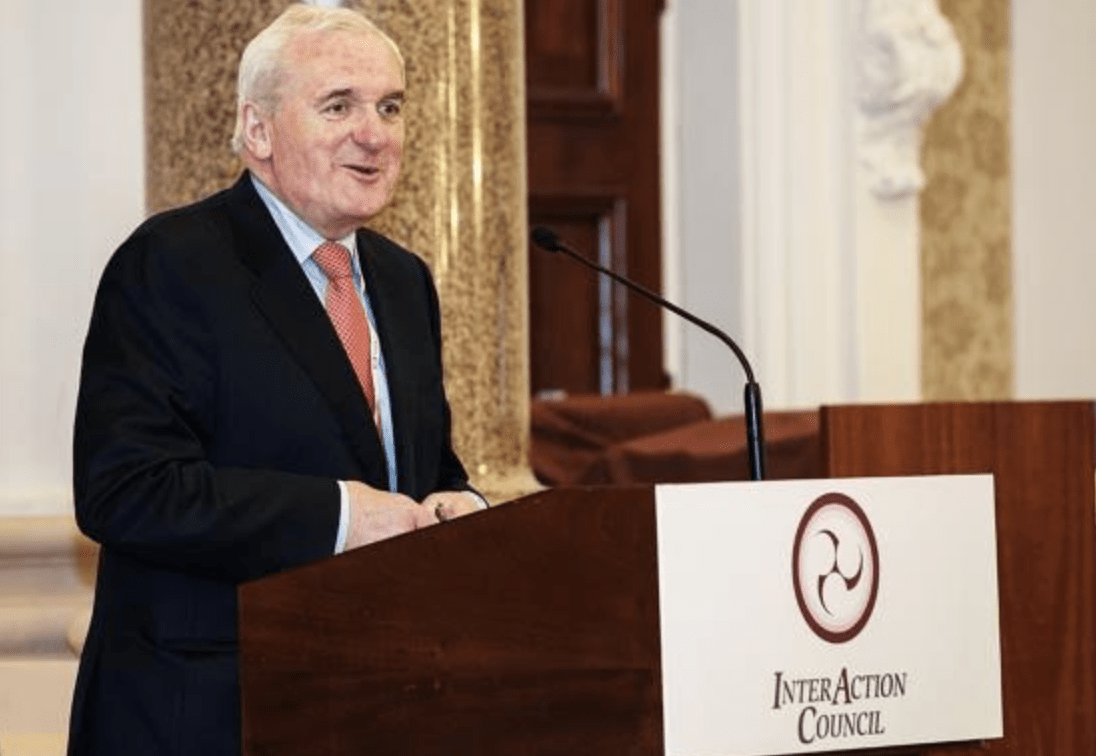 Former Irish Taoiseach Bertie Ahern at the 2025 InterAction meeting of former world leaders in Dublin
Ireland in 2025
A visit to Dublin in 2025, 50 years after my first, showed how much Ireland has been utterly transformed. I was there for the annual plenary of the InterAction Council of former world leaders, chaired by Bertie Ahern, Taoiseach or Prime Minister of Ireland from 1997 to 2008. This meeting overlapped with the conference of the One Young World group of youth leaders from around the globe, there to assess the state of the world as of the second Trump administration.
Trump’s tariff policy threatened every country represented at the gathering, not least Ireland, as the Irish-based pharmaceutical industry had caught the attention of the president. The meeting also coincided with the conclave in Rome to select a new pope, and as one wag put it: “We should learn from the Vatican, they’ve just bought American.”
The conference brought together business leaders including Danny McCoy, CEO of the Irish Business Employers Confederation, political figures such as Niamh Smyth, minister of state for artificial intelligence and digital policy, and a host of Irish policy experts.
The focus was global, especially how youth could make a difference, but inevitably, with the Irish talent assembled, the gathering also had aspects of a seminar on how Ireland had transformed itself and what lessons could apply in other jurisdictions.
Bertie Ahern, our InterAction Council host, hosted a dinner at Leinster House, home of the Oireachtas Éireann (the Irish Parliament), where the 1916 Proclamation of the Irish Republic is prominently displayed.
The One Young World delegates were especially interested in questioning Ahern about his “mutually hurting stalemate” concept as a precondition for conflict resolution. “All parties must feel that the cost of continuing conflict exceeds the cost of compromise,” he said, and once that breakthrough is reached, trust must be built, compromises made, and persuasion employed. So committed was Ahern during the final push for the Good Friday agreement that when his mother died, he briefly left the talks to attend her funeral but returned quickly as the process was reaching its decisive moment.
But the contrast between my first trip in 1973 and my 2025 immersion in questions of Irish policy and identity could not have been starker.
The tide of emigration, which had been seared into Ireland’s soul since the famine, has now begun to turn. In 1990, when Mary Robinson was elected President of Ireland, in she placed a lit candle in the window of her official residence in Phoenix Park so that there would “always be a light on … for our exiles and emigrants”.
In a reversal attributed to “the Trump effect”, last year saw more Americans emigrate to tech-savvy Ireland (9,600) than Irish citizens moving to the United States (6,100).
Ireland’s transformation has also produced another remarkable historical reversal. For centuries, Ireland was the poorer neighbour of Britain, its economy constrained by colonial rule.
Today, Ireland is wealthier per capita than the United Kingdom. The country once dismissed as Britain’s economic laggard has overtaken its former imperial ruler. In the aftermath of Brexit, the contrast between the two policy paths has become even more striking.
Fiscal strength to manage risk
Ireland’s transformation is also visible in its public finances. Globalization has risks as well as rewards. Ireland had a dash for growth in the 1970s but it was overextended when the global 1980s recession hit and had to undergo severe austerity in the 1980s to rebuild its fiscal balance. The Celtic Tiger expansion in the 1990s led to a property bubble and at the height of the financial crisis following the 2008 banking collapse, Irish public debt exceeded 120 percent of national income.
Ireland has learned from this boom-and-bust cycle, producing a period of economic growth (Irish GDP grew by more than 12% in 2025). It now runs large budget surpluses and today, measured against modified gross national income (GNI eliminates the distortions in GDP due to multinational tax schemes), the debt-to-GNI ratio has fallen to roughly 60%. Further, it diverts corporate tax receipts to a Future Ireland Fund and Infrastructure Investment Fund to provide immediate liquid support for future economic shocks. Over 16 billion euros have been invested so far, with the goal being 100 billion euros by 2035.
While it is often disparaged in Ireland as a cliché and discouraged as a hashtag based on the superstition around what befell the first Celtic Tiger after 2008, the label “Celtic Tiger 2.0” for Ireland’s economic revival isn’t entirely overblown.
In contrast to Ireland’s surplus of 12 billion euros in 2025, which represents 3.7 percent of GNI, Canada is moving in the opposite direction with a projected deficit of over 78 billion (CDN) or 2.5% of GNP. in 2025. Canada’s public debt relative to national income is near to 100 percent of GNI., much larger than Ireland.
More than 10% of Canadian government revenue now goes toward servicing public debt. In Ireland, the figure is closer to 2%.
Ireland now carries less debt relative to national income and spends far less on interest payments than Canada does. Ireland is preparing for future risk, while Canada appears to be far more blasé.
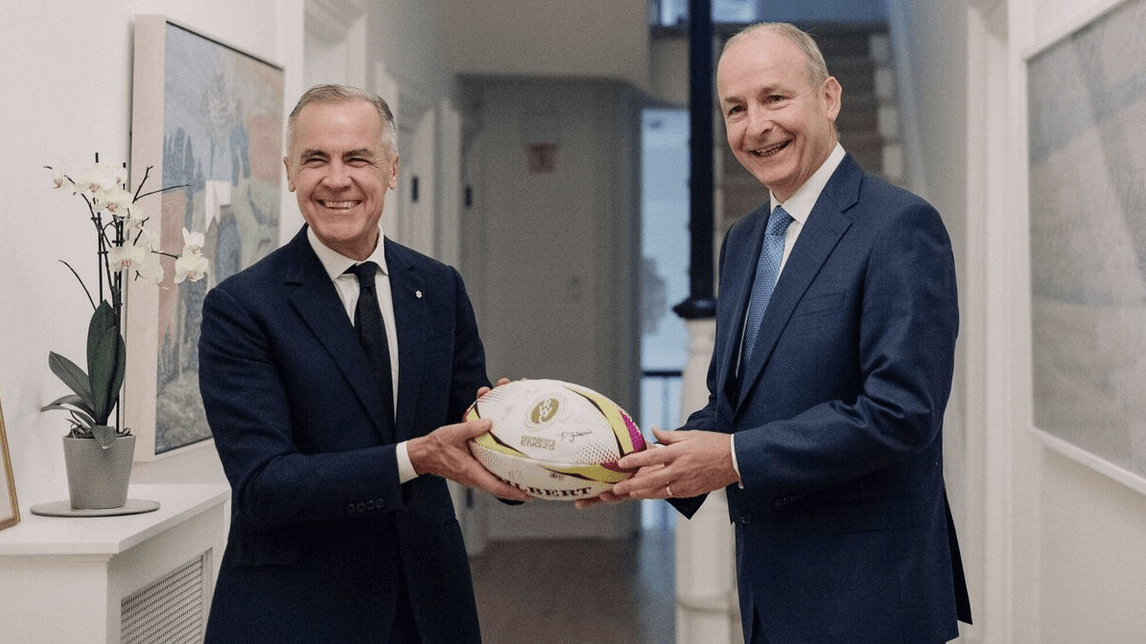 Prime Minister Mark Carney and Taoiseach Micháel Martin in Ottawa, September, 2025/Irish GIS
Carney, Davos and what Canada can learn
At the InterAction Dublin meeting, many of the former leaders knew Mark Carney personally from his days as head of the Bank of England. This was the first time that I began to realize how well-connected Carney was internationally and what an asset this was at a time when Canada needs new partnerships to counter an aggressive United States. Europe is Mark Carney’s patch.
This optimism was strengthened by Carney’s Davos speech. An editorial in the Irish Examiner described the speech as “A rare example of leadership at a moment when the global economic order appears increasingly fragile.”
Irish Culture Minister Patrick O’Donovan called the address “a very big glimmer of hope.”
Carney has deep Irish roots. Three of his grandparents emigrated from County Mayo, Carney had an Irish passport before he became prime minister, and when he headed the Bank of England, he kept a map of County Mayo in his office.
Since joining the United Nations in 1955, Ireland has been a strong supporter of multilateral diplomacy and peacekeeping. More than 70,000 Irish soldiers have served in United Nations peacekeeping missions, including long-standing deployments in Lebanon and earlier missions in the Congo and Cyprus. Ireland has also served four terms on the UN Security Council, reflecting its consistent engagement with the institutions of the international order.
Amid Carney’s call for cooperation among middle powers, Ireland is a natural partner.
Two visits, two Irelands.
In 1973, I enjoyed Dublin tremendously but Ireland was poor, rural, conservative and worried about security. My Irish friends wondered why Ireland was an economic failure.
During my 2025 visit, the topic was the Irish economic success and whether it could be emulated elsewhere. In less than a lifetime, Ireland has become a prosperous digital powerhouse, and a progressive democracy, while remaining one of the world’s most influential soft-power societies.
That transformation might once have seemed impossible. But, as Seamus Heaney writes in The Cure at Troy:
History says, Don’t hope
On this side of the grave.
But then, once in a lifetime
The longed-for tidal wave
Of justice can rise up,
And hope and history rhyme.
In Ireland, it seems, hope and history are now rhyming, perhaps for the first time in her history.
Happy St. Patrick’s Day to all.
Thomas S. Axworthy is Public Policy Chair, Massey College.