
‘Guardians of the North’: Sailors and their Ships
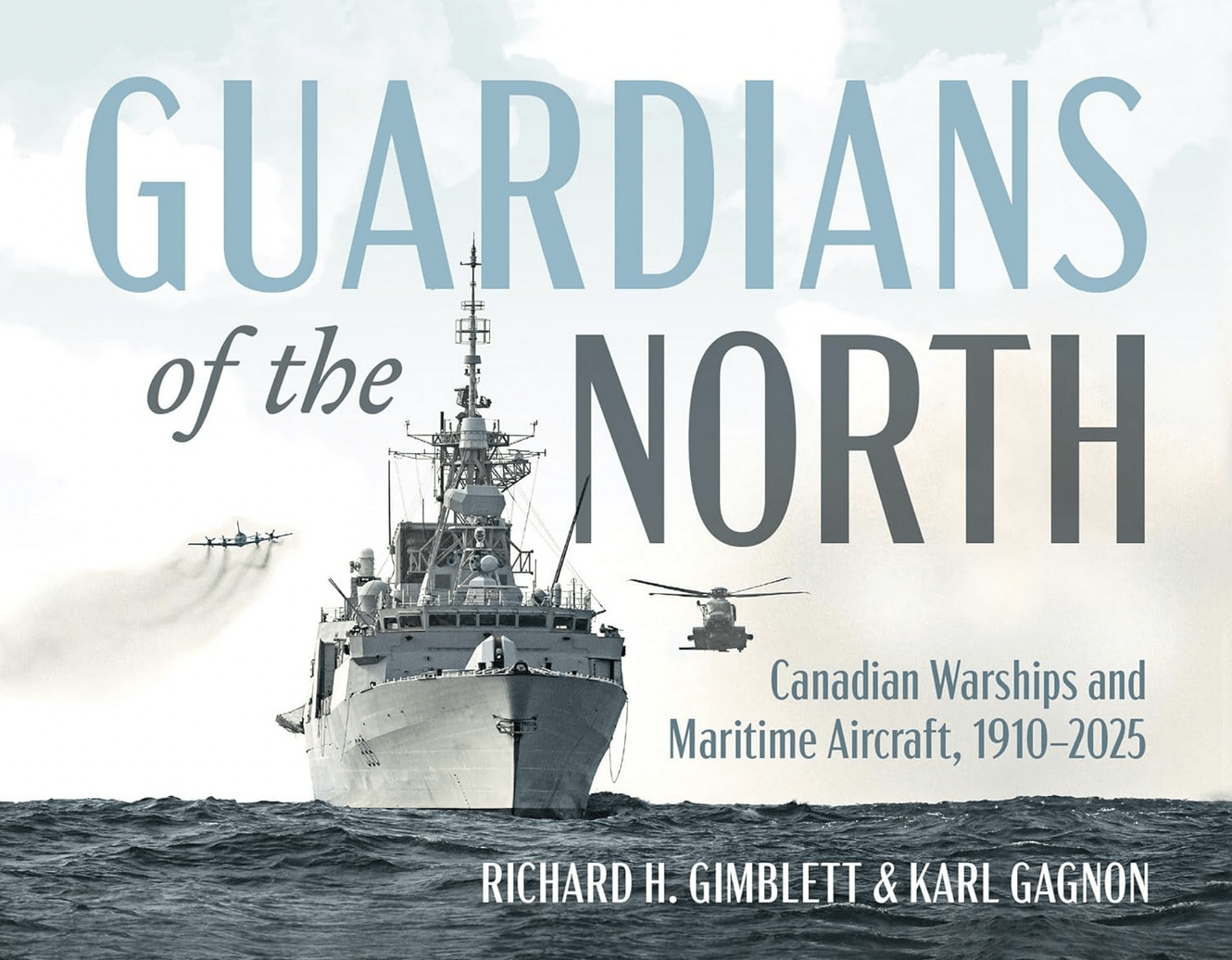
Guardians of the North: Canadian Warships and Maritime Aircraft
By Richard Gimblett and Karl Gagnon
Dundurn Press, October 2025/400 pages.
Reviewed by Colin Robertson
March 17, 2026
Canada is a maritime nation — A mari usque ad mare.
With the world’s longest coastline, access to three oceans, and a growing strategic stake in an increasingly navigable Arctic, Canada’s prosperity and sovereignty depend on the sea.
In an era of geopolitical tension, fragile supply chains, and renewed great-power rivalry, maritime power matters more today than it has since the Second World War. That is why Canada is currently purchasing 12 new submarines, two new polar icebreakers, 15 River-class Destroyers and six Arctic and Offshore Patrol Ships.
Guardians of the North: Canadian Warships and Maritime Aircraft, 1910–2025, by naval historian Richard H. Gimblett and illustrator Karl Gagnon, provides the background and context for both the evolution and necessity of Canada’s seagoing hardware. It is ostensibly a visual history of Canadian naval platforms, from early cruisers to modern frigates and maritime patrol aircraft.
But its deeper lesson is strategic: ships and aircraft tell the story of how Canada has tried, sometimes successfully, sometimes haltingly, to defend its maritime interests.
The most revealing insights come from the foreword by Angus Topshee, commander of the Royal Canadian Navy. Vice Admiral Topshee begins with a paradox.
“As someone who has always held that it is the quality of the sailors, not the ships, that determines the quality of a navy, it may seem odd that I’m writing the foreword to a book dedicated to the examination of all the ship classes and aircraft types of the RCN.”
Topshee’s point is that people ultimately determine naval effectiveness. Yet the ships they sail, and the aircraft that support them, reveal a nation’s strategic ambitions and constraints recognizing the fundamental principle that if you have interests you must have the capacity to advance and support them.
Canadians expect its Forces to know everything that’s happening on and under our waters all of the time, and that’s the responsibility of the Navy and Coast Guard.
The story Gimblett and Gagnon tell is therefore about more than hardware. It is about the persistent challenge of designing maritime forces for a country whose geography demands a navy capable of operating almost anywhere.
Canadian ships must be able to function in the frigid Arctic, the storm-lashed North Atlantic, and the Pacific approaches, while still deploying to the Caribbean, the Mediterranean, or the Persian Gulf. That reality of operating in multiple theatres explains why Canadian naval requirements are so demanding.
Topshee captures the dilemma bluntly. Force development, he notes, is shaped by the “iron triangle” of capability, schedule, and cost:
“Driving a positive change in any one of these factors inevitably produces negative changes in the others.” One of the many criticisms levelled against Canada’s defence procurement process is that Canadian naval procurement is plagued by “gold-plated” requirements.
Sometimes that criticism is fair. But often it reflects a misunderstanding of Canada’s geography, economic and operational needs. More than protecting our fisheries, the Royal Canadian Navy must serve larger Canadian interests.
History makes that clear. During the Second World War, Canadian sailors crossed the Atlantic in the open-bridge corvettes of the Flower class, escorting convoys through some of the worst conditions on earth. Topshee describes their achievement as “truly unbelievable,” a testament to the courage of those who fought the Battle of the Atlantic.
Canada built 131 of those corvettes and expanded its navy from 13 ships to more than 450 during the war. It was an extraordinary demonstration of national mobilization and shipbuilding capacity.
The postwar record has been more uneven.
Canada has produced notable innovations—such as the St. Laurent-class destroyers, nicknamed “the Cadillacs,” and the Halifax-class frigates—but long gaps in shipbuilding and procurement delays eroded capacity and capability. Continuous shipbuilding and ship maintenance in Halifax, Montreal and Vancouver should put that problem behind us.
It is ostensibly a visual history of Canadian naval platforms, from early cruisers to modern frigates and maritime patrol aircraft. But its deeper lesson is strategic: ships and aircraft tell the story of how Canada has tried, sometimes successfully, sometimes haltingly, to defend its maritime interests.
While not always appreciated, the Canadian navy has punched above its weight, pioneering important maritime innovations such as anti-submarine helicopters operating from small escorts and sophisticated sonar systems that made Canadian ships among the best submarine hunters in NATO.
Those capabilities, including the first integrated ship-wide communications system, mattered during the Cold War. They matter again today and, with the muscle memory still there, we are rebuilding those skill sets.
The strategic environment is changing rapidly. Russia and China are expanding naval operations in the Arctic. Undersea infrastructure—from data cables to energy pipelines—is increasingly vulnerable. Global supply chains remain fragile.
And the United States, while still the dominant maritime power, is more focused on its own geopolitical interests. Canada, as Gimblett observes, is the northern half of a continental island, so a continued close defence relationship with the United States should remain a fundamental planning factor in the development of naval strategy.
That said, the longstanding assumption that the United States Navy will guarantee freedom of navigation everywhere, as a kind of global public good, can no longer be taken for granted.
Implicitly acknowledging the new ‘variable geometry’, Prime Minister Carney declared last week in making his commitment to develop and defend Canada’s North, that it, “will also build both military power and economic strength.
It will enable the Canadian Armed Forces to defend the Arctic without the help of Allies, allowing Canada to take control of our Arctic security”. How this aligns with NATO and NORAD, our collective security alliances, remains to be seen.
‘Variable geometry’ also means protection of international sea lanes and fisheries will once again become a shared responsibility among like-minded states. Ships move more than 80% of goods traded worldwide while seafood accounts for around 17% of the global population’s protein intake.
This is where Canada’s maritime strategy intersects with the broader foreign-policy debate. Prime Minister Mark Carney has argued that middle powers must build “coalitions of the willing” to defend the international order in an era of geopolitical fragmentation.
Naval cooperation is an obvious place to start.
Ensuring the security of global commerce, from container traffic in the Pacific to energy shipments crossing the Atlantic—especially as Canada seeks to diversify its markets—will require collective action among democratic maritime nations. A capable Canadian navy is both a national asset and a contribution to collective security.
It also underpins Canada’s Arctic sovereignty. Presence matters in the North. Warships, aircraft, and icebreakers demonstrate control in ways that diplomatic notes never can.
Yet, expanding Canada’s maritime capacity will require more than new ships and submarines. It will require sailors. Like many Western militaries, the Royal Canadian Navy faces serious challenges in recruitment and retention: the current force of about 17,100 is short some 1,600 sailors. A larger fleet will demand more crews, more technicians, and more specialists in increasingly complex technologies.
Ships can be built in shipyards. Sailors must be recruited, trained, and retained.
In that sense, Topshee’s opening observation remains the book’s most important lesson. The quality of a navy ultimately depends on its people. But in a maritime nation such as Canada, those people need capable ships—and a clear strategic purpose.
At a moment when global sea lanes are becoming more contested and Arctic waters more accessible, the case for maritime power has rarely been clearer. For Canada, the guardians of the North are not simply symbols of national pride. They are instruments of sovereignty, security, and economic survival.
Contributing Writer Colin Robertson, a former career diplomat, is a fellow and host of the Global Exchange podcast with the Canadian Global Affairs Institute in Ottawa and Policy’s principal foreign affairs book reviewer. He is also an Honorary Captain in the Royal Canadian Navy.