
‘A Little Touch of Stephen in the Night’: A Tribute to Stephen Lewis

By Bob Rae
April 3, 2026
The outpouring of emotion and praise for Stephen Lewis on news of his death came from every quarter, and deservedly so.
At each stage of his life, Stephen made an impact and touched people with his clear moral direction and unequalled rhetorical power.
As Ed Murrow once said of Winston Churchill, Stephen Lewis mobilized the English language and sent it into battle. He inspired, cajoled, pushed, charmed, inveigled. He could be unrelenting in his scorn for inaction in the face of wrong and in his passion for battles ahead.
Shakespeare describes Henry V’s leadership gifts in visiting his anxious troops at Agincourt on the eve of battle as “a little touch of Harry in the night” — the ability to rejuvenate the exhausted, persuade the doubtful and fortify the fearful. Stephen’s talents went far beyond wordsmithing. He could move mountains of resistance with his unique combination of charm and persistence.
In the 1950s my father came back from judging a debate sponsored by the UN Association of Toronto saying he had been impressed by the personality and eloquence of a teenager named Stephen Lewis, “David’s son”. I can remember heading over to Queen’s Park from University College to watch raucous debates where the newly elected member from Scarborough West gave far better than he got in the 1960s.
His interest and passion for Africa took him to Biafra to see for himself the consequences of civil war in Nigeria.
When he became leader of the Ontario NDP, he led the party to Official Opposition status as the Big Blue Machine was reduced to a minority government.
He impressed and befriended his opponents as well his followers and became legendary not only for his oratory but for his passion for issues such as workers’ health and safety and Indigenous rights.
To the dismay of many, the wear and tear of politics led him to resign his seat and the leadership in 1978 and took him out of elected politics when he was only 40. He rejected all entreaties to return, focusing on his work on labour relations, public advocacy and media commentary.
It was Prime Minister Mulroney’s call in 1984 asking Stephen to become Ambassador to the UN in New York that provided the scope and platform for his international vision and put his political and rhetorical talents to work in a unique way.
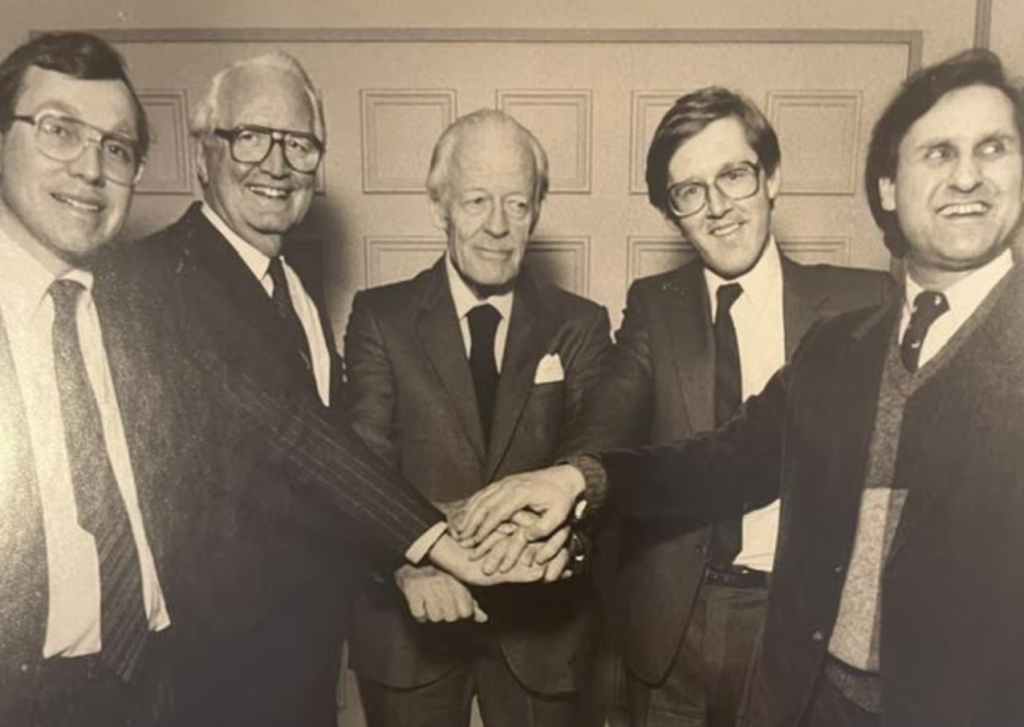 NDP and CCF leaders Michael Cassidy, Donald MacDonald, Ted Jolliffe, Bob Rae and Stephen Lewis in 1983/Courtesy Bob Rae
It also allowed Stephen to become an advocate for Africa once again, to push for stronger action on AIDS, conflicts and desperate famine conditions. He put Canada in the forefront on dealing with apartheid in South Africa and colonialism in Namibia. His efforts could put him at odds with diplomatic and bureaucratic colleagues, but his personal bonds with both Joe Clark and Brian Mulroney allowed him to persist.
He built strong ties with key officials in the UN, including Secretary General Kofi Annan, that led to his work as deputy director of UNICEF from 1995-99 and UN Special Envoy for Africa from 2001-06.
In 2003, he established the Stephen Lewis Foundation, specifically targeting AIDS in sub-Saharan Africa. The foundation has raised over $200 million and supported the work of dozens of agencies and civil society organizations in 14 countries.
Stephen battled ill health in his final years, but he fought on until the end. He was determined to see his son Avi’s victory as leader of the federal NDP, a wish fulfilled just before he died.
Stephen Lewis, like all of us, was a complex man. My own relationship with him dates back to the 1970s, when I joined the NDP as a law student. He was a strong supporter of my leadership of the provincial party in the 1980s and led my transition team after the election of 1990, when the Ontario NDP formed a majority government.
He served as head of a review of racism in policing in 1992, but he became increasingly critical of the government, particularly the Social Contract. That inevitably strained our personal relationship, as did my decision a decade later to seek the leadership of the federal Liberal Party in 2006.
My exit from federal politics and work on indigenous and refugee issues renewed our connection, as did my own appointment as ambassador to the UN in 2020. Despite his health battles, he was a keen follower of all things political, and he remained vigilant in his assessments.
I spoke with Stephen a few days before he died, and he made it clear, as only he could, that he remained adamant about the “error of your apostasy”, as he put it, but we also shared warm reflections of the difficulties of combining passion and accepting the discipline of diplomatic protocols.
I told him that he had left nothing on the table in fighting for his beliefs and had given it his all. I told him he should be especially proud of his work on AIDS, a battle we agreed was far from over. He ended the call by saying “I shall see you on the other side and shall greet you warmly.”
It was an emotional call for me, and I was struck by the clarity and precision of his unforgettable voice.
Stephen was the best of us.
Policy Columnist Bob Rae teaches and writes on law and public policy. He is the Visitor of Massey College, a Distinguished Fellow at the Munk School at the University of Toronto, as well as a Senior Fellow at the Forum of Federations and a Matthews Fellow in public policy at Queen’s University. He served as Ontario’s 21st Premier, interim leader of the Liberal Party of Canada, and Canada’s Ambassador to the United Nations.