
‘The Governors General’: The People Behind the Pomp
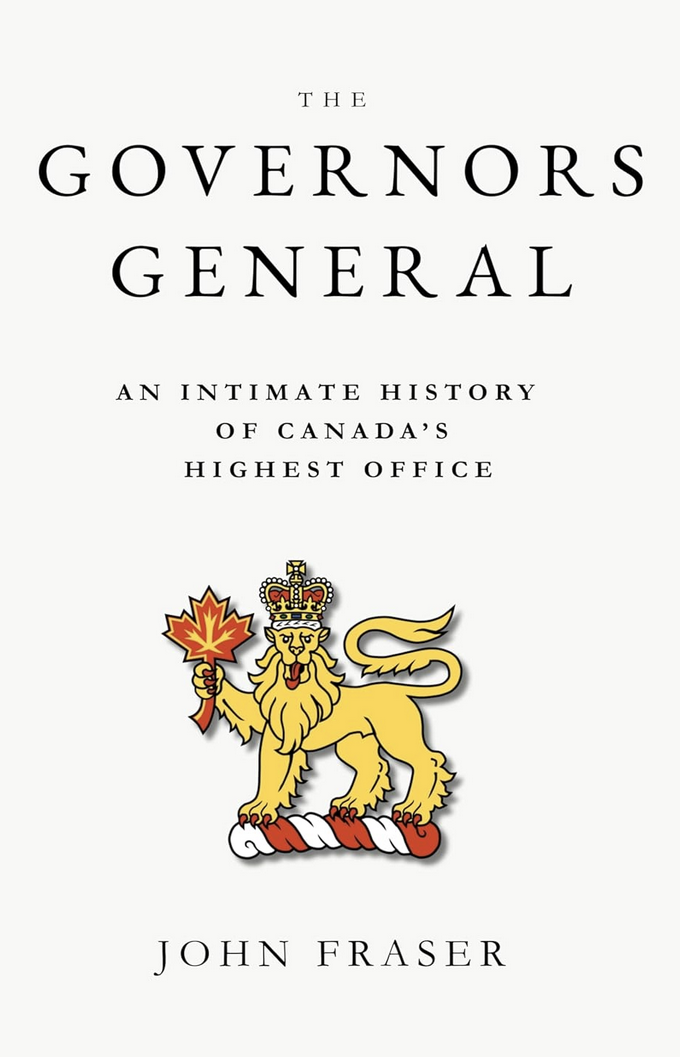
The Governors General: An Intimate History of Canada’s Highest Office
By John Fraser
Sutherland House, February 2026/159 pages
Reviewed by Thomas S. Axworthy
April 7, 2026
John Fraser begins his lively account of the 13 Canadian-born or naturalized Governors General — the first of whom, Vincent Massey, was appointed in 1952 — with the premise that the office “is an integral part of Canada’s system of responsible, elected government.”
Further, we are informed: “What I don’t want to leave any doubt about… is the worthwhile nature of an appointed constitutional leader, one selected by a democratically elected national leader and robed in regal paraphernalia.”
We should expect nothing less from the President of the Institute for the Study of the Crown.
A worthy book about the role of Canada’s Governor General — and a defence of the monarchy — might send many potential readers stampeding for the exits, but only if they don’t know John Fraser, one of the most distinguished journalists of his generation and an ebullient raconteur who, in key moments of the past 50 years, has been more than a witness to history.
As 30-year-old dance critic for The Globe and Mail, he was instrumental in the cloak-and-dagger logistics of Russian ballet virtuoso Mikhail Baryshnikov’s 1974 defection in Toronto. As a foreign correspondent for The Globe in Beijing, he made an impromptu speech on democracy to a crowd of 20,000 that might have led to his expulsion — or worse. His 1980 book The Chinese: Portrait of a People was a bestseller.
As editor of Saturday Night from 1987-94, his magazine won a host of awards, including for his role as editor. In 1995, he became Master of Massey College at the University of Toronto (where I have served as Public Policy Chair since 2016). The College’s role as a crossroads for ideas and personalities provides him with many insights and anecdotes for this book.
Fraser has met all 13 Governors General he portrays and some he knows very well. He uses their time in office to show how both the institution and Canada have evolved since the 1950s. Though he writes that “these portraits are personal and arbitrary,” one comes away from the book with a solid thumbnail understanding of our past half-century of political and cultural history.
The book’s first portrait is of Vincent Massey (Governor General, 1952–1959), and Fraser begins with the kind of humorous personal anecdote that connects him so effectively to the great and the good. One day when Massey was touring Upper Canada College, Fraser and his chums had sneaked into the chapel for a smoke.
A knock on the door caught the boys unawares; all fled except Fraser, who fell to his knees and chanted every prayer he could remember. Later that afternoon, after his companions had been chastised, he was summoned to the principal’s office, expecting punishment. Instead, he was told: “How pleased His Excellency was to see a boy at prayer.”
Fraser goes on to recount Massey’s many achievements—and equal number of demerits—and cheekily concludes: “I, of course, will go to my grave grateful for his support of my spiritual well-being all those years ago.”
As a boy growing up in Winnipeg, I used to play at the site of the Countess of Dufferin locomotive beside the Royal Alexandra Hotel on Main Street. The locomotive, the first steam engine in Western Canada, also provided — via childhood curiosity — my early knowledge of Governors General.
Fraser argues that we are wise to have the head of state separate from the elected head of government; the example of Donald Trump — naming cultural centres after himself and affixing his signature to the currency — illustrates the risks of conflating the two roles.
It was named after Lady Dufferin, whose husband, Lord Dufferin (Governor General, 1872–1878), established an important precedent in Canadian political history — one still relevant today. Sir John A. Macdonald was personally warned by Dufferin that the 1872 Pacific Scandal would “fatally affect” his position as Prime Minister. Macdonald eventually resigned, and Dufferin called on the Liberals to form a new government in 1873.
Fraser, who covered some of this territory in his broader 2012 book The Secret of the Crown: Canada’s Affair with Royalty, rightly underlines the importance of the Governor General as protector of the Canadian Constitution. As recently as 2008, Michaëlle Jean consulted widely before agreeing to Stephen Harper’s request for prorogation to avoid the likely defeat of Harper’s Conservative government in the House.
Fraser also argues that we are wise to have the head of state separate from the elected head of government; the example of Donald Trump — naming cultural centres after himself and affixing his signature to the currency — illustrates the risks of conflating the two roles.
Yet it is the personal qualities of Governors General — and their ability to inspire — that may be even more important than the rare occasions when they must temper the ambitions of prime ministers. One thinks of Georges and Pauline Vanier in Canada’s centennial year, 1967. Georges Vanier, former ambassador to France, was among the earliest defenders of the Free French and Charles de Gaulle. When de Gaulle made his infamous “Vive le Québec libre!” speech from Montreal’s City Hall balcony, Pauline Vanier sent him a message via intermediary bearing just the cryptic reminder: “1940.”
Or consider David and Sharon Johnston welcoming the first Syrian refugees at Pearson International Airport in 2015 with the Arabic greeting marhaba. Or, just two months ago, in February 2026, Mary Simon — Canada’s first Indigenous Governor General and former Arctic ambassador — arriving in Nuuk, Greenland, to open a Canadian consulate and signal solidarity with Greenlanders facing territorial pressures from the United States.
Fraser expertly captures this human dimension of the office in his vivid account of Roland Michener’s 1967 visit to Fogo Island, Newfoundland. Fraser, then a junior reporter with the St. John’s Evening Telegram, was assigned to cover the visit. The viceregal party — Roland and Norah Michener, accompanied by their secretary Esmond Butler — was met at the landing jetty by a cavalcade of ancient cars.
Butler affixed the viceregal standard to a 1955 Chevrolet convertible, whose bumper promptly fell off. Undeterred, the party proceeded to the town centre, only to be greeted by the strains of La Marseillaise, followed by Deutschland über alles. A local councillor, seeking to mark the occasion, had purchased a record of national anthems but struggled to find the groove for God Save the Queen. Michener, unflappable, laughed and asked the mayor to stand beside him.
Fraser recounts this comic-opera sequence with great charm but also makes a serious point: the people of Fogo Island had eagerly anticipated the visit. Everyone turned out, dressed to the nines, proud of their community. The visit affirmed that Fogo Island was not “at the end of the earth,” but worthy of national recognition. That is what good Governors General can do—inspire communities, remind citizens of the extraordinary country they inhabit, embody shared values, and use the traditions of monarchy to lift our sights beyond the everyday.
With wit and verve, John Fraser offers a balanced assessment of recent holders of the office, while remaining enthusiastic about the potential of Governors General to do good and make a difference. He urges prime ministers to take viceregal appointments seriously — not always the case in the past — and on that point, at least, there should be broad agreement.
Thomas S. Axworthy was Principal Secretary to former Prime Minister Pierre Trudeau and remembers with fondness his visits to Rideau Hall.