
International Law in the Strait of Hormuz

April 15, 2026
We have descended into the abyss when it comes to respect for international law and its centuries of progressive development to where we are today. The absence of American leadership and, worse, Donald Trump’s desecration of global rules and wanton disregard for historic legal precedent leaves us all aghast.
Nonetheless, it is vital to carry on signalling the critical importance of international law to our collective humanity and the high moral standards enshrined in the law of nations because, as many of us believe, the pendulum will return and world leaders — those of goodwill — will once again respect the common rules of global order.
With this in mind, let’s address the crisis the world faces in the Middle East in the war between the U.S. and Iran, specifically the closure of the Strait of Hormuz. Much commentary has been generated on the legal aspects of the war by numerous experts and credible think tanks about the war and its globally disastrous effects.
There’s a temporary cease-fire in place while efforts are underway, through Pakistan as intermediary, to find a path forward in US-Iran negotiations. While this is in play, the situation regarding the strait itself remains tense and extremely dangerous, with shipping suspended due to reciprocal blockades, first by Iran and then by the Americans in response. The closure of this critical waterway raises difficult and complex questions under international law.
The starting point concerns the strait’s legal status. As its name implies, whether through customary international law or under the United Nations Convention on the Law of the Sea (LOS), it is an “international strait” – being a body of water that connects two parts of the high seas or an exclusive economic zone (EEZ) and used for international navigation.
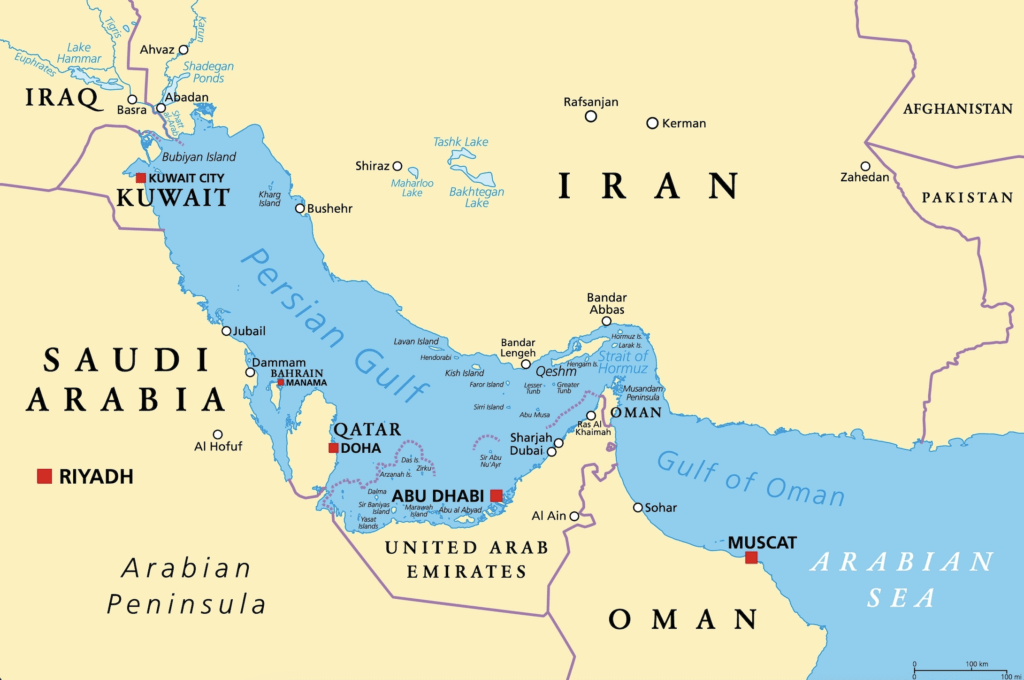
There is no doubt about this in legal terms, as its centuries-old history makes clear, an intensely used, heavily trafficked maritime connection between the Persian Gulf to the northwest and the Gulf of Oman and the Arabian Sea to the southeast.
 Shutterstock
A further point of fact is that the strait lies outside Iran’s 12-mile territorial sea. But even if it was entirely within Iran’s territorial sea, it would still qualify as international strait in legal terms for the reasons mentioned. As such, it is subject to what is called “innocent passage”, a sanctified right of transit by all vessels, whatever their nationality. This right has developed over centuries, affirmed by the International Court of Justice in the 1947 Corfu Channel Case and codified in Article 38 of the LOS Convention, which says that when it comes to an international strait,
“ …all ships and aircraft enjoy the right of transit passage, which shall not be impeded…”
Under Article 39 of the Convention, however, ships and aircraft have to behave accordingly in exercising innocent passage rights and to,
(a) proceed without delay through or over the strait;
(b) refrain from any threat or use of force against the sovereignty, territorial integrity or political independence of States bordering the strait, or in any other manner in violation of the principles of international law embodied in the Charter of the United Nations;
(c) refrain from any activities other than those incident to their normal modes of continuous and expeditious transit unless rendered necessary by force majeure or by distress.
What these rules mean is that Iran’s blockade of the strait to commercial tankers and other non-military ships of various nationalities embarking from non-belligerent Gulf ports, its mining of the strait and other threats of attack on such vessels, are flagrantly in breach of international law.
Iran’s action is clearly not a “blockade” as permitted under the laws of war, which recognizes the right to interdict commerce but only to and from belligerent states. Iran’s action is indiscriminate, seriously impacting non-belligerents, with hugely damaging effects across the globe. It’s clearly illegal. That’s the first conclusion.
The related legal question, then, is this. What is the permissible response on the part of other governments to Iran closing the strait? What kind of corrective action would be countenanced under international law? Would military action be allowed if all other efforts fail? These are hugely complex legal questions.
Whatever the legalities, the reality is that the U.S. is the only country that has the means to take direct, military action in response to Iran’s blockade. President Trump has ordered the U.S. Central Command (CENTCOM) and the U.S. navy to prevent all ships from entering or exiting Iranian ports through the strait. He has made other bellicose threats, including attacking any Iranian attempts to enforce their blockade.
Over a dozen American warships have been deployed to the area, supported by aircraft. As an additional response, the U.S. military, apparently, has begun to clear mines placed by Iran in the vital waterway. While threats were first made to prevent all ships approaching the blockaded waters, Trump has since stated the U.S. would allow neutral, non-Iranian traffic to exit the strait.
So far, there have been no reported instances of military action by U.S. forces. That may happen and, if it does, the circumstances surrounding such actions will have a bearing on the legal analysis.
For the present, however – whatever one might conclude about the broader legal issues surrounding the Middle East war, when it comes to Hormuz, some form of corrective action to keep the strait open could be permissible.
While the point is controversial and many legal aspects not settled, safeguard measures, including escort patrols and even some proportionate but limited naval action, could be justified. Disproportionate military action – such as large-scale attacks on Iranian naval and other assets – on the other hand, would not be tolerated under international law.
The problem is that we are in uncharted territory where international law regarding countermeasures in response to suspension of rights of innocent passage rights remains cloudy and uncertain. Depending on developments in the days ahead — hopefully short of military action — some of these elements may sort themselves out. Should a direct military confrontation occur, however, legal issues over innocent passage and blockades will no doubt be overcome by events.
Policy contributor Lawrence Herman is an international lawyer with Herman & Associates, a senior fellow at the C.D. Howe Institute in Toronto and a member of the Expert Group on Canada-U.S. Relations. He is a former foreign service officer, having served in Canada’s Permanent Mission to the United Nations and the GATT.