
The New Lessons of the Battle of the Atlantic
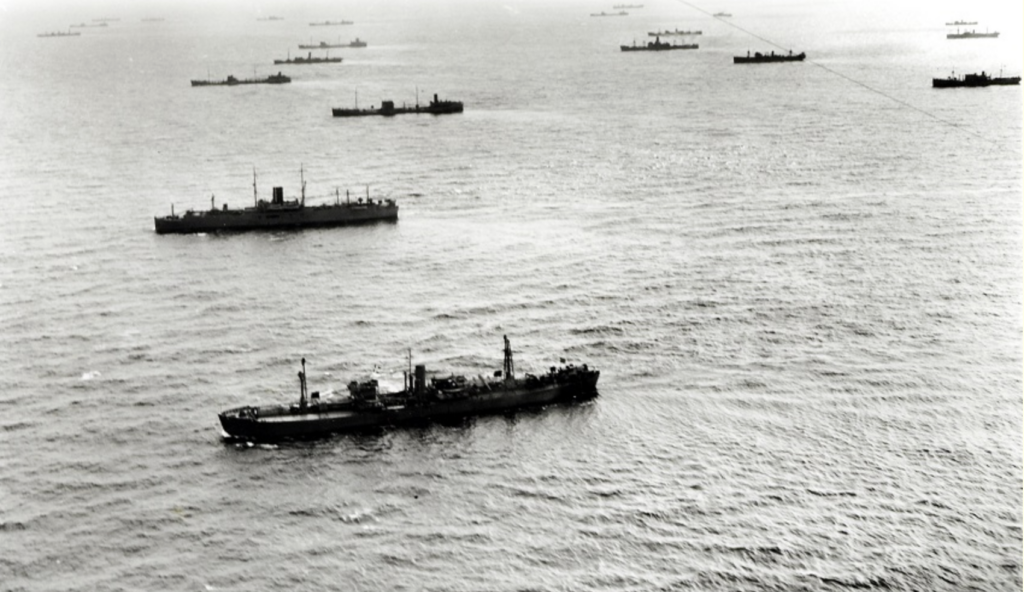 Convoy HX-188 of Canadian merchant ships en route to Britain in May 1942/LAC
April 30, 2026
Every year, on the first Sunday in May, Canadians gather to mark the Battle of the Atlantic. It is a ritual of remembrance.
Yet it should also be a warning.
The Battle of the Atlantic was not just World War II’s longest continuous campaign: it was a fight over the ability to move goods safely across the sea.
Today, we take those sea lanes for granted. Canada’s prosperity floats on salt water. But the illusion of safety is breaking down.
Consider the Strait of Hormuz, through which a fifth of the world’s oil passes. Or the Strait of Malacca, the crowded artery linking the Indian and Pacific Oceans. Or the other chokepoints; narrow passages where geography concentrates risk and risk of disruption. Increasingly, they are being weaponized.
States and non-state actors alike have learned that you do not need a blue-water navy to disrupt global trade. Mines, missiles, drones, even the threat of harassment can drive up insurance costs, reroute shipping, and unsettle markets.
The recent turmoil in the Middle East has shown how quickly ‘business as usual’ can become anything but. Freedom of navigation—once assumed, even taken for granted—is now contested.
This is where Canada’s history should inform its strategy. Prime Minister Mark Carney has spoken of “coalitions of the willing”—a flexible alignment of states prepared to defend shared interests when universal consensus fails.
What is more vital to our interests than protection of international sea lanes? Sea lanes transport 85% of global trade and the undersea cables guaranteeing connectivity. Their waters provide food, fuel and critical minerals.
A coalition of middle powers — including NATO allies and Indo-Pacific partners — should coordinate patrols, share intelligence and work to keep critical waters open.
Our economic strategy is, increasingly, a maritime strategy. With trade diversification beyond the United States, more of our exports will travel by sea.
Still, our capabilities lag our ambitions.
Defending freedom of navigation requires a stronger Royal Canadian Navy: not just new warships and submarines but embracing new technologies—unmanned surface and underwater vehicles, advanced sonar, and air and space surveillance.
The story of the Battle of the Atlantic reminds us that maritime security is not abstract. It is about whether a country can feed itself, fuel its economy, and support its allies. It is about whether trade flows or falters.
It means thinking differently about the maritime domain. The battlespace is no longer just on the surface. It extends under the sea, into the electromagnetic spectrum, and into orbit. Sensors, data, and networks are now as important as ships and sailors.
Naval procurement unfolds over decades, not election cycles. That is why the most important requirement is not money, but political will.
Canada needs sustained, multi-party commitment to rebuild its maritime capabilities — commitment that survives changes in government and shifting fiscal pressures. Without that continuity, rearmament will stall, costs will rise, and credibility will erode.
Equally important is public support. Canadians must understand why this matters.
In the early 1940s, Nazi Germany sought to strangle Britain by cutting its maritime lifelines. For Winston Churchill: the U-boat peril was the only thing that “ever really frightened” him.
The lesson was clear. If sea lanes fail, everything else follows.
Canada answered that threat. A small, ill-equipped navy became a global force. The Royal Canadian Navy, alongside the Merchant Marine and the Royal Canadian Air Force, escorted thousands of ships through submarine-infested waters. Convoys became the shield of democracy. More than 4,600 Canadians paid with their lives.
The story of the Battle of the Atlantic reminds us that maritime security is not abstract. It is about whether a country can feed itself, fuel its economy, and support its allies. It is about whether trade flows or falters.
That story needs to be told — not just by ministers, but by the navy, by industry, and by those who understand that prosperity depends on secure oceans. If we want the navy Canada needs, we must build the case for it.
The sailors we honour each May fought to keep lifelines open in the face of a determined enemy. They understood that control of the seas was the difference between survival and defeat.
We would do well to remember that.
Because the oceans are becoming contested again. Choke points are becoming pressure points. And the freedom to sail — so essential, so long assumed — is no longer guaranteed.
For a trading nation like Canada, it demands, once again, that we be ready.
Policy Contributing Writer Colin Robertson, a former career diplomat, is a fellow and host of the Global Exchange podcast with the Canadian Global Affairs Institute in Ottawa. He is also an Honorary Captain in the Royal Canadian Navy.