
Canada’s Changing Relationship Status with Europe

May 5, 2026
In Yerevan, Armenia, on Monday, Prime Minister Mark Carney — the first non-European leader invited to attend a European Political Community Summit — articulated the role Europe might play in a post-American liberal order.
“It is my strong personal view that the international order will be rebuilt,” Carney told the gathering, “but it will be rebuilt out of Europe.”
In the face of America’s alienation from the rules-based international order that Washington helped build and led for eight decades, Canada — what might now be known fondly across the Atlantic as “the other North America” — is shifting more closely into the EU’s orbit.
Or, as New York Times Canada Bureau Chief Matina Stevis-Gridneff wrote in her May 4th piece from Yerevan: “Canada and the European Union are turning commiseration and anxiety over their turbulent relationships with the United States under President Trump into a deepening bond.”
Canada and the EU are already strategically aligned in terms of global policy priorities — on climate, deference to international law, and the need for effective rules-based multilateral institutions.
Former Portuguese prime minister and current European Council President Antonio Costa, in his closing remarks in Yerevan, said Canada’s presence was a reflection of the “strong and growing alignment between Europe and Canada. And a powerful reminder that a principles- and rules-based international order, with multilateralism and the UN system at its heart, are objectives widely shared around the world.”
For her part, European Parliament President Roberta Metsola, who invited Carney to Brussels to address the body, said Canada’s attendance in Yerevan “shows Canadians that we are willing to go further with a country we could be very easily, much more integrated with.”
Based on recent public opinion polling of both Europeans and Canadians, the feelings are mutual.
An April 6th Spark poll showed that 25% of Canadians think joining the EU is a good idea and another 58% think it’s worth exploring. On May 1st, a YouGov poll found “A majority or plurality of adults in the five largest EU member states – France, Germany, Italy, Poland and Spain – say they would support admitting Canada to the European Union,” per the analysis. “Germans are the most likely to do so, at 55%, with 51% of Spaniards and 46% of Poles saying likewise.”
In practical terms, Canada couldn’t join the EU without undoing much of our needed bilateral regulatory framework with the US. But EU member states are beginning to see the merit of some form of non-member association with an ally whose values, economy, social model, level of ambition, and geographic adjacency via the Arctic provide an unusual fit for Carney’s anticipation of project-based mutual development.
The U.S. cheered on European integration, from its inception to the completion of the European Union in 1993 when the Maastricht Treaty came into force.
When I left Europe in July 2006, I wrote for the International Herald Tribune (July 26, 2006) that “as Canadian ambassador to Europeans for the last 14 years, I have urged Europeans and North Americans to celebrate that the wars of ‘that wonderful, murderous continent’ (Amos Oz) are over — Europe has never been so peaceful, prosperous, healthy or green.” I should have added: “free.”
The European Union helped bring democracy across the continent. It ended juntas in Spain, Portugal, and Greece. The promise of eventual EU membership encouraged and mentored the transition from Cold War regimes to a Europe mostly whole and free. Its achievement is unprecedented: proud sovereign nations voluntarily pooled sovereignty to prevent a return to Europe’s genocidal past.
The origins of the European Union lay in a mixture of idealism and pragmatic caution. They established the Common Market, eliminated internal tariffs, created a common external tariff, and introduced the free movement of goods, services, capital, and labour, and multiple common policies of common consequence.
However, projecting Europe as a single, influential force in international affairs was always an elusive goal: it challenged the historical sovereign prerogatives of member states, particularly France and the UK.
It partly explains why the liberal and democratic European Union of 450 million citizens, whose exports of goods and services surpass those of China and the US, has struggled for a global political impact commensurate with its inherent economic weight.
From the beginning, however, Europe’s central tension was clear: sovereignty versus integration.
Charles de Gaulle insisted that taxing and spending must remain with national parliaments. He understood that voters cared most about bread-and-butter issues and would not easily accept their transfer to an unelected European bureaucracy. The unintended consequence was that national leaders too often blamed “Brussels” for their own failures.
As was said after the French referendum defeat on the proposed European constitution in 2005: you cannot rail against Europe from Monday to Saturday and expect people to vote for it on Sunday.
The US cheered on European integration, from its inception to the completion of the European Union in 1993 when the Maastricht Treaty came into force. The US-EU economic relationship became the world’s most important. Direct inter-investment between the US and the EU surpassed that of trade. On an extraordinary scale, American and European companies have used foreign direct investment (FDI) to sell in each other’s markets — as of 2023, $5.7 trillion USD, dwarfing the value of bilateral trade at $976 billion.
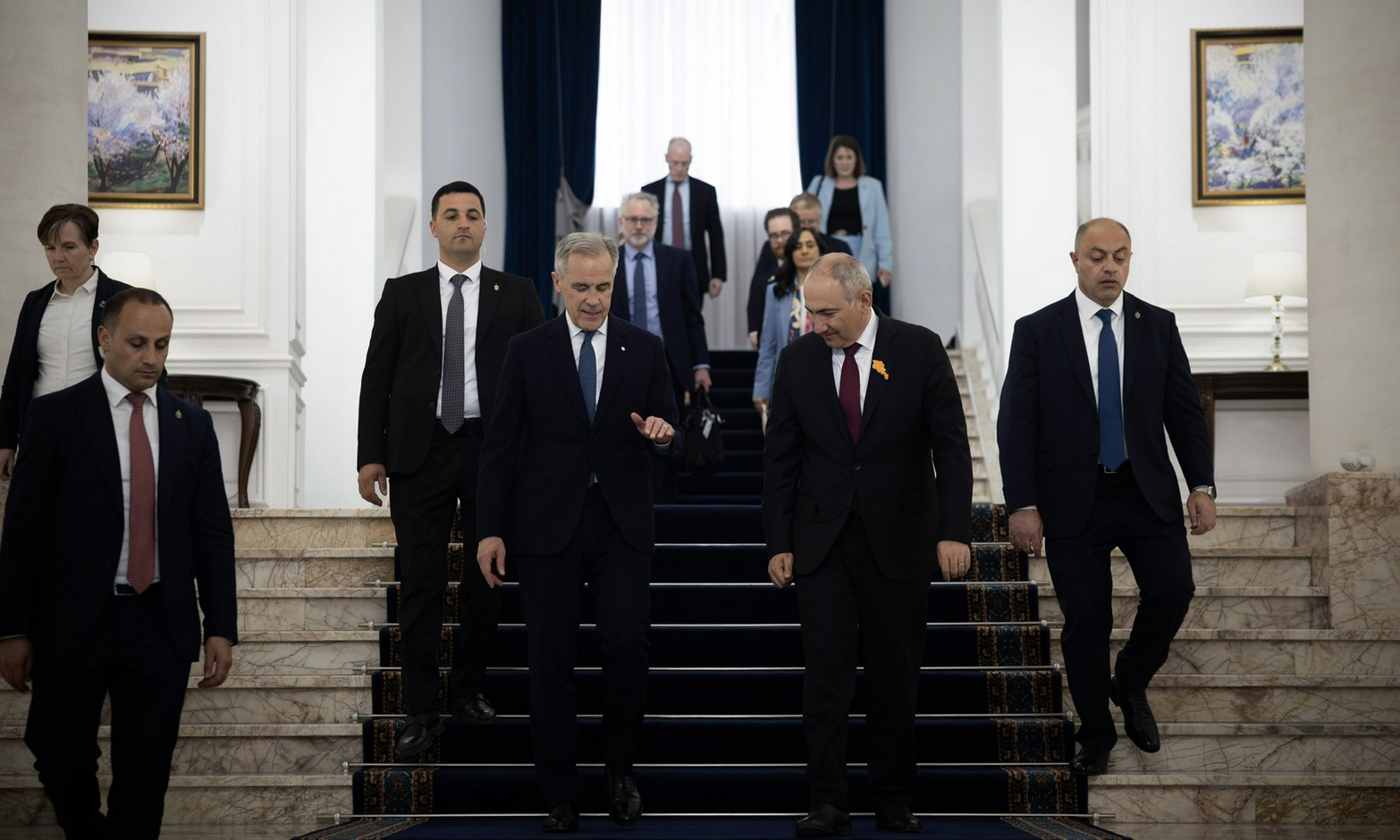 Prime Minister Mark Carney with Armenian Prime Minister Nikol Pashinyan in Yerevan on May 3, 2026/PMO
But the Trump administration has revealed alarming hostility to not just European governments, but to the historic European project itself. That contempt was evident in the Trump movement’s texts, Project 2025, and the 2025 National Security Strategy. They seemed to object in principle to the EU’s pooling of national sovereignty for whatever purpose. Their articulation was derisive about the idea of “Europe” itself.
It shows little comprehension of Europe’s postwar determination to end catastrophic wars on the continent forever, and how that vision informed the bloc’s evolution.
The US sidelined the Europeans on talks to end the war in Ukraine —on European soil — because of an apparent bias toward Vladimir Putin.
On the Iran war, which is becoming the issue that may sever US-Europe policy interdependency altogether, the EU and European NATO members refused to join a reckless military intervention gone sour, on which they were not consulted and didn’t agree.
Between Trump’s threats to annex Greenland, JD Vance’s anti-European screed at the 2025 Munich Security Conference, the ludicrous tariff war being waged to shred the existing, ironically US-led global trading regime and the WTO, and the transatlantic abyss widening over Ukraine, Trump has essentially done the dirty work of America’s geopolitical rivals by dividing the West and isolating America.
But by this year, there were signs that Trump’s brand was souring throughout Europe.
The April 12th electoral defeat of Hungarian Prime Minister Viktor Orban, poster boy of the illiberal anti-EU far right, implied a halt in the rather steady march of European far-right parties.
Since Trump launched the Iran war and in the wake of Orban’s shellacking, even some European far-right parties have begun distancing themselves from Trump. Being pro-Trump in Europe is becoming so politically costly, even French National Rally Leader Marine Le Pen is giving him a wide berth.
That creates an opportunity. Europe cannot merely placate Trump with flattery in exchange for protection. As Mark Carney said at Davos: compliance will not buy safety. Europe must instead project confidence, principle, and capability. The question is whether Europe can become an anchor of the democratic world as a self-reliant force for balance.
The Trump administration has revealed alarming hostility to not just European governments, but to the historic European project itself.
Trump has done Europe a remarkable service: he has clarified the stakes and prompted the urgency of greater unity among Europeans. They now know they must prepare for security without automatic dependence on the United States.
Acting also inside NATO as the European pillar, and through the EU, Europe must build shared military capacity and deepen strategic self-reliance, especially in air defence, logistics and munitions, where Europe relies on America. Forces and arms manufacturing need to be integrated, not duplicated inefficiently.
To do so at scale, the EU should enlarge its security cooperation and policy solidarity circle to include associate partners, namely Britain, Norway, Canada, Ukraine, and possibly even Turkey.
Such a larger Europe-centred community could become a significant moral, economic, and security force. Its purpose would not be anti-American. It would aim to preserve the principles America once led: cooperation, law, democracy, and restraint, and build back multilateralism together.
The United States built its postwar strength not only on military power, but on alliances. Those alliances were among its greatest assets. Trump’s unilateral nationalism has badly damaged trust. But damage need not be final.
A stronger, more self-reliant and “enhanced” Europe would make eventual transatlantic recovery more possible, not less. When and if America regains its composure, it will find partners capable of standing beside it, not dependencies waiting to be rescued.
Europe’s challenge is therefore historic: to become, at last, a strategic actor equal to its values, its memory, and its weight. And right now, that squares with Mark Carney’s vision for Canada.
Policy Columnist Jeremy Kinsman served as Canada’s ambassador to Russia, high commissioner to the UK, ambassador to Italy and ambassador to the European Union. He is a Distinguished Fellow of the Canadian International Council.