
Carney’s Tilt Toward Europe is not Nostalgia, it’s Foresight
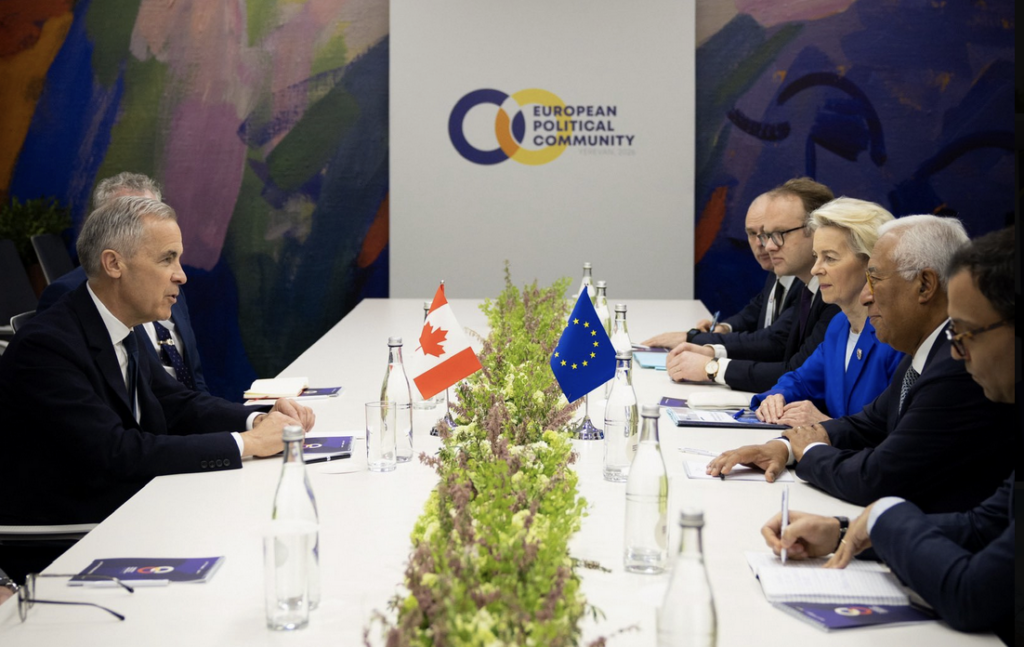
Prime Minister Mark Carney and EU Commission President Ursula von der Leyen in Yerevan on May 4, 2026/PMO
May 11, 2026
For generations, Canada’s foreign policy rested on a comfortable assumption: geography tied us to the United States, while values linked us to Europe. We never had to choose between the two because the Atlantic alliance functioned as one strategic community.
That world has changed.
The European Delegation in Ottawa recently celebrated its 50th anniversary at a moment when the Trump administration’s contempt and hostility has pushed Canada and Europe closer together. The speeches by Foreign Minister Anita Anand and EU Ambassador Geneviève Tuts spoke to a new urgency to strengthen relations. For Jonathan Wilkinson, Canada’s new ambassador to the European Union, there is much to do.
Prime Minister Mark Carney’s accelerating European tilt is neither diplomatic theatre nor sentimental Atlanticism. No, Carney’s Europe policy is a response to a harsher reality: Under Donald Trump, the United States is becoming more aggressive, more transactional, more protectionist, and less committed to the rules-based order Canada has relied upon since 1945.
From his first visits to Paris and London after taking office, Carney signalled that Ottawa was preparing for a world in which Washington could no longer be treated as a fully reliable anchor. At the European Political Community summit in Yerevan, Armenia on May 4th, he spoke with unusual bluntness. “Integration has been used as a weapon by some,” he warned. “The rules are not constraining the hegemons. Now, we must actively take on the world as it is, not as we wish it to be.”
Carney’s answer is to repeatedly emphasize what he calls “values-based realism” as the basis for his approach of “variable geometry” – building coalitions and networks of trusted partners around security, technology, energy and trade.
The shift is already substantial. Since Carney and European Commission President Ursula von der Leyen announced a new Strategic Partnership last June, Canada has joined the EU’s SAFE defence procurement initiative as its first non-European participant. Ottawa is deepening defence co-operation with Nordic countries while integrating policies on critical minerals, AI, energy and Arctic security with European partners.
Carney has notably described Canada as “the most European of non-European countries.” He has also said many times that nostalgia is not a strategy, and this is not nostalgia. It is foresight. The opportunities are real.
Europe is rearming at historic speed. Russia’s invasion of Ukraine and the growing doubts across European capitals about long-term American reliability have transformed European strategic thinking. Nordic countries are strengthening defence in the High North while Brussels pours hundreds of billions into defence production, energy resilience and industrial policy.
Canada has assets Europe needs. We are an energy superpower; with oil, gas, uranium and hydrogen. We possess critical minerals essential for batteries, semiconductors and defence technologies. We have world-class AI talent. Our Arctic geography is increasingly strategic.
With the Canada-EU Strategic Partnership and defence and procurement agreements, a transatlantic relationship that was cooperative but under-leveraged can flourish. Diversified trade would reduce exposure to American tariffs and political volatility.
European capital could help finance Canadian infrastructure and defence production. Canadian firms could plug into Europe’s expanding military supply chains. The closer Nordic partnerships Carney telegraphed with his March trip to Norway’s Arctic Circle for NATO’s Cold Response exercises could strengthen Arctic sovereignty precisely when Russia and China are probing northern vulnerabilities.
Canada is also politically trusted across Europe. Polling by YouGov and Spark suggests Canadians strongly support closer ties with Europe, while majorities in several large EU countries say they would back Canada joining the European Union. That gives Carney an opening to reposition Canada as a strategic transatlantic partner.
The real test of Carney’s European strategy will be balance: Can Canada deepen ties with Europe while preserving essential access to the United States?
The gains could be substantial. There is logic to this strategy, but there are also limits. The first is geography.
Europe will not replace the United States. Nearly three-quarters of Canadian exports still go south. North American supply chains remain deeply integrated. Our energy infrastructure – pipelines, electricity grids and transportation corridors – is overwhelmingly continental.
The second challenge is capacity. Europe talks strategically, but its 27 member states often move slowly. Nearly a decade after the signing of CETA, ten EU countries have yet to fully ratify the agreement. Meanwhile, Canada’s use of the opportunities CETA already provides remains disappointing.
The EU also remains more regulatory superpower than unified geopolitical actor. Defence integration is improving, but political divisions and industrial protectionism persist. And as former European Central Bank president Mario Draghi has argued, Europe faces major productivity challenges of its own. What Draghi described as “immense complacency” when it comes to competitiveness could also apply to Canada.
Canada also needs to be realistic about European interests. Brussels talks about “strategic autonomy,” but this can easily become economic nationalism. European governments want Canadian minerals and energy, but often on terms designed to benefit European industry first.
There is another uncomfortable question: how European does Canada really want to become?
Finnish President Alexander Stubb has mused publicly about Canada joining the European Union. It is unlikely. Carney’s approach appears less about formal integration than functional alignment – on defence, Arctic security, critical minerals and artificial intelligence.
That is probably wise. But “variable geometry” can also become a patchwork foreign policy lacking strategic clarity. Coalitions of the willing work well in crises. Sustaining them over decades is harder.
Canada also cannot afford romantic anti-Americanism disguised as strategic autonomy. Our prosperity still depends fundamentally on stable access to the U.S. market. Diversification must supplement, not abandon, the continental relationship.
There are things we can do. The premiers should coordinate and ramp up trade and investment missions to increase CETA’s utilization rate. We should also further develop research ties and exchange opportunities in the sectors identified by Carney.
The real test of Carney’s European strategy will be balance: Can Canada deepen ties with Europe while preserving essential access to the United States? Can we strengthen our industrial base, Arctic security and economic resilience without pretending geography no longer matters?
The values linking Canada and Europe matter, perhaps more than ever. But values alone are not enough. The challenge now is to translate aspiration into strategy – and strategy into results.
Policy Contributing Writer Colin Robertson, a former career diplomat, is a fellow and host of the Global Exchange podcast with the Canadian Global Affairs Institute in Ottawa.