
Letter from Nairobi: Beyond the Macron Headlines at the Africa Forward Summit
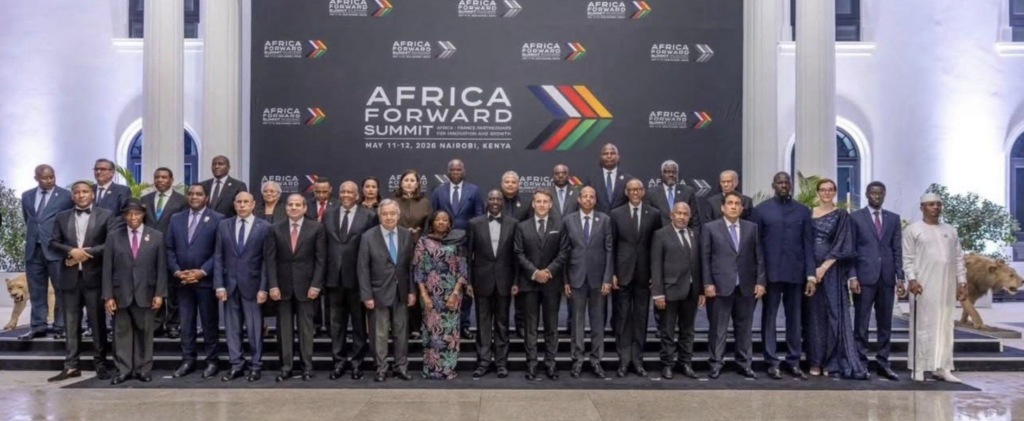 Africa Forward Summit ‘class photo’, May 11, 2026/Kenya government image
By Zara Rabia
May 14, 2026
On May 11th and 12th, Nairobi hosted the Africa Forward Summit, a high-level gathering bringing together political leaders, entrepreneurs, students, investors, and civil society voices to discuss the future of Africa-Europe relations, economic cooperation, innovation, and youth leadership across the continent.
I had the privilege of attending the summit, and beyond the headlines and viral moments, what I witnessed was something larger: a city and a continent increasingly confident in defining their own future.
One of the most notable moments came during French President Emmanuel Macron’s intervention, where he emphasized the importance of building what he described as an “equal-to-equal partnership” with Africa.
Macron argued that the era of France coming to Africa to “give morals” was over, a statement that reflects a broader recognition that African countries are no longer willing to accept paternalistic relationships from former colonial powers.
However, much of the international media coverage focused on a different moment. During one discussion, President Macron briefly interrupted proceedings to ask attendees to lower the noise level in the venue.
The clip quickly circulated online, with several outlets framing the moment negatively and associating it primarily with Nairobi itself rather than the organizational setup of the event. The viral moment quickly overshadowed many of the broader discussions taking place during the summit.
What many reports failed to mention is that the summit’s layout, which included multiple stages operating simultaneously in the same open space, was part of the “Africa Forward Inspire & Connect” segment of the summit, a section organized by French institutions including Bpifrance, Business France, and Proparco (AFD Group), under the patronage of Macron and Kenyan President William Ruto.
The resulting overlap between discussions and panels naturally created significant background noise throughout parts of the venue. As a result, the viral moment that circulated online reflected organizational choices made within the French-led segment of the summit rather than a failure on Nairobi’s part.
In contrast, Nairobi’s own logistical and security coordination throughout the summit was seamless. Access to the summit required passing through multiple security checkpoints, and major roads around the university area were carefully secured with visible coordination between authorities and event organizers.
From transportation management to crowd organization, Kenya demonstrated its ability to host high-level international gatherings effectively.
Yet beyond diplomacy and summit logistics, the most striking aspect of the trip was Nairobi itself.
Too often, international narratives about African cities remain trapped between outdated stereotypes and simplistic clichés. Nairobi challenges those assumptions immediately. It is a rapidly growing center of technology, entrepreneurship, finance, and youth innovation — often referred to as the “Silicon Savannah” due to Kenya’s expanding digital economy and startup ecosystem.
Increasingly, cities like Nairobi are becoming places where young people believe they can build globally relevant careers while remaining rooted locally.
Over the last decade, Nairobi has increasingly positioned itself as one of Africa’s leading innovation hubs. Major international companies, startups, and venture capital firms have expanded their presence in the city, helping transform Kenya into a regional centre for technology and entrepreneurship, a trend highlighted by the Financial Times’ coverage of Nairobi’s startup ecosystem.
Kenya’s fintech boom, led in part by the global success of mobile payment systems such as M-Pesa, has become an international case study in digital financial innovation.
What stood out most to me, however, was not simply infrastructure or economic growth, but the ambition of the younger generation. During the summit, I spoke with a university student who told me something that stayed with me:
“I’m not interested in going to the West. I want to make it here.”
That mindset reflects a broader shift taking place across parts of Africa. According to Brookings Institution demographic projections, Africa is expected to become home to one of the world’s largest and youngest workforces in the coming decades.
For many young African professionals and students, success is no longer automatically imagined abroad. Increasingly, cities like Nairobi are becoming places where young people believe they can build globally relevant careers while remaining rooted locally.
Kenya has also strengthened its position as a regional economic and diplomatic hub in East Africa, attracting multinational companies and international organizations while expanding infrastructure and investment projects across the country.
What I found particularly remarkable was the contrast between perception and reality. Many people outside the continent still imagine African capitals through outdated lenses. Yet walking through Nairobi, attending international forums, and observing the organization surrounding state-level events tells a far more complex story: one of ambition, modernization, and global relevance.
At a time when China continues to expand its influence across Africa through infrastructure, trade, and investment, Europe faces an important strategic question: how can it remain a relevant partner on the continent? The answer may lie not in competition through dominance, but through cooperation grounded in equality, respect, and mutual interests.
The Africa Forward Summit was ultimately about more than diplomacy between France and Africa. It was also a reminder that cities like Nairobi are no longer peripheral actors in global conversations. They are becoming central to them.
Perhaps that is the story that deserves the most attention.
Zara Rabia is an undergraduate student in Economics and Political Science at the University of Ottawa, with a focus on international political economy and digital development. Her work explores youth entrepreneurship, informal economies, and the role of digital transformation in emerging markets.