
A Tale of Two Technocrats: The Diverging Political Fates of Keir Starmer and Mark Carney
 Mark Carney and Keir Starmer in Ottawa’s Royal Oak pub, June, 2025/PMO
By Louis Massé and Daniel Béland
May 20, 2026
The contrasting political fortunes of British Prime Minister Keir Starmer and Canadian Prime Minister Mark Carney might be framed as Shakespearean if only we lived in less Iannuccian times.
Both liberal centrists, both Oxford grads in their early 60s, both often cast as technocrats — though Starmer more debatably — the two G7 leaders are experiencing drastically different degrees of political success and public approval.
While Carney’s leap into politics has so far been an all-but unequivocal success, Starmer’s has spiralled into a party-leader ousting orgy that has begun to emulate the UK-Tory coups of post-Brexit politics.
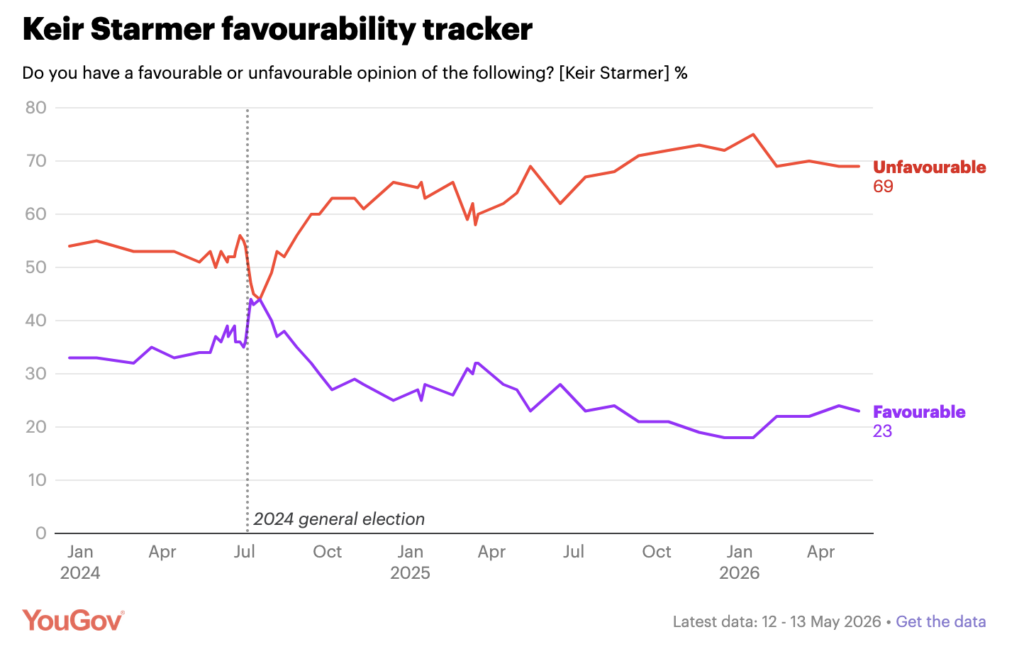
Two years after securing a strong majority government, Starmer’s disapproval rating at YouGov as of May 12-13 was 69%. As of May 11th, half of UK adults think he should step down.
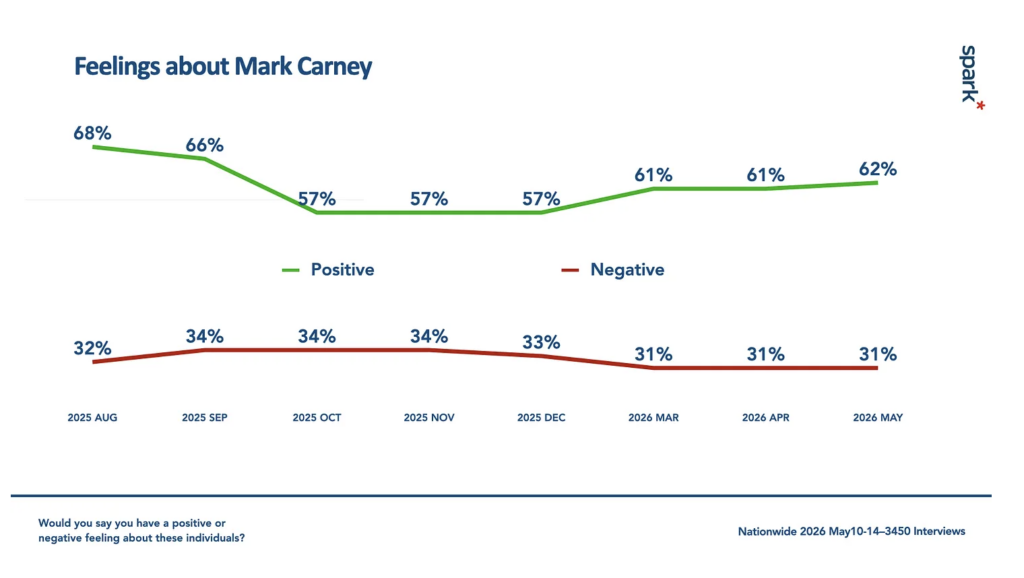
Just over a year since his stunning election victory of April 2025, Carney’s latest personal approval per Spark Advocacy (conducted May 10-14) is at 62%. The two men — so similar in other ways — are essentially at opposite ends of the popularity spectrum, with predictable political results.
But Starmer’s slide started before he hit the one-year mark that Carney just celebrated with record approval ratings and a belated majority government built on floor-crossers and byelection wins. In July 2025, Starmer’s disapproval rating was 67%, slightly higher than Carney’s approval ratings at his one-year anniversary.
That slide has not been helped in 2026 by the scandal involving New Labour veteran Peter Mandelson, whom Starmer appointed ambassador to the United States before yanking him back after the scope of Mandelson’s relationship with the late, élite sex trafficker Jeffrey Epstein was revealed. That has now ballooned into a classic coverup story of the what-did-the-prime-minister-know-and-when-did-he-know-it? variety.
On May 7th, the UK-wide local elections saw the Labour Party shellacked and Reform UK, the right-wing populist party led by Brexiteer Nigel Farage, breaking through with more than 1,350 seats out of 5,000 up for grabs, nearly all of those gained at Labour’s expense.
After years of Conservative leadership churn, the Labour government is in turmoil as calls for Starmer to be replaced echo through Westminster and rivals scramble to replace him while he’s still in the job.
Meanwhile, though he only formally entered the political arena in January 2025, Carney has proven to be an astute politician whose unique economic credentials as a central banker to both Canada and the UK are still seen as a net asset to Canadians, whose priorities have been realigned based on the economic and existential threat of Donald Trump.
Why has Starmer turned the word “technocrat” into a punchline, while Carney has breathed life into it as an aspirational brand?
It may help to draw the lessons of technocratic politics in an age of political instability. More than a question of individual personality, the success of technocrats in office depends on the conditions of their election, their ability to craft a positive message, and their capacity to manage conflicts and expectations in the face of difficult economic conditions.
Keir Starmer became a Labour MP in 2015, after a career as a human rights lawyer that led him to become Director of Public Prosecutions, the highest civil service rank in Britain’s prosecution system. He was elected leader of the Labour Party in 2020, following four consecutive Labour losses since 2010 under Ed Miliband and Jeremy Corbyn.
During his time as leader of the Opposition, Starmer faced short-lived Conservative Prime Ministers (Boris Johnson, Liz Truss, and Rishi Sunak) and prepared the party for the 2024 general election.
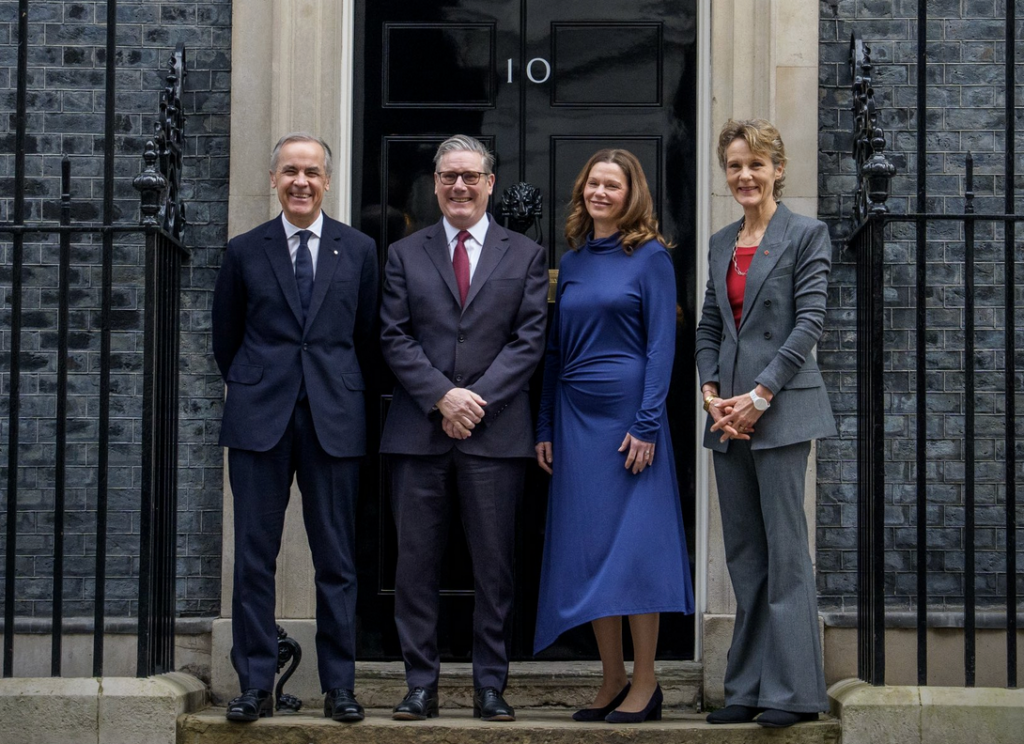 Mark Carney, Keir Starmer, Victoria Starmer and Diana Carney at Number 10 Downing Street on March 16, 2026/PMO
Change was Labour’s slogan in that election. Change from 14 years of Conservative reign that saw five different Prime Ministers, constant Cabinet turnover, and much instability originating from the 2016 Brexit referendum and contentious negotiations with the European Union. Starmer’s Labour Party capitalized on this wave of disruption by portraying itself as a source of stability.
At the same time, Starmer made clear that change would be orderly, incremental, and respect strict fiscal rules. On July 4, 2024, the Labour Party stormed the election by winning 412 seats out of 650, Britain’s second-largest majority government ever. The flip side of that election victory was Labour’s voting share of 33.7%, foreshadowing the unpopularity of the party once in power.
Ever since Starmer became leader of the Labour Party, British pundits have marvelled at what “Starmerism” is, exactly. Campaigning first on the left of the Labour Party, then moving closer to the centre, his government’s failure to craft a coherent economic story is a constant criticism in British politics.
While his background in human rights has swayed the debate over whether Starmer belongs in the technocrat class at all, his details-oriented manner of governing tends to settle it.
The technocratic language of “mission-driven government” inspired by economist Mariana Mazzucato, and the repetition of the “growth mission” as the government’s main message did not strike a chord beyond Westminster and Whitehall.
To some extent, Britain shares many of the same challenges as Canada.
Rethinking its relationship with a large regional bloc, decarbonization amid an energy crisis, sliding economic fundamentals, and rising needs for social protection — a confluence of policy demands that creates intra-party conflicts and high political expectations of the speed and scale for delivering meaningful policy change.
In this context, Starmer’s leadership is marked by failures in commanding the support of Labour’s factions and managing Britain’s fiscal constraints in an imaginative way. His Prime Minister’s Office turnover is reminiscent of previous Conservative governments and has created a permanent distraction.
The great paradox of Keir Starmer’s government is that they arrived in power well prepared but were unable to shift the tides and meet the moment.
The opposite is true of Prime Minister Carney, who captured the international Zeitgeist with his Davos speech in January while continuing to enjoy a long political honeymoon with voters at home. Although he fell just short of a majority in last April’s election, he turned things around for the Liberals, who had been fully expecting a rout at the polls after 10 years in power under Justin Trudeau.
Carney’s “Canada Strong” rhetoric, economic expertise and claims of a generational moment have a provided a public besieged by Trump anxiety a substantive diversion. British politics is not as impacted by the “Trump effect”, and since 2022 has been much more influenced by the energy and affordability crises and bond-market instability.
Despite the Starmer government’s “Securonomics” rhetoric, he has not been the technocratic beneficiary of these uncertain times. And, with three years left before the next general election, it may become even more difficult for Starmer or his successor to command electoral success.
Louis Massé is a PhD candidate in Political Science at the University of Ottawa. His research compares the politics of industrial strategy in Canada and the United Kingdom in the last 15 years.
A Fellow of the Royal Society of Canada, Daniel Béland is professor of political science and director of the McGill Institute for the Study of Canada at McGill University.