
To Leave or Not to Leave: What is the Question?
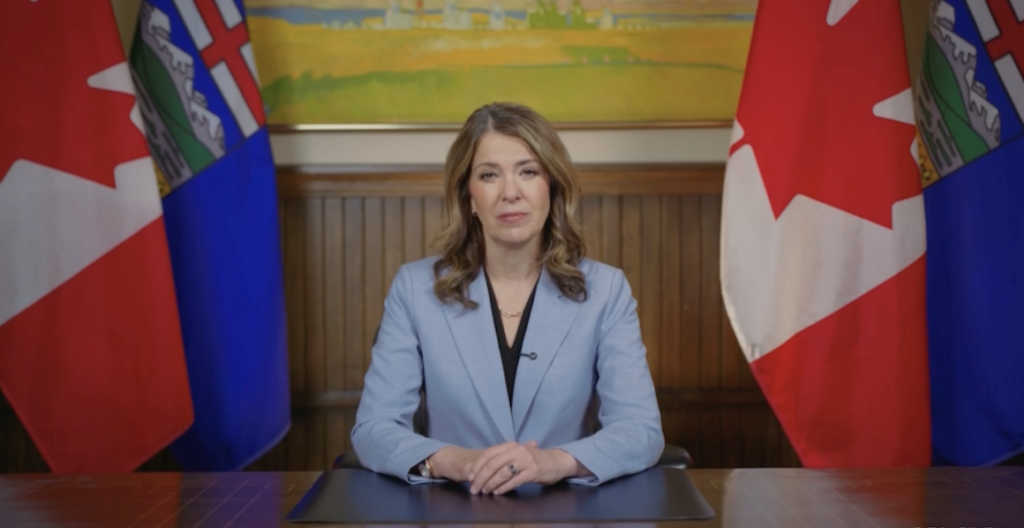 Danielle Smith’s question unveiling, May 21, 2026/CPAC
By Daniel Béland and André Lecours
May 24, 2026
Not only is Alberta’s independence drama not unfolding in a vacuum of national and international context, it’s also not unfolding in an absence of Canadian and international precedent.
How does the Alberta referendum question on the independence issue compare to other independence-related referendum questions?
In her May 21st televised address on the issue, Alberta Premier Danielle Smith unveiled the wording of the October 19th referendum question on the referendum question as follows:
“Should Alberta remain a province of Canada or should the Government of Alberta commence the legal process required under the Canadian Constitution to hold a binding provincial referendum on whether or not Alberta should separate from Canada?”
In terms of its immediate comparatives as an Alberta independence-referendum question, the question is quite different from the one tied to the “Forever Canadian” petition, which Premier Smith could simply have adopted: “Do you agree that Alberta should remain within Canada?”
Another question that had previously been on the table was put forward by the Alberta Prosperity Project in the context of the Stay Free Alberta petition: “Do you agree that the Province of Alberta should cease to be part of Canada to become an independent state?”
In her address, the Premier mentioned the recent court ruling that the second petition was unconstitutional due to the lack of adequate consultation with the province’s First Nations. Expressing disagreement with the ruling, she claimed not wanting to let “a legal mistake by a single judge silence the voices of hundreds of thousands of Albertans” who had signed the two petitions mentioned above.
Yet, because of that ruling and while expressing her “personal support for remaining in Canada,” she opted for a question, labelled by some critics as a “referendum-on-a-referendum,” aimed at appeasing the large contingent of pro-independence United Conservative Party (UCP) members who constitute a potential threat to her leadership.
As CBC journalist Jason Markusoff framed it: by putting the new referendum question forward, Premier Smith “no doubt wanted to offer the large separatist faction within her UCP base something to reduce the chances they plot to oust her as party leader and premier.”
In other words, by asking a question related to independence that might lead to a second referendum on independence at a later, unknown date, abiding by a court decision she denounces, and saying she would campaign for the “remain” side, Premier Smith is trying to preserve her leadership and premiership. The rhetoric of a “sovereign Alberta within a united Canada” was obviously not doing the job.
The idea of holding a referendum to appease a politically threatening part of your base and, at the same time, campaigning against what that faction of the party wishes is paradoxical.
Yet, it is not entirely new, as it is strikingly similar to the position taken by UK Prime Minister David Cameron when he pledged to have a Brexit referendum to accommodate the many Eurosceptics within his Conservative Party while expressing his own support for his country remaining within the European Union.
Referendum campaigns on independence are divisive and highly contentious, and this would also be likely the case in Alberta, regardless of whether the question asked is simple or convoluted.
Like the question Premier Smith has adopted, the 2016 Brexit referendum question was not a Yes/No question:
“Should the United Kingdom remain a member of the European Union or leave the European Union?”
In the case of Brexit, “Remain” and “Leave” became the two options around which the referendum campaign was structured.
In contrast, in both 1980 and 1995, the Parti Québécois (PQ) government asked a Yes/No question. Also, unlike both the new Alberta question and the Brexit question, the two Quebec referendums featured long and complex questions.
The 107-word long 1980 question was especially convoluted:
“The Government of Québec has made public its proposal to negotiate a new agreement with the rest of Canada, based on the equality of nations; this agreement would enable Québec to acquire the exclusive power to make its laws, levy its taxes and establish relations abroad – in other words, sovereignty – and at the same time, to maintain with Canada an economic association including a common currency; no change in political status resulting from these negotiations will be effected without approval by the people through another referendum; on these terms, do you give the Government of Québec the mandate to negotiate the proposed agreement between Québec and Canada?”
Hence, the 1980 referendum asked Quebecers to give René Lévesque’s PQ government a mandate for negotiating secession from Canada; the results of these negotiations would have had to be approved by Quebecers in a second referendum for secession to take effect. Unlike the UCP, the raison d’être of the PQ is the independence of the province. Its governments formed respectively in 1976 and 1994 were clear that it would hold an independence referendum during its first mandate.
The wording of the 1995 Quebec referendum question was as follows:
“Do you agree that Quebec should become sovereign, after having made a formal offer to Canada for a new economic and political partnership, within the scope of the bill respecting the future of Quebec and of the agreement signed on June 12, 1995?”
Beyond the exact wording of the referendum question Premier Smith announced on Thursday, the future of the Alberta secessionist movement is uncertain, particularly because it lacks the two features that have given such movements elsewhere staying power: a sense of nationhood for the community it claims to represent and a high degree of institutionalization, typically through a political party dedicated to independence that can elect a good number of representatives and sometimes form government.
The aftermath of the October referendum will be crucial for seeing what the future has in store for the Alberta secessionist movement.
If Albertans decline to have a subsequent vote on independence, it will be important to remember that after the independence referendums in Québec (1980 and 1995), Scotland (2014), and Catalonia (2017), where the side that stood against independence won, the party that spearheaded the referendum and campaigned for independence remained in power.
In the case of Scotland in 2014, the 45% in favour of independence gave tremendous momentum to the secessionist movement and that level of support has now become a virtual floor. The question in that referendum was, “Should Scotland be an independent country?”
If Albertans vote in October to have a referendum on independence, there will still be a number of steps to be completed before the province can even approach secession.
- Perform a degree of consultation with First Nations that would prove satisfactory to the highest courts.
- Preferably clear the requirements on clarity of question and of results as stipulated in the Clarity Act, which does not apply to the current question but certainly would in the case of a hypothetical second referendum on secession.
- In case of such a second referendum, persuade a majority of Albertans to vote in favour of independence, a very arduous task in any prosperous democratic society.
- Finally, convince the international community, starting with Canada, to recognize it as an independent state.
There has never been a secession in a modern, advanced industrialized liberal democracy, and it is extremely unlikely that Alberta would be the first case.
But referendum campaigns on independence are divisive and highly contentious, and this would also be likely the case in Alberta, regardless of whether the question asked is simple or convoluted.
A Fellow of the Royal Society of Canada, Daniel Béland is professor of political science and director of the McGill Institute for the Study of Canada at McGill University.
A Fellow of the Royal Society of Canada, André Lecours is professor in the School of Political Studies at the University of Ottawa. He holds the Forum of Federations and University of Ottawa Research Chair on Comparative Federalism.