
Architecture, Art, Gardens, Music, and Politics: In Pursuit of the Perfect English Sojourn
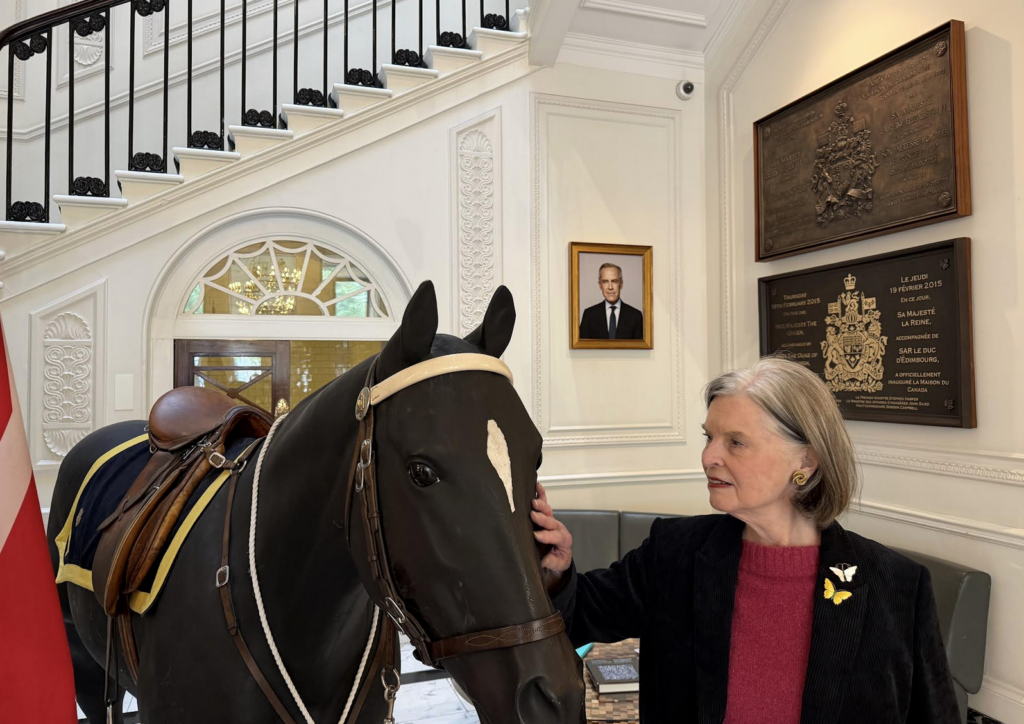 Susan Peterson-d’Aquino with friend at Canada House in London/Tom d’Aquino
May 25, 2026
My wife Susan and I have lived in London twice — once in our 20s when I was studying at the London School of Economics, and later when I worked for an international consulting firm.
Over many decades, we’ve travelled to every corner of England.
Recently, we set out in pursuit of the perfect three-week English sojourn that would combine our passions for historic architecture, art, music, and gardens.
But before our journey had barely begun, we landed in a London consumed with the crisis and chaos at Westminster. The severe setback of Sir Keir Starmer’s government in local elections across Britain on May 7th, the growing chorus within his own party calling for his resignation, and deepening fragmentation afflicting the British party system, all led to some quite animated exchanges.
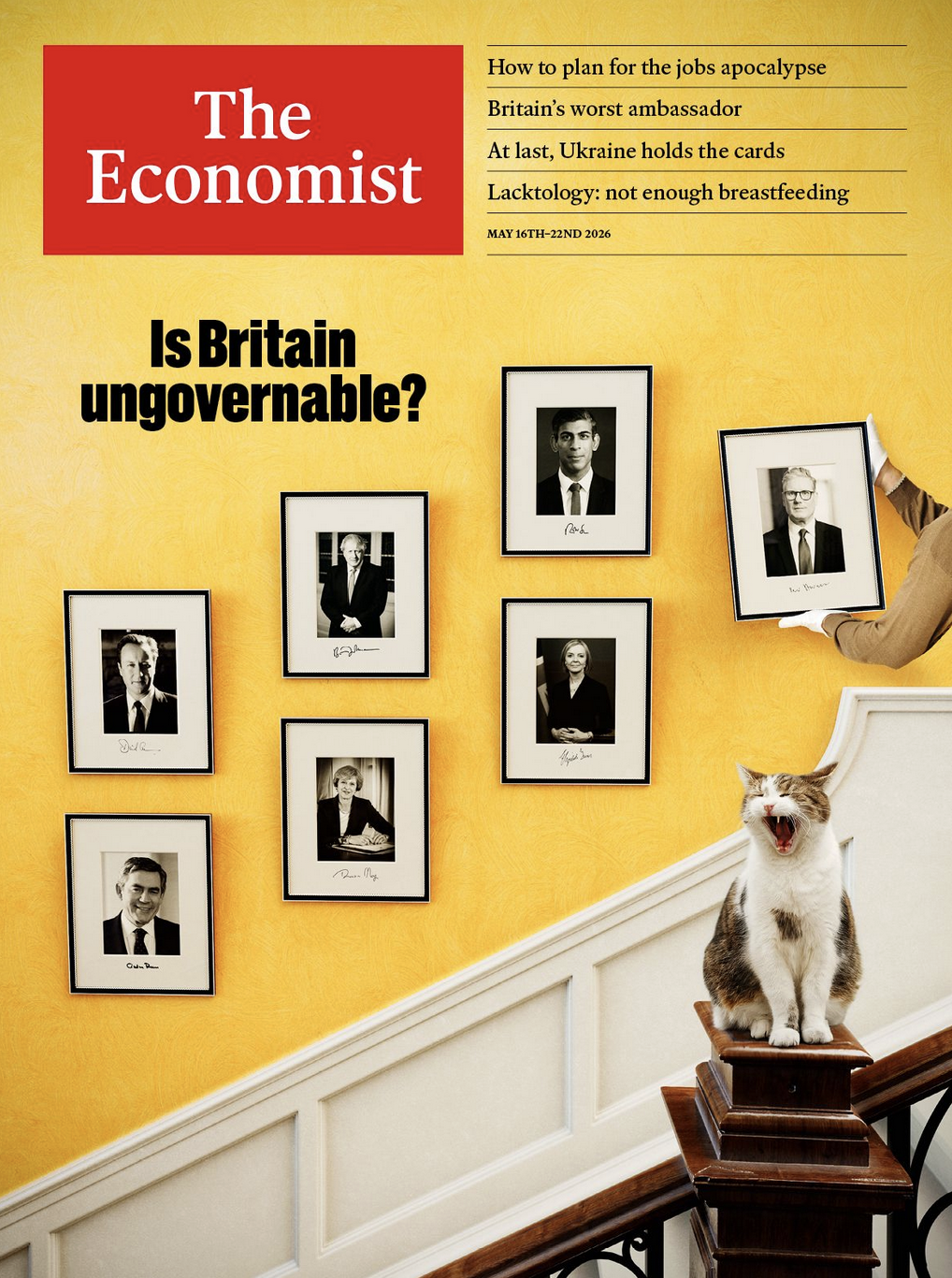
After five British prime ministers in a decade — possibly heading for a sixth — the fate of Sir Keir seemed to be on everyone’s mind. Picking up from media commentary, including from The Economist, people wondered aloud whether Britain had become ungovernable.
Low levels of growth, rising inflation and a burgeoning debt burden are adding to their anxiety. The bond market in turn is delivering warning signals. In our conversations, it was clear that the hangover of the Brexit debate remains in place and divisions about Europe remain unresolved.
Permeating that anxiety is a sense of post-Brexit national decline — in military capabilities and in influence in global affairs. Time and time again, individuals voiced concerns about the erratic politics and policies of the Trump administration while expressing pride in the manner in which King Charles delivered nuanced but clear messages to his American audiences during his recent visit to the United States.
Not surprisingly, given his background as Bank of England governor, Prime Minister Mark Carney’s name surfaced frequently in conversation. Carney enjoys high name recognition in Britain, and broadly favourable reviews.
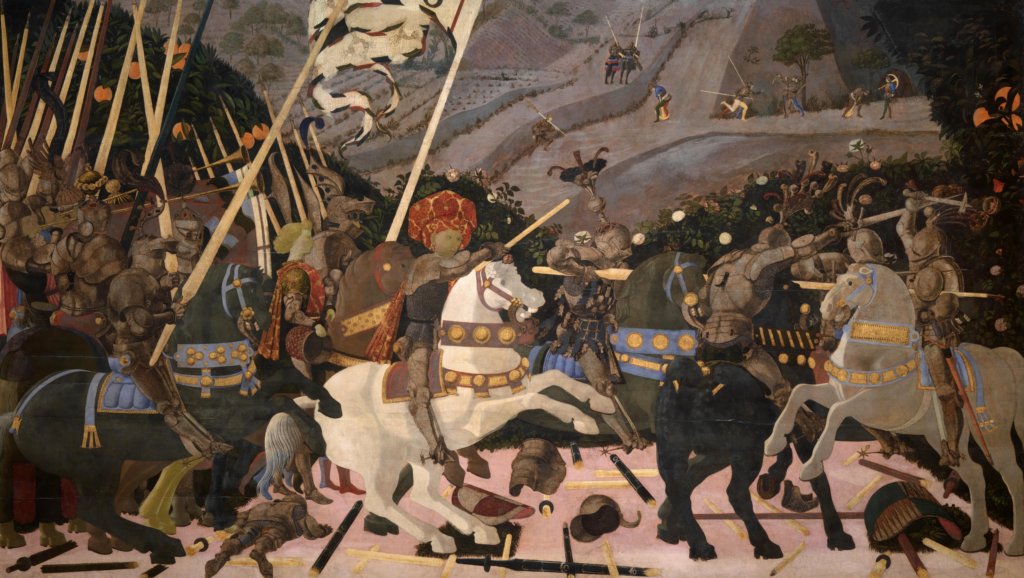 Niccolò Mauruzi da Tolentino at the Battle of San Romano, by Paolo Uccello/Wikipedia
To escape the hubbub blaring from page ones across virtual Fleet Street, we set out from our London base at the Oxford and Cambridge Club to admire the spring floral beds in St. James’s Park. From there, it was on to our favourite works in the National Gallery: van Eyck’s The Arnolfini Portrait; Holbein the Younger’s The Ambassadors; van Gogh’s Sunflowers; da Vinci’s The Virgin of the Rocks; Botticelli’s Venus and Mars; Caravaggio’s The Supper at Emmaus; and, Susan’s top pick over the decades, Paolo Uccello’s Battle of San Romano (above).
If the National Gallery is the main tourist mecca of Trafalgar Square, Canadians also flock to its neighbour, Canada House, the landmark home of Canada’s high commission to the United Kingdom and a cherished, maple leaf-adorned presence in the iconic panorama dominated by Nelson’s Column.
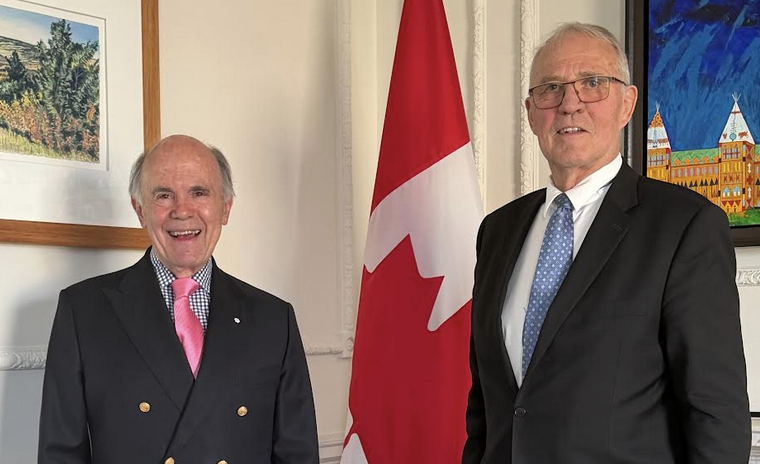 With Canadian High Commissioner Bill Blair at Canada House
We called on our newly appointed high commissioner, Bill Blair, who received us warmly and was pleased to exchange views on the latest developments in the politics and economics of both Canada and the United Kingdom.
We reminisced about the great unveiling in 2015 of the renovation to Canada House — where over the years we were entertained by high commissioners including dear friends Jake Warren, Roy McLaren, Donald Macdonald, Royce Frith — by Her Majesty Queen Elizabeth II, who won our hearts with her affectionate remarks about Canada at the unveiling. Thanks to the leadership and creativity of Gordon Campbell, Canada House today benefits from a most successful restoration and a fine collection of Canadian art and artifacts.
For us, a perfect English sojourn includes receiving Holy Communion on Sunday morning at Westminster Abbey, a spiritual experience all the more moving amid the soaring refrains of the Abbey choir and the ghosts of — among hundreds of others — 30 interred British monarchs, Charles Darwin, and the immortal geniuses of Poet’s Corner.
Our pilgrimages to the Abbey provide hope in these times of division, rupture and violence. For more than half a century, England’s mightiest cathedrals have been a source of fascination and awe to Susan and me — Canterbury, Ely, Lincoln, Durham, York, Gloucester, Wells, Salisbury and Winchester among them. They stand as magnificent monuments to the power of faith and to the civilizational foundations of modern-day Britain.
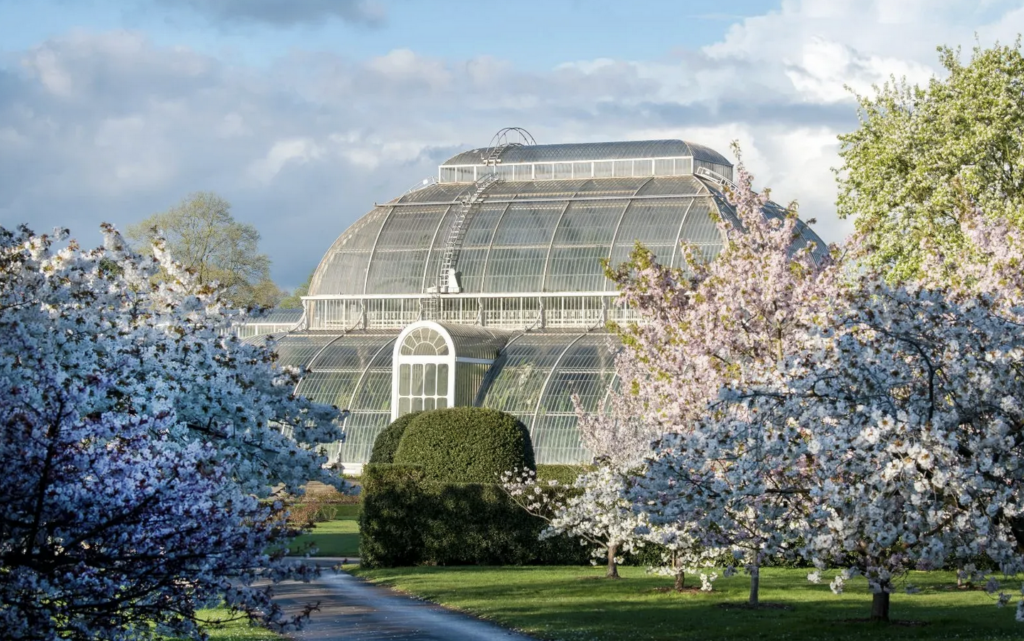 The Palm House at Kew Gardens/RBG Kew
England is to avid gardeners like us what France and Italy are to oenophiles. Always on our garden itinerary is Kew Gardens. Founded in 1759, the Royal Botanical Gardens, Kew houses the world’s largest and most diverse botanical and mycological collections in the world. We walked the great expanse of gardens in the sunshine with old friends who live nearby and took pleasure in the flourishing woodlands of bluebells and other spring flowers. No better preview of our next destination.
The Cotswolds — a favourite destination over the decades, especially for epic walking — span some 800 square miles across five counties: Gloucestershire, Oxfordshire, Warwickshire, Wiltshire and Somerset. The region’s timeless villages of honey-coloured Jurassic limestone and thatched roofs nestled in the rolling hills (“wold” meaning “forested hill” in Old English) never disappoint in either beauty or sense of unique national history.
Home to Shakespeare’s Stratford-upon-Avon, the Cotswolds scenery always evokes the famous lines from Richard II —
This sceptre’d isle,
This earth of majesty, this seat of Mars,
This other Eden, demi-paradise,
This fortress built by Nature for herself…
April is an ideal time to visit — the hedgerows are abloom with hawthorn flowers and the fields abundant with newborn lambs. We were attracted to old haunts, of course, but our goal was to discover a jewel not known to us where we could settle for our second week.
We succeeded: the village of Southrop, not far from Lechlade on the Thames, formed our base. There, we took up lodging in a country hotel called Thyme — originally part of the 17th-century Southrop Manor Estate, transformed over the last couple of decades into a quiet retreat surrounded by beautiful gardens. The ingenious creation of the Hibbert family, the hotel sits on land farmed in Roman times and is mentioned in the Domesday Book of 1086.
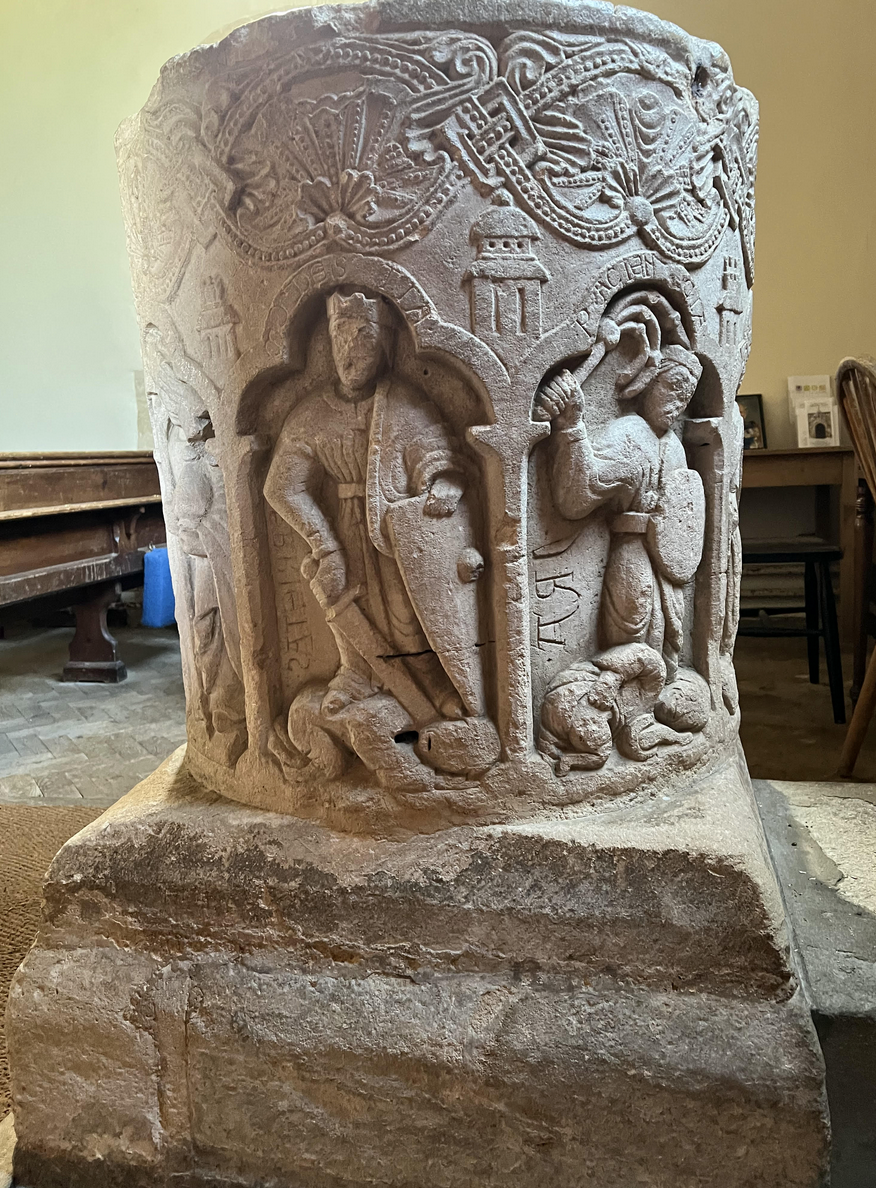
A Norman font at St. Peter’s Church
One fine morning, setting out on foot, we visited the Norman village church, St. Peter’s, with its nave marked by Saxon herringbone masonry. A gem even more beautiful in the stillness of its surroundings. We then crossed a farmer’s field on a public footpath — a quintessentially civilized English invention— and walked along the small Leach River only to discover two Norman churches facing each other across the river — the Church of St. Michael and St. Martin on one side, and St. Andrew’s Church on the other.
Seemingly out of nowhere, a villager approached us and, upon hearing we were Canadian, asked “How are you coping with Trump?” We laughed. “Carney is the right man for the job”, she added. She walked on.
Three fine Norman churches during a morning’s walk. “How rare and beautiful is this?” Susan observed.
About 50 km (30 miles) north of Southrop, Hidcote Manor Garden created by Lawrence Johnston at the turn of the last century and now a National Trust site, offers up a sequence of outdoor “garden rooms” marked by box hedges, hornbeam, yew, and stone walls. There is a certain discipline to its architecture, with surprises around every corner. The beddings around the Manor House offer up countless ideas for our own garden. We were lost for many hours in this wonder of human creativity.
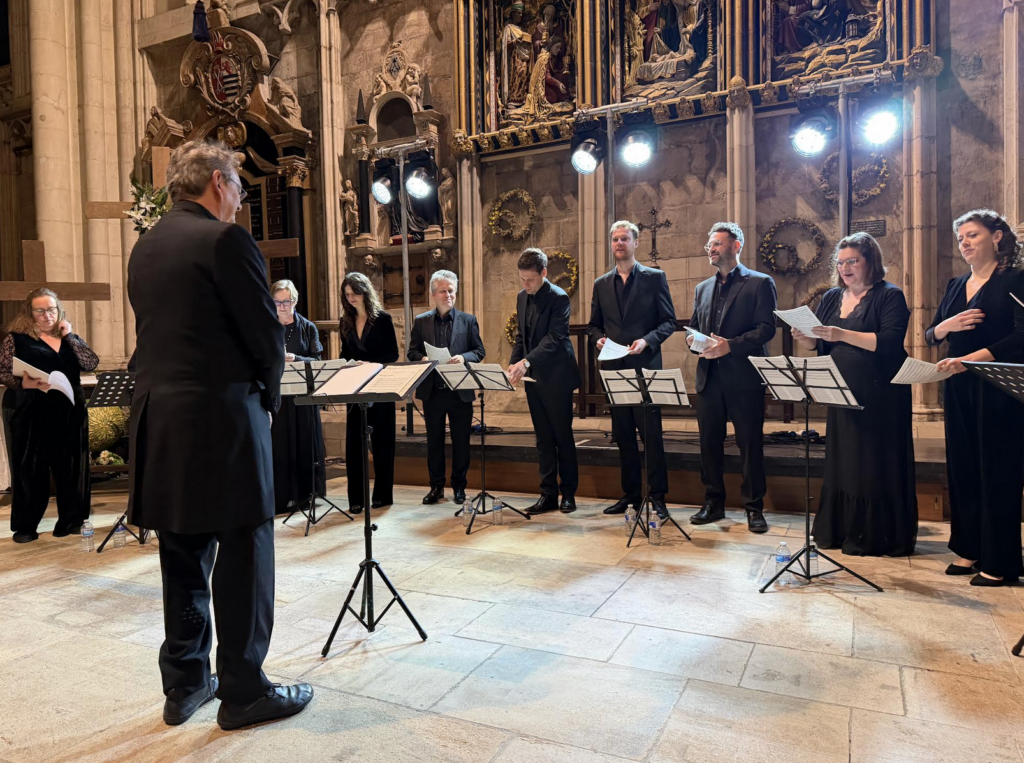 The Tallis Scholars at York Minster
In our search for a perfect English sojourn, music occupies an essential place. What better than a week in the historic city of York during the Early Music in Yorkshire festival celebrating Medieval, Renaissance and Baroque. Organized by one of Britain’s most respected cultural touring companies, Martin Randall, the festival opened with a choral concert by the Tallis Scholars in the dramatic setting of York Minster, the largest of English medieval cathedrals and, in the opinion of many, the greatest.
There we sat, in the Lady Chapel in front of the Great East Window — the largest expanse of medieval stained glass in Britain — and listened to the Tallis Scholars sing the exquisite music of English composers John Taverner, Thomas Tallis and Christopher Tye.
The historic venues added to the magic of the music. Especially so in the case of the timbered Merchant Adventurers’ Hall, among the best-preserved medieval guildhalls in England, and likewise the York Guildhall, built in 1459. The latter was heavily damaged in a bombing raid in 1942, but we took satisfaction in knowing that the massive vertical supporting beams installed during its restoration came from the forests of Canada.
As for the prospects of today’s conflicted England, an historian at dinner one evening in York painted a brighter picture for Britain’s future. He said, “We stand on lands inhabited and fought over by Romans, Saxons, Vikings and Normans. We created a unique people who have given much to the world. Our empire may be gone, but our legacy is profound and will persist for centuries to come. Britain will carry on.”
To him, I raised my glass and said, “God save our King, and God save the United Kingdom.”
Policy Contributing Writer Thomas d’Aquino is an entrepreneur, corporate director, author, philanthropist and a member of the Order of Canada. He is the Founding CEO of the Business Council of Canada, Chairman of Thomas d’Aquino Capital and author of the bestseller Private Power, Public Purpose: Adventures in Business, Politics and the Arts