
Ethiopia’s Looming Election: Redefining ‘Free and Fair’
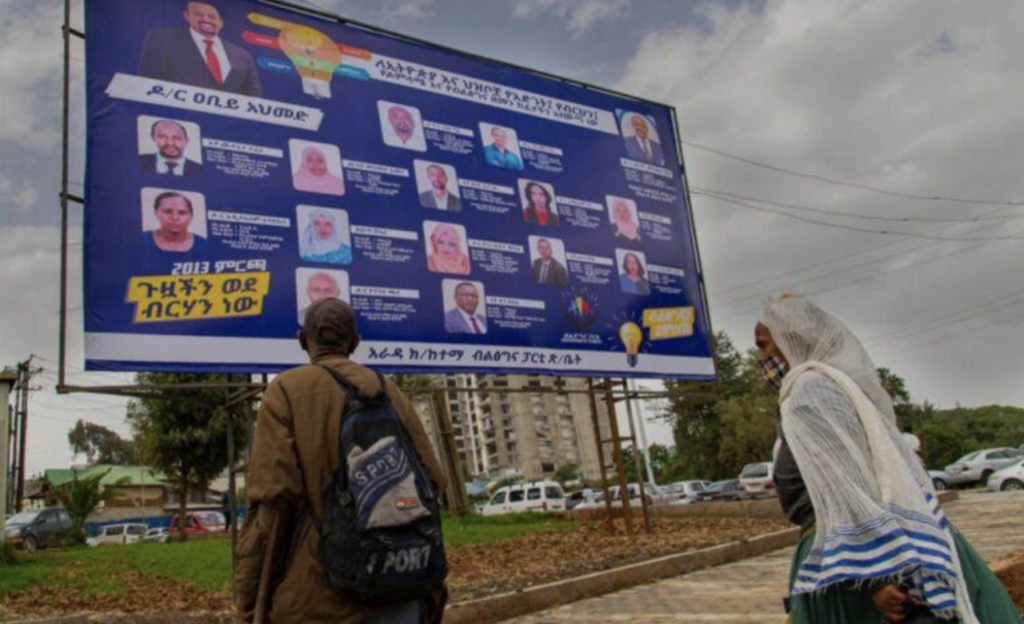 A Billboard for Prime Minister Abiy Ahmed’s Prosperity Party/VOA
May 27, 2026
As Ethiopia’s June 1st national election looms, the country continues to preserve the formal structures of electoral democracy while steadily weakening the substantive conditions that give elections democratic meaning and legitimacy.
At this hour, electoral institutions remain in place and preparations for voting continue, yet conflict, shrinking civic space, widespread human rights concerns and constrained political competition are reshaping the environment in which political choice is formed.
The central issue is no longer simply whether the election will proceed on schedule, but whether it can meaningfully reflect the political will of citizens under conditions of insecurity and restriction.
The re-election of Prime Minister Abiy Ahmed’s Prosperity Party is all-but certain — that certainty both engulfed in and predetermined by the sort of chaos that makes free and fair elections aspirational at best.
Armed conflict remains the most immediate constraint. Violence continues across Amhara, Oromia, and parts of Tigray, alongside recurring communal clashes in several regional border areas.
Federal forces, regional security actors, militias, and insurgent groups operate within a fragmented security landscape that has significantly disrupted civilian life. In many affected areas, insecurity limits mobility, restricts access to services, and weakens the basic conditions required for political participation.
These dynamics have also produced direct civilian harm, with reports from 2025 and 2026 documenting continued military operations and drone strikes in Amhara, resulting in civilian casualties, alongside killings and abductions of teachers, aid workers, and healthcare professionals. Restricted humanitarian access further deepens isolation and limits external oversight.
The humanitarian consequences are severe. By mid-2025, an estimated 3.3 million people were internally displaced due to conflict and insecurity, while millions of children were out of school as a result of violence, displacement, and overlapping climate pressures. These conditions erode civic foundations such as education, stability, and access to public institutions that underpin meaningful political participation.
Alongside conflict, Ethiopia’s civic space has narrowed significantly. Journalists, human rights defenders, and media workers face increasing pressure through arbitrary detention, intimidation, and legal action linked to reporting on politically sensitive issues. Civil society organizations operate under legal uncertainty due to broad definitions of “political activity,” creating a chilling effect on election monitoring and civic engagement.
Opposition parties formally remain part of the political system, but their operational space is increasingly constrained. Restrictions on movement, difficulties organizing outside urban centers, and repeated detention of senior figures have limited political competition. In conflict-affected regions, organizing is in some cases effectively impossible, resulting in uneven participation across regions.
Human rights conditions have deteriorated sharply alongside these political pressures. In 2025, the World Organization Against Torture classified Ethiopia as facing a “very high risk” of torture and ill-treatment. Reports describe arbitrary detention, enforced disappearances, coercive interrogations, and prolonged incommunicado detention, particularly affecting journalists, human rights defenders, political dissidents, and civilians from conflict-affected communities.
Elections derive legitimacy not only from logistics, but from whether citizens can participate freely, express political preferences without fear, and access information without restriction.
Broader economic pressures further shape the electoral environment. High inflation, rising debt, and fiscal constraints have increased the cost of living, contributing to public frustration and periodic labour protests, including among public sector workers. These conditions indirectly affect electoral participation by intensifying socioeconomic insecurity and weakening public trust in state responsiveness.
These dynamics indicate not the disappearance of electoral politics, but its narrowing. Elections remain formally intact, yet the conditions that enable genuine political competition, security, freedom of expression, association, and access to information are increasingly constrained.
Just days before the June 1st vote, the central question is therefore not only whether Ethiopia can hold an election, but whether an election conducted under these conditions can credibly express the political will of its citizens.
Under such circumstances, timing becomes part of the democratic question itself. A short, clearly defined postponement of the electoral timetable if linked to minimum conditions such as improved security in conflict-affected areas, basic guarantees for civic participation, and credible administrative readiness may be considered as a contingency option.
This is not a call for indefinite delay, but an argument that legitimacy depends on more than adherence to schedule alone.
Even limited de-escalation in conflict-affected regions, alongside improved humanitarian access and civilian protection measures could reduce barriers to participation. Protecting remaining civic space is equally essential: journalists, civil society actors, and political parties must be able to operate without intimidation or arbitrary detention.
Credible and independent investigations into allegations of arbitrary detention, enforced disappearances, and abuses linked to security operations will be important for post-election accountability. Without some measure of accountability, public trust in institutions and electoral processes is likely to erode further over time.
The international community retains a significant role through diplomatic engagement, humanitarian assistance, and electoral observation.
Actors such as the African Union, European Union, and United Nations continue to hold leverage in shaping both immediate electoral conduct and post-election trajectories. Continued engagement that prioritizes stability while overlooking civic restrictions risks normalizing elections under severely constrained conditions.
At this writing, the African Union has sent a 73-member observation mission led by former Kenyan President Uhuru Kenyatta to watch over Monday’s election. But elections derive legitimacy not only from logistics, but from whether citizens can participate freely, express political preferences without fear, and access information without restriction.
Where these conditions are substantially weakened, the question of process becomes decoupled from the question of democratic credibility.
Woyesa Worana is a graduate student at the Max Bell School of Public Policy, McGill University. He holds a law degree from Hawassa University and serves as a human rights advocate with HALE-Human Rights and Inclusion Network.